Apple Inc. (AAPL): Navigating Innovation, Regulation, and Global Ambition
By:
PredictStreet
December 08, 2025 at 11:26 AM EST
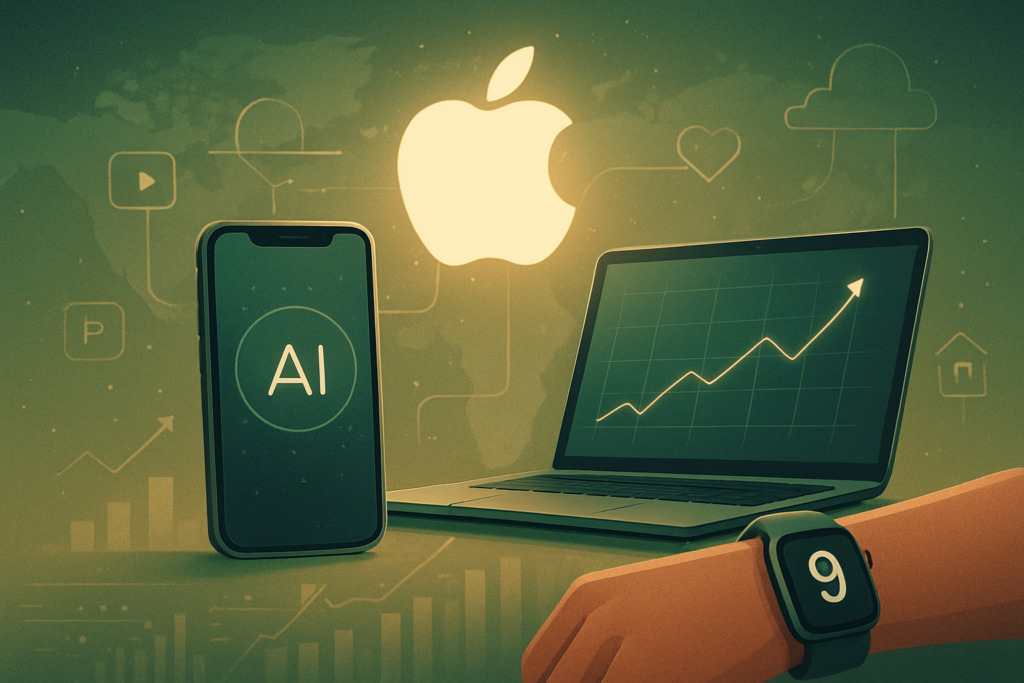
Apple Inc. (AAPL/NASDAQ) remains a dominant force in the global technology sector as of December 8, 2025, distinguished by its strong market position, ongoing innovation, and robust financial performance. The company's vertically integrated ecosystem and strategic advancements, particularly in Artificial Intelligence (AI) and new product categories, continue to make it a significant focus for investors. Headquartered in Cupertino, California, Apple is renowned for designing, manufacturing, and marketing a diverse range of consumer electronics, software, and online services. Its core product offerings include the iconic iPhone, Mac personal computers, iPad tablets, and a suite of wearables and accessories such as Apple Watch, AirPods, Apple Vision Pro, Apple TV, and HomePod. Complementing its hardware, Apple provides an extensive array of services, including the App Store, Apple Music, Apple Pay, iCloud, Apple Arcade, Apple Fitness+, Apple News+, Apple TV, and Apple Card. Apple's business model thrives on creating a tightly integrated ecosystem where hardware, software, and services work seamlessly together, fostering strong customer loyalty. The company generates substantial revenue primarily from product sales, alongside its high-margin services segment. This emphasis on design, innovation, and user experience has consistently positioned Apple at the forefront of the tech industry, with a market capitalization of approximately $4.14 trillion USD, consistently placing it among the world's most valuable companies. Investors are keenly focused on Apple due to its robust financial performance (FY2025 annual revenue of $416.16 billion, up 6.43% from 2024, and net income of $112.0 billion), aggressive push into AI with "Apple Intelligence" features, strong product cycle momentum driven by the iPhone 17 series, and an exciting pipeline of upcoming products for 2026, including a rumored foldable iPhone. Despite potential risks such as high valuation, regulatory scrutiny, and geopolitical challenges, Apple's established ecosystem and clear vision for AI integration make it an attractive and closely watched investment. 2. Historical BackgroundApple Computer Company was founded on April 1, 1976, by Steve Jobs, Steve Wozniak, and Ronald Wayne. Wozniak, then an engineering intern at Hewlett-Packard, had designed a personal computer, but HP expressed no interest. He teamed up with Jobs, a former high school classmate, and they established operations in Jobs' family garage. Ronald Wayne, an experienced tech industry executive, joined as a co-founder but left less than two weeks later, selling his 10% share for $800. Their inaugural product, the Apple I, was unveiled in July 1976. Designed and hand-built by Wozniak, it was sold as an assembled circuit board. The Apple II, unveiled in 1977, was a significant breakthrough, one of the first personal computers to come in a plastic case with color graphics, an integrated keyboard, and a power supply, making it a mass-market success. On December 12, 1980, Apple went public on the NASDAQ stock exchange under the ticker symbol "AAPL," selling 4.6 million shares at $22 per share, generating over $100 million. In 1984, Apple introduced the Macintosh, one of the first personal computers to utilize a graphical user interface (GUI) and a mouse, influencing the personal computing industry. Despite these innovations, internal conflicts led to Steve Jobs' departure from Apple in 1985. He subsequently founded NeXT Computer. Wozniak also stepped away from the company in 1985. For more than three decades, Apple Computer primarily focused on manufacturing personal computers, but faced challenges with sales and market share in the 1990s. A significant turning point occurred in 1997 when Steve Jobs returned to Apple after the company acquired NeXT. Under Jobs' renewed leadership, Apple underwent a comprehensive restructuring, centralizing decision-making, streamlining its product portfolio, and focusing on core products. This era saw the introduction of:
After Steve Jobs resigned as CEO in 2011 and subsequently passed away, Tim Cook took over as CEO. Under Cook's leadership, Apple continued to expand its product categories, introducing the Apple Watch in 2015. These transformations, driven by a relentless commitment to innovation, design minimalism, and user experience, have enabled Apple to evolve from a niche computer company into a global technology powerhouse, reaching a market value of $1 trillion by 2018. 3. Business ModelApple Inc. (AAPL) continues to thrive as a global technology leader, driven by a diversified business model encompassing innovative hardware, robust software, and an expanding suite of services. As of December 8, 2025, the company's revenue streams are robust, its product lines are continually evolving, its services ecosystem is a major growth driver, and its market segments and customer base demonstrate strong loyalty and global reach. Revenue Sources (Fiscal Year 2025 Annual):
Product Lines:
Apple's operating systems (iOS, iPadOS, macOS, watchOS, visionOS, tvOS) provide seamless experiences across its devices. Services:
Market Segments:
Customer Base:
4. Stock Performance OverviewApple Inc. (AAPL) has demonstrated significant growth and notable price movements over the past decade, shaped by product innovations, strategic initiatives, and macroeconomic factors. As of December 8, 2025, the stock closed at $278.78. AAPL 1-Year Stock Performance (December 8, 2024 – December 8, 2025):
AAPL 5-Year Stock Performance (December 8, 2020 – December 8, 2025):
AAPL 10-Year Stock Performance (December 8, 2015 – December 8, 2025):
Overall, Apple Inc. has demonstrated remarkable long-term growth driven by consistent product innovation, expansion into services and wearables, and strong brand loyalty. While experiencing intermittent headwinds, the company has consistently adapted and rebounded, reaching unprecedented market valuations. 5. Financial PerformanceAs of December 8, 2025, Apple Inc. (AAPL) has demonstrated robust financial performance, highlighted by its recently reported fiscal fourth-quarter (Q4 2025) and full fiscal year 2025 results, which concluded on September 27, 2025. Latest Earnings and Revenue Growth:
Profit Margins:
Debt Levels:
Cash Flow:
Valuation Metrics:
6. Leadership and ManagementAs of December 8, 2025, Apple Inc. (AAPL) is navigating a period of significant leadership transitions and strategic evolution, while maintaining a robust corporate governance framework. The company, with a market capitalization of approximately $4.14 trillion USD, continues to prioritize innovation, services growth, and a privacy-first approach. CEO: Tim Cook Leadership Team (Executive Team)
Board of Directors Corporate Strategy
Governance Reputation 7. Products, Services, and InnovationsAs of December 8, 2025, Apple Inc. (AAPL) continues to solidify its position as a global technology leader, driven by a robust ecosystem of products, an expanding suite of services, aggressive innovation, substantial research and development, a comprehensive patent portfolio, and a well-defined competitive strategy. Current Product and Service Offerings:
Innovation Pipelines:
R&D Investments: Patents: Competitive Edge:
8. Competitive LandscapeApple Inc. (AAPL) continues to be a dominant force in the technology industry as of December 8, 2025, characterized by its robust ecosystem, strong brand loyalty, and significant market presence across several key segments. However, the company also navigates intense competition, increasing regulatory scrutiny, and supply chain challenges. Industry Rivals:
Market Share Across Key Product and Service Segments (as of Q3 2025 or projections for 2025):
Competitive Strengths:
Competitive Weaknesses:
9. Industry and Market TrendsApple Inc. (AAPL) is navigating a dynamic technological and economic landscape as of December 8, 2025, characterized by significant sector-level trends, influential macro drivers, evolving supply chain dynamics, and distinct cyclical effects across its diverse product and service offerings. Sector-Level Trends:
Macro Drivers:
Supply Chain Dynamics:
Cyclical Effects:
10. Risks and ChallengesApple Inc. (AAPL) is currently navigating a complex landscape of operational, regulatory, controversial, and market risks as of December 8, 2025. These challenges stem from its global scale, intense competition, increasing regulatory scrutiny, and evolving technological and geopolitical dynamics. Operational Risks:
Regulatory Risks:
Controversies:
Market Risks:
11. Opportunities and CatalystsAs of December 8, 2025, Apple Inc. (AAPL) is strategically positioned for sustained growth, driven by a robust pipeline of product innovations, an expanding services ecosystem, and a deliberate push into new market segments, alongside potential significant acquisitions. The company's near-term outlook is shaped by upcoming earnings, recent product updates, and anticipated launches in early 2026. Growth Levers:
New Market Opportunities:
M&A Potential: Near-Term Catalysts (as of 12/8/2025):
12. Investor Sentiment and Analyst CoverageAs of December 8, 2025, investor sentiment surrounding Apple Inc. (AAPL) is generally positive, driven by favorable Wall Street analyst ratings, significant institutional investor holdings, and ongoing discussions among retail investors, despite some mixed signals regarding valuation and AI strategy. The company's strong financial performance, particularly in its Services segment and iPhone sales, alongside its aggressive push into AI, are key factors influencing this outlook. Wall Street Ratings:
Hedge Fund Activity:
Institutional Investor Holdings:
Retail Investor Sentiment:
13. Regulatory, Policy, and Geopolitical FactorsApple Inc. (AAPL) is navigating a complex and dynamic landscape of regulatory, policy, and geopolitical factors as of December 8, 2025. The company faces increasing scrutiny across multiple jurisdictions regarding its market practices, data handling, and supply chain, while also seeking to leverage government incentives and mitigate geopolitical risks. Laws and Compliance:
Government Incentives:
Geopolitical Risks and Opportunities:
14. Outlook and ScenariosApple Inc. (AAPL) is currently navigating a dynamic technological and economic landscape as of December 8, 2025, presenting both optimistic "bull" and cautious "bear" case scenarios for its short-term and long-term outlook. The company is also undergoing significant strategic pivots, particularly in its approach to artificial intelligence (AI) and leadership. Overall Outlook: Short-Term Projections (Late 2025 – 2026):
Bear Case:
Long-Term Projections (2027 and Beyond):
Bear Case:
Strategic Pivots for Apple Inc. (AAPL):
15. ConclusionAs of December 8, 2025, Apple Inc. (AAPL) continues to demonstrate robust financial performance and strategic advancements, yet it faces an increasingly complex landscape of competition and regulatory scrutiny. The company's resilience is underpinned by its powerful ecosystem, strong brand loyalty, and significant investments in future growth areas like Artificial Intelligence (AI) and Augmented/Virtual Reality (AR/VR). Summary of Key Findings: Apple reported record Q4 2025 revenue of $102.5 billion, with diluted EPS up 13%. Fiscal year 2025 revenue hit $416 billion, driven by strong iPhone 17 sales and the high-margin Services division, which is on track to exceed $100 billion annually. Apple has initiated an aggressive AI strategy with "Apple Intelligence" and significant U.S. investments. Advancements in AR/VR with the Vision Pro, ecosystem expansion with new Mac and iPad models, and manufacturing diversification are also key. Investor confidence remains strong, with analysts maintaining "Buy" ratings and raising price targets. Balanced Perspective: Weaknesses and Risks: Despite robust iPhone sales for new models, concerns about market saturation and slowing overall iPhone growth persist, with some analysts predicting potential shipment declines. Apple's substantial reliance on iPhone sales (52% of revenue) remains a vulnerability. The company faces intense competition across all segments. Increasing regulatory scrutiny and antitrust lawsuits in major markets, especially concerning App Store policies, pose a significant threat to the high-margin services business. Geopolitical tensions, particularly between the U.S. and China, could impact market access and introduce potential tariffs. While Apple is investing heavily in AI, there are lingering concerns about its pace compared to AI-first rivals. Finally, Apple's current stock valuation appears high relative to historical averages, implying elevated investor expectations. The "Apple Car" project, "Project Titan," continues to face delays, with a reported target launch date of 2028, and still carries a risk of never being released. What Investors Should Watch For Apple Inc. (AAPL) as of 12/8/2025:
This content is intended for informational purposes only and is not financial advice More NewsView More
Via MarketBeat
2 Stocks to Avoid as Crypto Momentum Wanes ↗
December 21, 2025
Via MarketBeat

3 Dividend Growth Stocks Analysts Are Upgrading for 2026 ↗
December 21, 2025
Via MarketBeat

These 3 Banks Are Rallying Into Year-End, But Will It Continue? ↗
December 20, 2025
Via MarketBeat

Recent QuotesView More
Stock Quote API & Stock News API supplied by www.cloudquote.io
Quotes delayed at least 20 minutes. By accessing this page, you agree to the Privacy Policy and Terms Of Service.
© 2025 FinancialContent. All rights reserved.
|