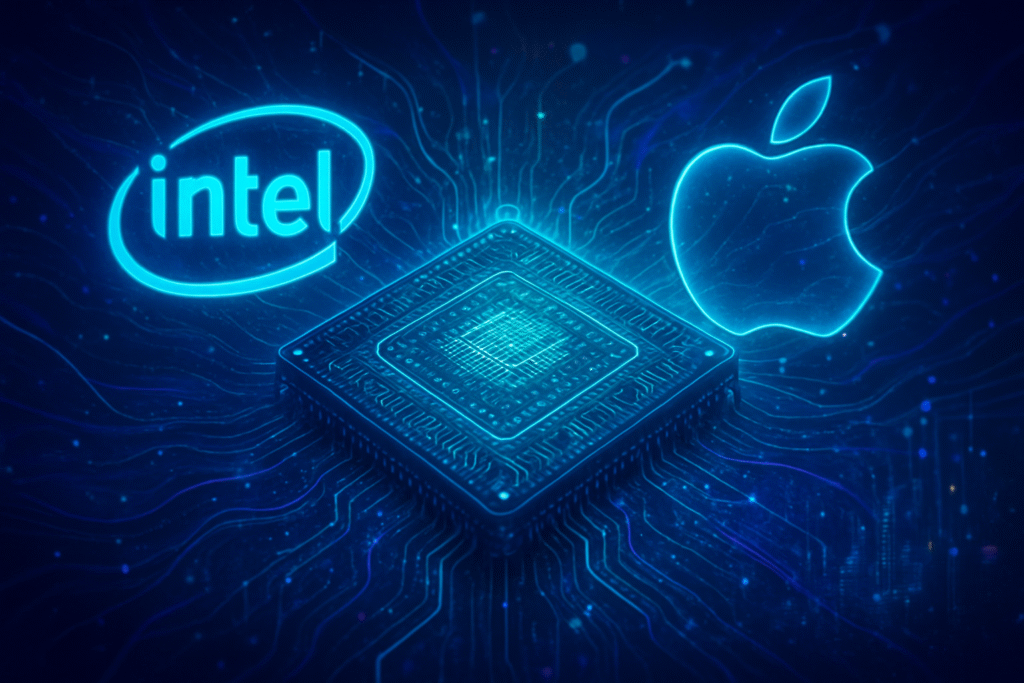
The landscape of US chipmaking is on the cusp of a transformative shift, fueled by strategic partnerships designed to bolster domestic semiconductor production and diversify critical supply chains. At the forefront of this evolving narrative is the persistent and growing buzz around a potential landmark deal between two tech giants: Intel (NASDAQ: INTC) and Apple (NASDAQ: AAPL). This isn't a return to Apple utilizing Intel's x86 processors, but rather a strategic manufacturing alliance where Intel Foundry Services (IFS) could become a key fabricator for Apple's custom-designed M-series chips. If realized, this partnership, projected to commence as early as mid-2027, promises to reshape the domestic semiconductor industry, with profound implications for AI hardware, supply chain resilience, and global tech competition.
This potential collaboration signifies a pivotal moment, moving beyond traditional supplier-client relationships to one of strategic interdependence in advanced manufacturing. For Apple, it represents a crucial step in de-risking its highly concentrated supply chain, currently heavily reliant on Taiwan Semiconductor Manufacturing Company (TSMC) (NYSE: TSM). For Intel, it’s a monumental validation of its aggressive foundry strategy and its ambitious roadmap to regain process leadership with cutting-edge technologies like the 18A node. The reverberations of such a deal would be felt across the entire tech ecosystem, from major AI labs to burgeoning startups, fundamentally altering market dynamics and accelerating the "Made in USA" agenda in advanced chip production.
The Technical Backbone: Intel's 18A-P Process and Foveros Direct
The rumored deal's technical foundation rests on Intel's cutting-edge 18A-P process node, an optimized variant of its next-generation 2nm-class technology. Intel 18A is designed to reclaim process leadership through several groundbreaking innovations. Central to this is RibbonFET, Intel's implementation of gate-all-around (GAA) transistors, which offers superior electrostatic control and scalability beyond traditional FinFET designs, promising over 15% improvement in performance per watt. Complementing this is PowerVia, a novel back-side power delivery architecture that separates power and signal routing layers, drastically reducing IR drop and enhancing signal integrity, potentially boosting transistor density by up to 30%. The "P" in 18A-P signifies performance enhancements and optimizations specifically for mobile applications, delivering an additional 8% performance per watt improvement over the base 18A node. Apple has reportedly already obtained the 18AP Process Design Kit (PDK) 0.9.1GA and is awaiting the 1.0/1.1 releases in Q1 2026, targeting initial chip shipments by Q2-Q3 2027.
Beyond the core transistor technology, the partnership would likely leverage Foveros Direct, Intel's most advanced 3D packaging technology. Foveros Direct employs direct copper-to-copper hybrid bonding, enabling ultra-high density interconnects with a sub-10 micron pitch – a tenfold improvement over traditional methods. This allows for true vertical die stacking, integrating multiple IP chiplets, memory, and specialized compute elements in a 3D configuration. This innovation is critical for enhancing performance by reducing latency, improving bandwidth, and boosting power efficiency, all crucial for the complex, high-performance, and energy-efficient M-series chips. The 18A-P manufacturing node is specifically designed to support Foveros Direct, enabling sophisticated multi-die designs for Apple.
This approach significantly differs from Apple's current, almost exclusive reliance on TSMC for its M-series chips. While TSMC's advanced nodes (like 5nm, 3nm, and upcoming 2nm) have powered Apple's recent successes, the Intel partnership represents a strategic diversification. Intel would initially focus on manufacturing Apple's lowest-end M-series processors (potentially M6 or M7 generations) for high-volume devices such as the MacBook Air and iPad Pro, with projected annual shipments of 15-20 million units. This allows Apple to test Intel's capabilities in less thermally constrained devices, while TSMC is expected to continue supplying the majority of Apple's higher-end, more complex M-series chips.
Initial reactions from the semiconductor industry and analysts, particularly following reports from renowned Apple supply chain analyst Ming-Chi Kuo in late November 2025, have been overwhelmingly positive. Intel's stock saw significant jumps, reflecting increased investor confidence. The deal is widely seen as a monumental validation for Intel Foundry Services (IFS), signaling that Intel is successfully executing its aggressive roadmap to regain process leadership and attract marquee customers. While cautious optimism suggests Intel may not immediately rival TSMC's overall capacity or leadership in the absolute bleeding edge, this partnership is viewed as a crucial step in Intel's foundry turnaround and a positive long-term outlook.
Reshaping the AI and Tech Ecosystem
The potential Intel-Apple foundry deal would send ripples across the AI and broader tech ecosystem, altering competitive landscapes and strategic advantages. For Intel, this is a cornerstone of its turnaround strategy. Securing Apple, a prominent tier-one customer, would be a critical validation for IFS, proving its 18A process is competitive and reliable. This could attract other major chip designers like AMD (NASDAQ: AMD), NVIDIA (NASDAQ: NVDA), Qualcomm (NASDAQ: QCOM), Google (NASDAQ: GOOGL), and Amazon (NASDAQ: AMZN), accelerating IFS's path to profitability and establishing Intel as a formidable player in the foundry market against TSMC.
Apple stands to gain significant strategic flexibility and supply chain security. Diversifying its manufacturing base reduces its vulnerability to geopolitical risks and potential production bottlenecks, ensuring a more resilient supply of its crucial M-series chips. This move also aligns with increasing political pressure for "Made in USA" components, potentially offering Apple goodwill and mitigating future regulatory challenges. While TSMC is expected to retain the bulk of high-end M-series production, Intel's involvement could introduce competition, potentially leading to better pricing and more favorable terms for Apple in the long run.
For TSMC, while its dominance in advanced manufacturing remains strong, Intel's entry as a second-source manufacturer for Apple represents a crack in its near-monopoly. This could intensify competition, potentially putting pressure on TSMC regarding pricing and innovation, though its technological lead in certain areas may persist. The broader availability of power-efficient, M-series-like chips manufactured by Intel could also pose a competitive challenge to NVIDIA, particularly for AI inference tasks at the edge and in devices. While NVIDIA's GPUs will remain critical for large-scale cloud-based AI training, increased competition in inference could impact its market share in specific segments.
The deal also carries implications for other PC manufacturers and tech giants increasingly developing custom silicon. The success of Intel's foundry business with Apple could encourage companies like Microsoft (NASDAQ: MSFT) (which is also utilizing Intel's 18A node for its Maia AI accelerator) to further embrace custom ARM-based AI chips, accelerating the shift towards AI-enabled PCs and mobile devices. This could disrupt the traditional CPU market by further validating ARM-based processors in client computing, intensifying competition for AMD and Qualcomm, who are also deeply invested in ARM-based designs for AI-enabled PCs.
Wider Significance: Underpinning the AI Revolution
This potential Intel-Apple manufacturing deal, while not an AI breakthrough in terms of design or algorithm, holds immense wider significance for the hardware infrastructure that underpins the AI revolution. The AI chip market is booming, driven by generative AI, cloud AI, and the proliferation of edge AI. Apple's M-series chips, with their integrated Neural Engines, are pivotal in enabling powerful, energy-efficient on-device AI for tasks like image generation and LLM processing. Intel, while historically lagging in AI accelerators, is aggressively pursuing a multi-faceted AI strategy, with IFS being a central pillar to enable advanced AI hardware for itself and others.
The overall impacts are multifaceted. For Apple, it's about supply chain diversification and aligning with "Made in USA" initiatives, securing access to Intel's cutting-edge 18A process. For Intel, it's a monumental validation of its Foundry Services, boosting its reputation and attracting future tier-one customers, potentially transforming its long-term market position. For the broader AI and tech industry, it signifies increased competition in foundry services, fostering innovation and resilience in the global semiconductor supply chain. Furthermore, strengthened domestic chip manufacturing (via Intel) would be a significant geopolitical development, impacting global tech policy and trade relations, and potentially enabling a faster deployment of AI at the edge across a wide range of devices.
However, potential concerns exist. Intel's Foundry Services has recorded significant operating losses and must demonstrate competitive yields and costs at scale with its 18A process to meet Apple's stringent demands. The deal's initial scope for Apple is reportedly limited to "lowest-end" M-series chips, meaning TSMC would likely retain the production of higher-performance variants and crucial iPhone processors. This implies Apple is diversifying rather than fully abandoning TSMC, and execution risks remain given the aggressive timeline for 18A production.
Comparing this to previous AI milestones, this deal is not akin to the invention of deep learning or transformer architectures, nor is it a direct design innovation like NVIDIA's CUDA or Google's TPUs. Instead, its significance lies in a manufacturing and strategic supply chain breakthrough. It demonstrates the maturity and competitiveness of Intel's advanced fabrication processes, highlights the increasing influence of geopolitical factors on tech supply chains, and reinforces the trend of vertical integration in AI, where companies like Apple seek to secure the foundational hardware necessary for their AI vision. In essence, while it doesn't invent new AI, this deal profoundly impacts how cutting-edge AI-capable hardware is produced and distributed, which is an increasingly critical factor in the global race for AI dominance.
The Road Ahead: What to Watch For
The coming years will be crucial in observing the unfolding of this potential strategic partnership. In the near-term (2026-2027), all eyes will be on Intel's 18A process development, specifically the timely release of PDK version 1.0/1.1 in Q1 2026, which is critical for Apple's development progress. The market will closely monitor Intel's ability to achieve competitive yields and costs at scale, with initial shipments of Apple's lowest-end M-series processors expected in Q2-Q3 2027 for devices like the MacBook Air and iPad Pro.
Long-term (beyond 2027), this deal could herald a more diversified supply chain for Apple, offering greater resilience against geopolitical shocks and reducing its sole reliance on TSMC. For Intel, successful execution with Apple could pave the way for further lucrative contracts, potentially including higher-end Apple chips or business from other tier-one customers, cementing IFS's position as a leading foundry. The "Made in USA" alignment will also be a significant long-term factor, potentially influencing government support and incentives for domestic chip production.
Challenges remain, particularly Intel's need to demonstrate consistent profitability for its foundry division and maintain Apple's stringent standards for performance and power efficiency. Experts, notably Ming-Chi Kuo, predict that while Intel will manufacture Apple's lowest-end M-series chips, TSMC will continue to be the primary manufacturer for Apple's higher-end M-series and A-series (iPhone) chips. This is a strategic diversification for Apple and a crucial "turnaround signal" for Intel's foundry business.
In the coming weeks and months, watch for further updates on Intel's 18A process roadmap and any official announcements from either Intel or Apple regarding this partnership. Observe the performance and adoption of new Windows on ARM devices, as their success will indicate the broader shift in the PC market. Finally, keep an eye on new and more sophisticated AI applications emerging across macOS and iOS that fully leverage the on-device processing power of Apple's Neural Engine, showcasing the practical benefits of powerful edge AI and the hardware that enables it.
This content is intended for informational purposes only and represents analysis of current AI developments.
TokenRing AI delivers enterprise-grade solutions for multi-agent AI workflow orchestration, AI-powered development tools, and seamless remote collaboration platforms.
For more information, visit https://www.tokenring.ai/.