The world's oceans, vast and enigmatic, are on the cusp of a profound digital transformation. Driven by increasing investment in ocean innovation, advanced connectivity and the Internet of Things (IoT) are rapidly becoming indispensable tools for understanding, managing, and protecting our planet's most vital ecosystem. This technological tide promises to revolutionize marine research, enhance resource management, and provide unprecedented capabilities for environmental monitoring, ushering in an era of real-time insights and data-driven decision-making for the blue economy.
As of December 1, 2025, the vision of a connected ocean is rapidly moving from concept to reality. From smart buoys tracking elusive marine life to autonomous underwater vehicles (AUVs) mapping the deepest trenches, these innovations are equipping scientists, policymakers, and industries with the critical intelligence needed to address pressing global challenges, including climate change, overfishing, and pollution. The implications for sustainable development and our stewardship of marine resources are immense, promising a future where humanity's interaction with the ocean is guided by precise, actionable data.
Unveiling the Subsea Internet: Technical Leaps and Innovations
The deployment of IoT in marine environments, often termed the Subsea Internet of Things (SIoT) or Internet of Underwater Things (IoUT), represents a significant leap from traditional, sporadic data collection methods. This advancement is characterized by a confluence of specialized hardware, robust communication protocols, and sophisticated data analytics designed to overcome the ocean's inherent challenges: limited bandwidth, high latency, energy constraints, and harsh conditions.
Key technical advancements include the miniaturization and increased sensitivity of underwater sensors, capable of measuring a wide array of parameters such as temperature, pressure, salinity, pH, dissolved oxygen, and even marine particles. Emerging eDNA sensors are also poised to revolutionize marine biological research by detecting genetic material from organisms in water samples. Communication, a major hurdle underwater, is being tackled through hybrid approaches. While acoustic communication remains the most widely used for long ranges, offering data transmission via sound waves, it is complemented by short-range, high-bandwidth optical communication and specialized electromagnetic technologies like Seatooth radio for challenging water-air interfaces. Crucially, innovations like Translational Acoustic-RF (TARF) communication enable seamless data transfer between underwater acoustic signals and airborne radio signals by sensing surface vibrations. This differs significantly from previous approaches that relied heavily on infrequent human-operated data retrieval or tethered systems, offering continuous, real-time monitoring capabilities. Initial reactions from the AI research community and industry experts highlight the potential for unprecedented data density and temporal resolution, opening new avenues for scientific discovery and operational efficiency.
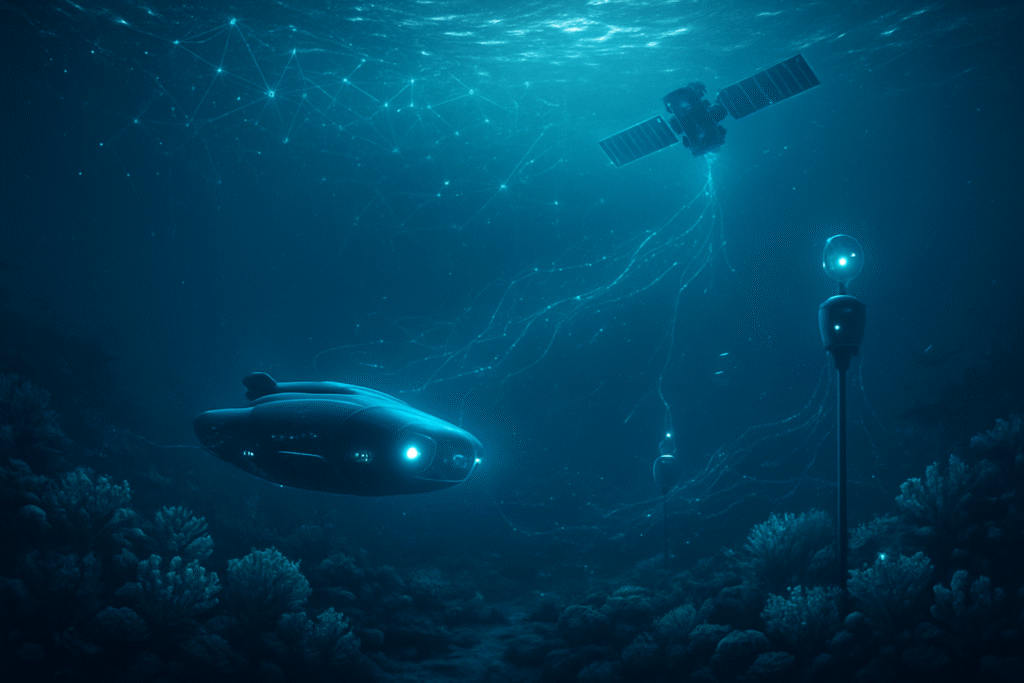
Further bolstering the SIoT are advancements in marine robotics. Autonomous Underwater Vehicles (AUVs) and Remotely Operated Vehicles (ROVs) are no longer just exploration tools; they are becoming mobile data mules and intelligent sensor platforms, performing tasks from seafloor mapping to environmental sampling. Unmanned Surface Vessels (USVs) act as vital surface gateways, receiving data from underwater sensors via acoustic links and relaying it to shore via satellite or cellular networks. The integration of edge computing allows for on-site data processing, reducing the need for constant, high-bandwidth transmission, while cloud platforms provide scalable storage and analysis capabilities. These integrated systems represent a paradigm shift, moving from isolated data points to a comprehensive, interconnected network that continuously monitors and reports on the state of our oceans.
Corporate Tides: Beneficiaries and Competitive Shifts
The burgeoning field of ocean IoT and connectivity is attracting significant attention and investment, poised to reshape the competitive landscape for tech giants, specialized startups, and established marine technology firms. Companies positioned to benefit immensely include those specializing in satellite communication, underwater robotics, sensor manufacturing, and AI/data analytics platforms.
Major satellite communication providers like Iridium Communications Inc. (NASDAQ: IRDM) and Globalstar, Inc. (NYSE: GSAT) stand to gain from the increasing demand for reliable, global data transmission from remote ocean environments, particularly with the rise of Low Earth Orbit (LEO) satellite constellations. Companies developing advanced AUVs and ROVs, such as Kongsberg Gruppen ASA (OSL: KOG) and Teledyne Technologies Incorporated (NYSE: TDY), are seeing expanded markets for their autonomous systems as key components of the SIoT infrastructure. Sensor manufacturers, both large and specialized, will experience heightened demand for robust, accurate, and energy-efficient underwater sensors. AI labs and tech giants like Google (NASDAQ: GOOGL), Microsoft (NASDAQ: MSFT), and Amazon (NASDAQ: AMZN) are strategically positioning themselves to offer the cloud infrastructure, AI/ML processing power, and data analytics tools necessary to manage and interpret the vast datasets generated by these ocean networks. Their existing cloud services and AI expertise give them a significant competitive advantage in processing and deriving insights from marine data.
This development could disrupt traditional marine surveying and monitoring services, shifting towards more automated, continuous, and less labor-intensive operations. Startups focused on niche solutions, such as battery-free underwater communication (e.g., Piezo-Acoustic Backscatter technology) or specialized marine AI applications, could carve out significant market shares by addressing specific technical challenges. The competitive implications are clear: companies that can integrate hardware, software, and communication solutions into cohesive, scalable platforms will lead the charge. Strategic partnerships between hardware manufacturers, communication providers, and AI specialists are becoming crucial for market positioning, fostering an ecosystem where collaborative innovation drives progress and market share.
A Deeper Dive: Wider Significance and Global Implications
The rise of advanced connectivity and IoT in ocean environments represents a pivotal moment in the broader AI and technology landscape, extending the reach of smart systems into one of Earth's last great frontiers. This development aligns perfectly with global trends towards pervasive sensing, real-time data analysis, and autonomous operations, pushing the boundaries of what is possible in extreme environments.
The impacts are far-reaching. In environmental monitoring, continuous data streams from smart buoys and sensors will provide unprecedented insights into ocean health, enabling earlier detection of harmful algal blooms, hypoxic dead zones, and pollution. This real-time intelligence is critical for understanding and mitigating the effects of climate change, tracking phenomena like coral bleaching and ocean acidification with granular detail. For resource management, particularly in sustainable fishing and aquaculture, IoT devices offer the promise of precision monitoring, ensuring compliance with quotas, optimizing fish farm operations, and combating illegal, unreported, and unregulated (IUU) fishing through smart surveillance systems in Marine Protected Areas (MPAs). The ability to monitor offshore energy infrastructure, such as wind turbines and oil & gas platforms, for performance and predictive maintenance also significantly enhances operational efficiency and safety, while minimizing environmental risks. However, potential concerns include the energy consumption of these vast networks, the risk of acoustic pollution from underwater communication systems impacting marine life, data security, and the ethical implications of pervasive surveillance in marine ecosystems. This milestone can be compared to the advent of satellite imaging for terrestrial monitoring, but with the added complexity and challenge of the underwater domain, promising a similar revolution in our understanding and management of a critical global resource.
Charting Uncharted Waters: Future Developments and Predictions
The trajectory for connectivity and IoT in ocean environments points towards even more sophisticated and integrated systems in the coming years. Near-term developments are expected to focus on enhancing energy efficiency, improving the robustness of underwater communication, and further integrating AI for autonomous decision-making.
Experts predict a significant expansion of cooperative multi-robot systems, where AUVs, ROVs, and USVs work in concert to conduct large-scale surveys and coordinated sampling missions, with machine learning algorithms enabling adaptive mission planning and real-time data interpretation. The drive towards batteryless and highly scalable ocean IoT deployments, leveraging technologies like Piezo-Acoustic Backscatter (PAB), is expected to reduce maintenance costs and environmental impact, making widespread, continuous monitoring more feasible. Long-term, the vision includes a truly global Subsea Cloud Computing architecture, where edge computing plays a critical role in processing massive marine datasets efficiently, enabling instantaneous insights. Potential applications on the horizon include highly automated deep-sea mining operations, advanced tsunami and hurricane forecasting systems that provide earlier and more accurate warnings, and sophisticated networks for tracking and predicting the movement of marine plastics. Challenges that need to be addressed include standardizing communication protocols across diverse platforms, developing truly robust and long-lasting power sources for deep-sea applications, and establishing international frameworks for data sharing and governance. Experts foresee a future where our oceans are no longer black boxes but transparent, digitally monitored environments, providing the foundational data for a sustainable blue economy.
The Ocean's Digital Horizon: A Concluding Assessment
The emergence of advanced connectivity and IoT in ocean environments marks a pivotal moment in our technological and environmental history. This development is not merely an incremental improvement but a fundamental shift in how humanity interacts with and understands its marine ecosystems. The key takeaway is the transition from sporadic, often manual, data collection to continuous, real-time, and autonomous monitoring, driven by a convergence of sensor technology, sophisticated communication networks, marine robotics, and powerful AI/ML analytics.
This technological wave holds immense significance, offering unprecedented tools to tackle some of the most pressing global challenges of our time: climate change, biodiversity loss, and unsustainable resource exploitation. It promises to empower marine researchers with richer datasets, enable resource managers to implement more effective conservation and exploitation strategies, and provide environmental agencies with the intelligence needed to protect vulnerable ecosystems. As we move forward, the long-term impact will be measured not just in technological prowess but in the health and sustainability of our oceans. What to watch for in the coming weeks and months are further pilot projects scaling up to regional deployments, increasing standardization efforts across different technologies, and a growing number of public-private partnerships aimed at building out this crucial marine infrastructure. The digital awakening of the ocean is here, and its waves will undoubtedly shape our future.
This content is intended for informational purposes only and represents analysis of current AI developments.
TokenRing AI delivers enterprise-grade solutions for multi-agent AI workflow orchestration, AI-powered development tools, and seamless remote collaboration platforms.
For more information, visit https://www.tokenring.ai/.