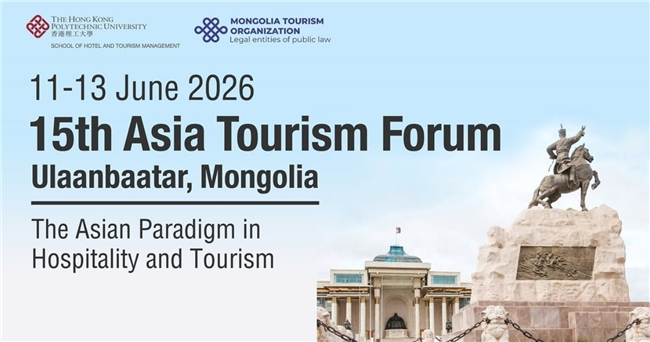
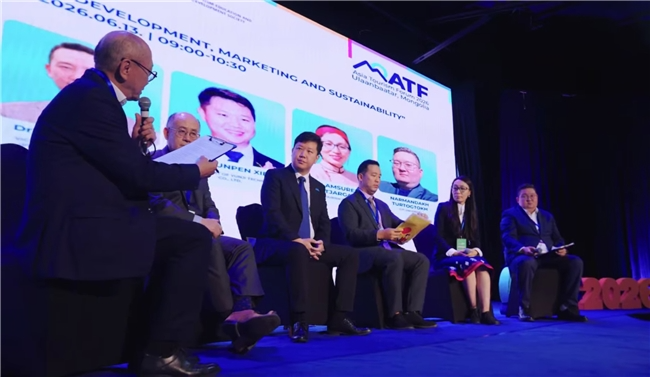
 At the 15th Asian Tourism Forum in Ulaanbaatar (June 11–13), co-hosted by Mongolia’s Ministry of Culture, Sports, Tourism and Youth and The Hong Kong Polytechnic University, Ms. Liu Ying from PolyU’s Research Centre for Digital Transformation of Tourism (RCdTT) presented a joint data report with Yunjee Technology. The study, based on 357 Chinese hotels and 3,187 monthly observations (August 2024 – May 2025), moves beyond binary adoption metrics to measure actual usage intensity – monthly task volume and execution duration.
The core findings overturn conventional wisdom: for every additional 1,000 robot tasks per month, occupancy rises 4.007%, average daily rate (ADR) increases 4.57% (approx. ¥19), and revenue per available room (RevPAR) jumps 9.63% (approx. ¥31). This dual effect – simultaneously boosting demand and strengthening pricing power – disproves the fear that automation undermines rate integrity. Instead, robots appear to enhance both guest attraction and revenue management.
Yet the benefits are not uniform. Heterogeneity analysis profiles the hotels that capture the largest gains: younger hotels, free from legacy system burdens, integrate robots into SOPs more swiftly; urban hotels, serving time-sensitive business travellers, see significant ADR lifts (non-urban properties do not); chain-affiliated hotels leverage standardised management to replicate best practices across properties; and larger hotels, with complex service scenarios, fully exploit scale economies. These findings confirm that robot value depends on organisational context, market positioning, and operational maturity – not on the technology alone.
Yunjee’s Chief Development Officer, Xie Yunpeng, linked the data to embodied AI practice. He noted that each robot runs a marathon’s distance daily, and during the May Day holiday, service volume spiked 72%, validating the system’s peak-shaving resilience. With 750 million service interactions over the past year, this massive real-world usage intensity underpins the statistical robustness of the model. Addressing industry anxiety about human replacement, Xie argued that robots are not job killers; they handle dull, repetitive, and physically taxing tasks, freeing staff to deliver warm, personalised service. This human-robot collaboration, he said, is the core of new productive forces in hospitality.
The report’s most significant contribution is a quantifiable evaluation framework that replaces the binary “to purchase or not” with the continuous metric of “usage intensity.” It shifts the industry’s focus from adoption decisions to operational management – the critical variable is not installation but frequency, duration, and scenario fit. For hotel managers, this reframes resource allocation: invest in enabling active use, not just hardware acquisition.
The PolyU-RCdTT collaboration with Yunjee, presented at Asia’s premier tourism forum, signals that China’s practical robotics experience has achieved academic validation. The findings offer a universal benchmark for measuring technology asset returns, demonstrating that technology alone is inert; value emerges only through sustained, high-intensity deployment.
*Source: PolyU RCdTT report “Service Robots in Hotels: Usage Intensity and Heterogeneous Effects on Performance” (357 hotels, 3,187 hotel-month observations, Aug 2024 – May 2025).*