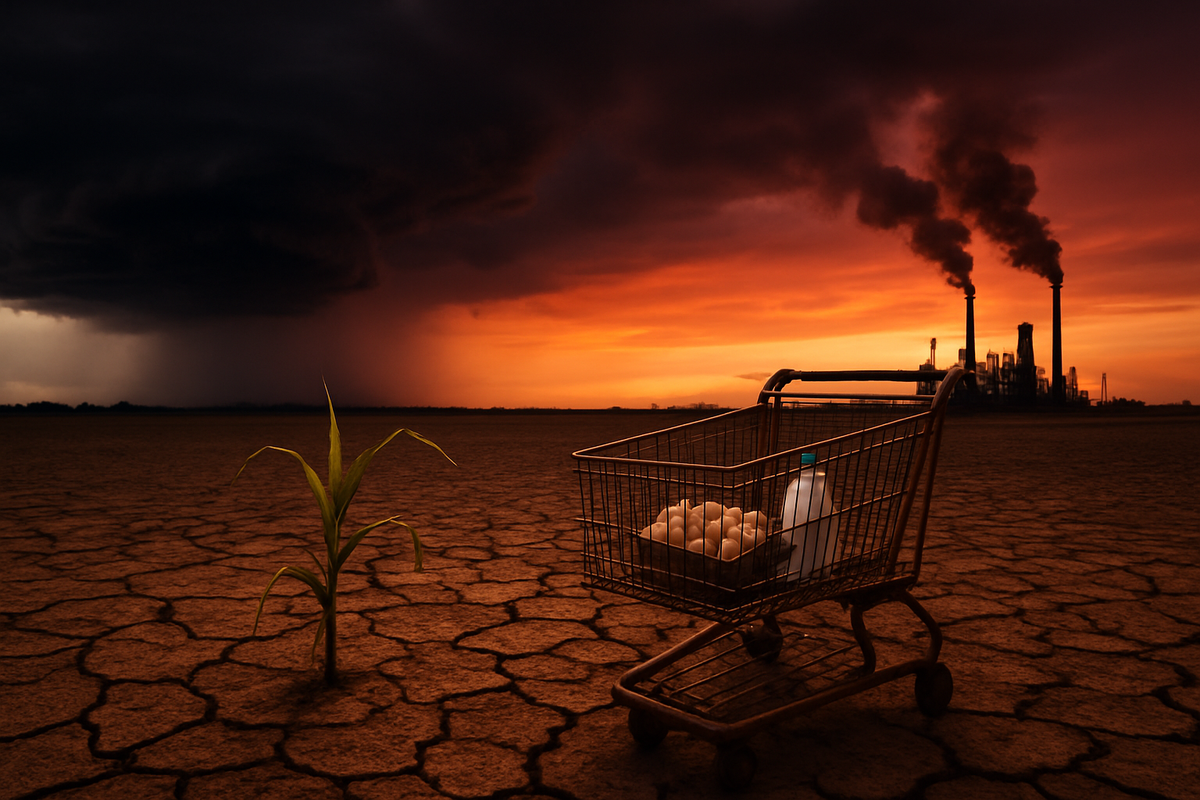
As of late December 2025, American consumers are facing a stark new reality at the checkout counter: the "cheap food" era has been effectively dismantled by a pincer movement of climate-driven crop failures and a structural reliance on volatile fossil fuel markets. Recent reports from the USDA and the FAO indicate that while general inflation has cooled in other sectors, food prices have surged by 3.0% in 2025 alone, outpacing the 20-year historical average and leaving the average household spending 30% more on groceries than they did just five years ago.
The immediate implications are profound, as "heatflation"—inflation driven by extreme weather—is no longer a theoretical risk but a primary driver of the Consumer Price Index (CPI). From a 17.7% spike in beef prices to record-breaking costs for morning staples like coffee and cocoa, the disruption of global supply chains is forcing a massive shift in consumer behavior and corporate strategy. As the year draws to a close, the intersection of a warming planet and a fossil-fuel-dependent agricultural system has created a permanent state of volatility for the world's most essential commodities.
The Perfect Storm: Weather Shocks and Energy Volatility
The crisis reached a tipping point throughout 2024 and 2025 as a series of unprecedented weather "shocks" targeted global agricultural hubs. In early 2024, a blistering heatwave and erratic rainfall in West Africa decimated cocoa yields in Côte d'Ivoire and Ghana, sending cocoa prices up a staggering 280% by April of that year. This was followed by a severe drought in Brazil and record heat in Vietnam, which together drove coffee prices up 55% in late 2024, culminating in a 14.5% price hike for U.S. consumers by mid-2025.
Domestically, the situation has been equally dire. Prolonged drought conditions across the American West, particularly in California and Arizona, have led to an 80% price increase for certain vegetable categories over the last three years. Simultaneously, a shrinking national cattle inventory—a direct result of parched grazing lands—pushed beef prices to historic highs in late 2025. These weather events were compounded by the food system's "petrochemical problem." Natural gas, the primary feedstock for nitrogen-based fertilizers, saw a price resurgence in 2025 as U.S. liquefied natural gas (LNG) exports expanded and new electricity demand from AI data centers tightened domestic supply.
Key stakeholders, including the USDA and international bodies like the FAO, have noted that 60% to 80% of the cost of producing nitrogen fertilizer is tied directly to natural gas prices. This dependency means that even when weather is favorable, energy market volatility can still price farmers out of a profitable harvest. The initial market reaction has been one of defensive posturing, with major food producers and retailers reporting narrowed margins and a frantic search for supply chain resilience.
Corporate Winners and Losers in a High-Cost Environment
The current environment has created a clear divide between companies positioned for the "green transition" and those tethered to traditional, high-input models. CF Industries Holdings, Inc. (NYSE: CF), the world’s largest ammonia producer, has navigated 2025 with mixed results; while its cost of sales jumped nearly 77% due to natural gas spikes, it has maintained strong margins by passing those costs directly to farmers. Similarly, The Mosaic Company (NYSE: MOS) has faced margin pressure as production costs for phosphate and potash rose by 21% year-over-year, yet it remains a critical player in a world desperate for soil nutrients.
On the losing end, meat processors like Tyson Foods, Inc. (NYSE: TSN) have been hit hard by the "cattle cycle" collapse. With feed costs remaining high and the available supply of livestock at multi-decade lows due to drought, Tyson’s beef segment has struggled with record-high input costs that are difficult to fully pass on to price-sensitive consumers. Conversely, retail giants like Walmart Inc. (NYSE: WMT) and The Kroger Co. (NYSE: KR) have emerged as relative "winners" by capturing a larger share of the market. As consumers trade down from premium brands to private labels to save money, these retailers have leveraged their massive scale to maintain inventory and offer value, though they too face the long-term challenge of rising logistics and refrigeration costs.
Structural Shifts and the Petrochemical Trap
This event signifies a shift from "transitory" inflation to a "structural" transformation of the global food economy. The reliance on fossil fuels—not just for fertilizer, but for the plastic packaging and diesel-fueled transport that define modern logistics—has made the food system a proxy for the energy market. Recent data suggests that 40% of all petrochemicals are now consumed by the food system, a vulnerability that is increasingly being scrutinized by regulators and climate advocates.
Historically, food prices were dictated by seasonal yields and labor costs. Today, they are increasingly tied to the "Scope 3" emissions of major corporations. Companies like General Mills, Inc. (NYSE: GIS) and Ahold Delhaize (OTCMKTS: ADRNY) have begun aggressively publishing climate transition plans, recognizing that long-term survival depends on decarbonizing their supply chains. This mirrors broader industry trends where "regenerative agriculture" and drought-resistant seed technology, led by firms like Corteva, Inc. (NYSE: CTVA) and Bayer AG (OTCMKTS: BAYRY), are transitioning from niche environmental goals to core business necessities.
Looking Ahead: Resilience or Retrenchment?
Looking ahead to 2026, the market must prepare for a "new normal" of supply chain fragility. In the short term, beef and egg prices are expected to remain elevated as producers wait for herds to recover and avian influenza risks persist. However, the long-term outlook suggests a strategic pivot toward localized food systems and vertical farming to reduce the carbon and transport footprint of fresh produce. Strategic adaptations will likely include a massive investment in "precision agriculture," using AI to optimize fertilizer use and reduce waste in the face of high input costs.
Market opportunities may emerge for companies specializing in alternative proteins and climate-resilient crops. As traditional commodities like coffee and cocoa become luxury goods due to climate-driven scarcity, the race to develop lab-grown or sustainably sourced alternatives will accelerate. Investors should expect a period of "greenflation," where the costs of transitioning to a more sustainable food system are felt at the checkout line before the long-term benefits of stability and lower energy dependency are realized.
Summary and Investor Outlook
The events of 2024 and 2025 have proven that the American food supply chain is only as strong as its weakest link, whether that link is a rain-starved cocoa farm in Ghana or a natural gas pipeline in the Gulf Coast. The key takeaway for investors and consumers alike is that food security is now inextricably linked to energy security and climate resilience. The market is moving toward a bifurcated future: one where companies that fail to adapt to extreme weather will face terminal margin erosion, while those that innovate in soil health and energy efficiency will lead the next generation of agribusiness.
Moving forward, the market will likely remain volatile as the global climate continues to shift. Investors should keep a close watch on natural gas price trends and USDA crop progress reports in the coming months. The era of predictable food prices is over; in its place is a complex, high-stakes environment where the weather forecast is just as important as the quarterly earnings report.
This content is intended for informational purposes only and is not financial advice.