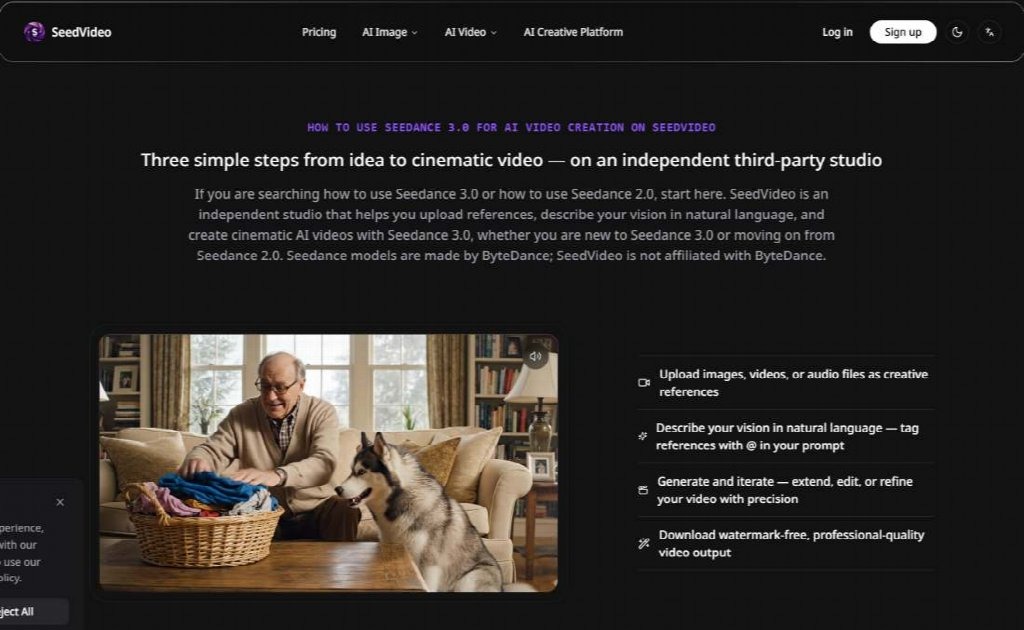
A finance team can approve a software line and still have no reliable estimate for the work it will produce. AI video makes that gap wider because cost changes with model, duration, output quality, reference media, and failed attempts. The landing page for Seedance 3.0 currently says the version is coming soon, while the working generator uses Seedance 2.0. Any forecast that prices the unreleased name as if it were an available SKU starts with a false input.
The sensible response still allows the platform into the plan, while separating three numbers that often get blended together: the published reference rate, the live cost shown before generation, and the effective cost of an approved clip after rejected outputs. SeedVideo exposes enough information to build that distinction, provided procurement treats the generator screen as a transaction surface rather than a marketing illustration.

Version Status Belongs in the Budget Assumptions
Model availability is a financial fact. The current home page identifies Seedance 3 as upcoming and points users toward Seedance 2.0 for production. That means a purchase request can name the platform and its current credit system, but it should not assign the future model a confirmed rate, launch date, resolution, duration, or API capability.
This distinction matters when a campaign calendar extends across quarters. A planner may reasonably reserve budget for video generation, yet the base case must use a model available at approval time. A separate scenario can cover a future model, with the assumption clearly marked for revision. If the release changes price or workflow, only the scenario changes; the approved baseline remains auditable.
Published Rates and Live Costs Serve Different Jobs
The public pricing page lists Seedance 2.0 at 2.5 credits per second and Seedance 2.0 Fast at 2 credits per second. The live generation workspace, however, displays output-quality rates of 4 credits per second for 480p, 8 for 720p, and 12 for 1080p. It also updates the Generate button with a total before the user submits a job.
Those figures should not be forced into one universal rate. A pricing table is useful for model-level planning; the live button is the better source for the exact configuration about to consume credits. Quality, duration, and references can change the total. The budget policy should therefore capture the visible pre-submit cost for each approved production setting.
Record the Generate Button Before Every Approved Run
A screenshot or task note with model, quality, duration, and displayed credits creates a usable ledger entry. It also makes a later variance explainable. Without that record, a finance reviewer sees only a shrinking balance and has to guess whether the difference came from a longer clip, a higher output tier, or repeated generation.
Calculate Approved Output, Not Raw Generation Volume
The cheapest generated file is not necessarily the cheapest usable asset. A four-second clip that changes a product mark, deforms a hand around the featured object, or loses synchronisation at the key action will never clear editorial review. Its credits were spent, but it contributes nothing to the delivered count. Effective cost needs a keep rate.
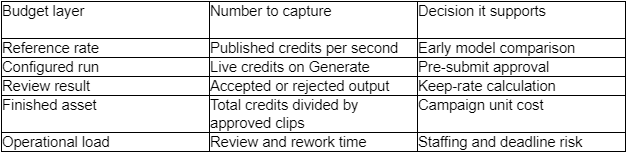
Suppose a team generates five configured runs and approves two. The production cost is not the displayed rate for one run; it is all five runs divided across two usable clips, plus review time. The first preview should be logged against the same acceptance rule as the fifth rather than receiving a free pass because it opened the session. No invented performance percentage is needed. The team can collect its own accepted and rejected counts from the actual campaign.
Rejection reasons also matter. A prompt problem can often be reduced by tightening the brief. Identity drift across several outputs may call for cleaner references. Unreadable on-screen text may require conventional typography in post rather than another generation. A visually strong clip that is never published still belongs in the rejected spend, not in a portfolio count. Each category points to a different corrective action and prevents the credit ledger from becoming a vague account of "experimentation."
References Change Labor Even Before Credits Change
The current Seedance 2.0 form supports up to nine images, three reference videos, and three audio files. Video references can total up to 15 seconds, as can audio references. This expands control, but every uploaded item has a preparation and review cost: checking rights, trimming the useful section, resolving contradictions, and confirming that the output did not copy an unwanted detail.
A prompt-only draft may be quick to launch but expensive to steer. A reference-heavy draft may take longer to prepare but reduce ambiguity. Procurement should not declare either route cheaper in advance. It should compare total staff minutes and accepted outputs for the type of work being purchased.
Put Rights Review Beside Render Approval
Uploaded media remains the user's responsibility, even though the terms say users retain ownership of inputs and may own compliant generated output. The use of third-party model providers also brings their policies into the workflow. If legal review is delayed until a visually successful clip appears, the team may lock the asset after credits and editing time have already been spent. Earlier rights triage avoids that bottleneck.
Credit Expiry Changes the Carrying Cost Calculation
The pricing page says subscription credits roll over and accumulate rather than resetting, while one-time credit packs never expire. That removes a common pressure to generate low-value work before a monthly balance disappears. It does not remove the need to choose the right purchase type.
A recurring content desk can compare subscription allocation with its observed monthly approved-output rate. A one-off campaign may value a permanent credit pack because unused balance can wait for the next brief. The decision should use expected production cadence, not a forced rush to consume credits. This is where a modest pilot is useful: it estimates keep rate and review load without pretending to forecast an unreleased model.
SeedVideo also states that used credits are non-refundable because generation consumes compute. That makes pre-submit review financially meaningful. Confirming model, ratio, quality, duration, and references before pressing Generate is not administrative ceremony; it is the last point where the configured spend can still be stopped.
Current Model Boundaries Belong in Risk Reserves
ByteDance's official Seedance 2.0 release describes text, image, video, and audio inputs, 15-second multi-shot audiovisual output, stereo sound, editing, and extension. It also acknowledges room for improvement in multi-subject consistency, text reproduction, complex edits, multi-person lip matching, and occasional audio distortion. These known boundaries help teams classify contingency work.
A campaign with one product and no generated text may need a smaller review reserve than a dialogue-heavy scene with several recognisable people. A clip that depends on exact packaging copy should budget for compositing real type after generation. The reserve becomes tied to observable risks, not to a generic percentage applied to every AI video.
The appearance of Seedance 3 in a headline does not erase those planning principles. When the model becomes selectable, finance can run the same comparison: displayed cost, accepted-output count, review minutes, and any downstream editing. Until then, it remains a scenario rather than a booked capability.
One Realistic Limit Keeps Forecasts Honest
No short pilot can guarantee future queue times, model availability, or creative acceptance. Provider capacity and rate limits can interrupt service, and visual quality remains brief-dependent. Keep a conventional production fallback for fixed launch dates instead of treating a credit balance as guaranteed delivery.
Approve a Controlled Pilot With Exit Criteria
A useful pilot specifies one asset class, one delivery ratio, a maximum configured spend, and a rejection list before generation begins. It records the live credit preview and the time from reference preparation through approval. It also names an exit condition: for example, stop if identity, packaging text, or audio timing repeatedly requires manual reconstruction.
SeedVideo is a reasonable fit for teams that want several reference modes and are prepared to measure finished output rather than celebrate raw render count. It is not a substitute for a budget owner, rights review, or editorial acceptance. The investment case becomes credible when current tools carry the base forecast and future models remain clearly labelled assumptions.
That discipline does not slow adoption. It prevents a version rumor from becoming a purchase commitment, while leaving the organization ready to evaluate a real release as soon as the model, price, and controls are visible.