Traditional 3D workflows have historically relied on disconnected tools and time-consuming processes, requiring creators to move back and forth between separate applications for modeling, texturing, optimization, and final output. As sectors like gaming, design, and digital media face increasing demands to deliver high-quality assets under tighter deadlines and constrained budgets, the inefficiencies of these traditional pipelines are becoming harder to ignore. In response, the emergence of the AI 3D model generator represents a shift toward more streamlined, integrated, and accessible 3D creation—lowering technical barriers while preserving creators' control over the final 3D models.
A Unified AI Workspace for 3D Model Production
Tripo Studio is built as an integrated 3D workspace that consolidates the traditionally fragmented stages of creation into a single, intelligent platform. Powered by Tripo AI, it brings together core capabilities—3D modeling, AI-driven texturing, optimization, and rigging—to support streamlined, end-to-end production.
Beyond asset creation, Tripo also provides a 3D model viewer that enables fast, accurate viewing and sharing across devices and operating systems. Supporting major 3D file formats such as OBJ, FBX, GLB, and STL, creators can instantly preview, present, and collaborate on models without relying on external tools. As an AI 3D model generator, Tripo reduces workflow friction while maintaining creative control, making it easier to move from concept to finished asset within one unified environment.
A Closer Look at AI-Powered 3D Modeling Capabilities
To better understand how Tripo Studio supports complete 3D production workflows, it is useful to look more closely at the core capabilities behind the platform. This section focuses on the individual tools that make up Tripo's AI-powered 3D modeling pipeline, from initial asset generation to refinement and optimization, illustrating how the system operates as an AI 3D model generator while maintaining flexibility and creative control at each stage.
Text to 3D Model: Fast Concept Generation
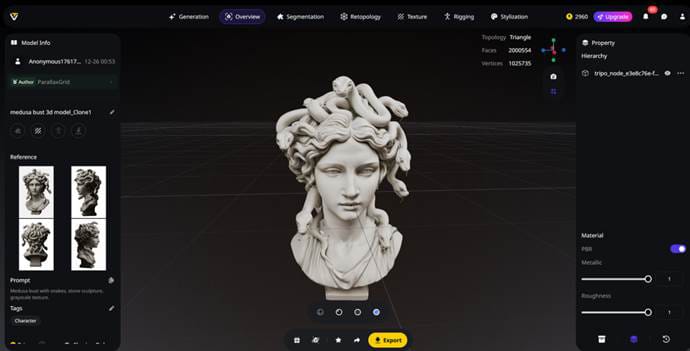
Text to 3D Model allows creators to generate detailed 3D assets directly from natural language descriptions, eliminating the need for manual modeling during the early stages of creation. By describing an object's structure, materials, and visual features, users can move from an abstract idea to a usable 3D model in seconds, significantly accelerating concept development.
This approach is particularly effective for early-stage ideation and concept exploration. For example, a prompt such as "Medusa bust with snakes, stone sculpture, grayscale texture" can be translated into a structured 3D model that captures the overall form and surface characteristics of the subject, providing a solid starting point for further refinement. At the same time, text-based generation can also support structured or educational use cases—such as creating a plant cell 3D model with labels—where textual descriptions help define core components and layout before additional detailing or optimization. By enabling rapid iteration through natural language input, Tripo Studio allows creators to explore, test, and refine ideas efficiently at the concept stage.
Image to 3D Model: Reference-Based Reconstruction
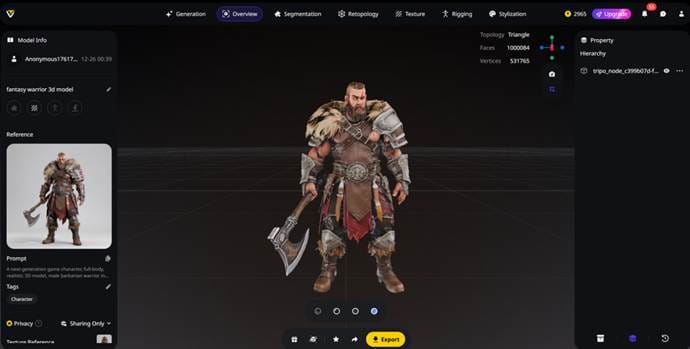
Image to 3D Model lets creators to convert 2D visuals into detailed 3D assets by using existing visual references as the foundation. By uploading a single image or multiple reference images, users can generate 3D models that preserve accurate proportions, surface details, and overall visual consistency, making this feature especially useful for concept art, product visuals, and character designs.
For improved reconstruction quality, Tripo Studio supports multi-view image input, enabling creators to provide multiple angles of the same object to achieve more reliable geometry. In addition, tools such as Nano Banana make it possible to refine or adjust reference images before generation, helping ensure cleaner inputs and more precise 3D results.
AI Model Segmentation: Structured Asset Control
The AI Model Segmentation feature enables creators to break down complex 3D models into clean, logically organized components that can be edited independently. Instead of working with a single, merged mesh, the system automatically analyzes model geometry and separates it into meaningful parts, giving creators finer control over structure and organization.
By eliminating the need for manual mesh splitting, this AI 3D model generator allows creators to focus on refining individual elements without disrupting the rest of the model. Segmented components can be adjusted, combined, or reorganized as needed, making it easier to create variations, optimize assets for different use cases, or prepare models for downstream workflows such as game development, level-of-detail optimization, or 3D printing. The result is a more efficient and controlled approach to managing complex 3D assets.
AI Retopology: Clean and Efficient Mesh Optimization
Tripo's Smart Retopology automates the process of rebuilding clean, efficient mesh structures from existing 3D models. By intelligently analyzing geometry, the system generates optimized quad- or triangle-based topology that retains essential visual detail while reducing unnecessary complexity, resulting in lighter and more organized assets.
Instead of manually reconstructing topology, creators can rely on automated retopology to produce meshes that are easier to edit and ready for downstream use. Within Tripo, these optimized models integrate smoothly into workflows such as real-time rendering, game development, and VR or AR experiences, where performance and visual consistency must be carefully balanced. By simplifying a traditionally time-consuming step, AI Retopology helps creators focus more on design decisions and less on technical cleanup.
Advanced AI Texturing: Production-Ready Surface Detail
Tripo's AI Texturing system enables creators to generate complete, production-ready PBR texture sets from either text descriptions or reference images. Rather than simple material assignment, the system applies consistent global styles while introducing realistic surface detail and accurate material properties, ensuring visual coherence and compatibility with modern production pipelines.
To support finer artistic control, Tripo includes tools such as Magic Brush, allowing creators to make targeted adjustments directly on the model—refining wear patterns, surface variation, or material highlights without disrupting the overall look. Recent enhancements, including an Ultra HD texturing engine and texture upscaling capabilities, further improve resolution and detail capture while preserving the original artistic intent. The result is high-quality, export-ready assets suitable for games, visualization, and product design workflows.
AI Auto Rigging: Animation-Ready Character Setup
It's AI Auto Rigging streamlines one of the most technically demanding stages of 3D production by automatically transforming static meshes into animation-ready models. Instead of manually building skeletons and painting skin weights, creators receive clean, editable rigs with natural deformation in just a few steps, significantly reducing setup time.
The system analyzes model geometry to generate accurate skeletal structures and optimized skin weights, supporting a wide range of assets—from humanoid characters and creatures to mechanical forms. To speed up prototyping and motion preview, Tripo Studio provides access to a library of over 100 motion-capture–quality biped animations, allowing users to quickly test poses and movement without additional configuration.
For added flexibility, the Lock Frame feature enables creators to freeze any animated pose and export it as a static model, making it easy to generate pose variations or prepare assets for 3D printing without re-rigging. All generated rigs are compatible with major 3D software, including Blender, Maya, and Unreal Engine, ensuring a smooth transition from model creation to professional animation workflows.
Model Stylization: Flexible Artistic Transformation
Model Stylization in Tripo enables creators to transform base 3D models into various distinct visual styles without manual remodeling. A single asset can be reinterpreted into formats such as Lego-inspired block styles, voxel-based designs, or Voronoi patterns, allowing rapid experimentation with different artistic directions that would otherwise require significant rework.
Stylized models generated in Tripo, an all-in-one AI 3D workspace, remain fully editable after export, giving creators the freedom to refine or extend assets in their preferred 3D software. With support for common file formats such as OBJ, FBX, and GLB, the stylization workflow integrates smoothly into existing pipelines. Fully automated and accessible to beginners, the process also preserves enough flexibility for advanced users to make further adjustments as needed.
Practical Applications Across Industries
As an AI 3D model generator, Tripo is applied across many industries, helping teams move efficiently from early concepts to production-ready 3D assets.
Gaming & Animation
Game developers and animators can generate initial 3D assets directly from text descriptions, accelerating early iteration while maintaining visual consistency. This reduces manual modeling effort and allows teams to focus more on gameplay, animation, and creative direction.
3D Printing
Tripo produces clean, watertight models suitable for real-world fabrication. Assets can be exported for printing, minimizing post-processing and ensuring structural accuracy across a variety of 3D printing workflows.
Product Design & Visualization
By converting reference images into fully editable 3D models, designers can quickly explore form, proportion, and surface detail. This approach streamlines concept refinement, visualization, and presentation without rebuilding models from scratch.
AR & VR
With optimized geometry, textures, and stylized assets, Tripo-generated models can be deployed directly into real-time and immersive environments. This makes it well suited for interactive applications, simulations, and virtual experiences.
Architecture & Interior Design
Architects and interior designers can rapidly generate spatial elements to explore layouts, iterate on design concepts, and visualize environments. The platform supports collaborative workflows and clear client presentations throughout the planning process.
Shaping the Next Phase of 3D Creation
Tripo has already supported millions of creators worldwide with access to a vast library of high-quality assets and automated production tools. By unifying intelligent generation, texturing, and optimization within a single pipeline, this AI 3D model generator enables teams to move faster from concept to usable output.
Looking ahead, the demand for rapid iteration, immersive experiences, and stylistic diversity will continue to rise. Platforms like Tripo Studio are increasingly positioned to meet these needs by lowering technical barriers and expanding creative possibilities. For creators exploring flexible workflows or starting points, access to a free AI 3D model generator further opens the door to experimentation—allowing ideas to evolve quickly into scalable, production-ready 3D assets.
Media Contact
Company Name: Tripo3D
Contact Person: Mike Hassy
Email: Send Email
City: New York
Country: United States
Website: https://www.tripo3d.ai