You have about seven seconds to keep a visitor on your site. That’s it. If your homepage feels generic, or your product page loads slowly, or your offer doesn’t match what they’re looking for, they leave. Usually to a competitor who got it right.
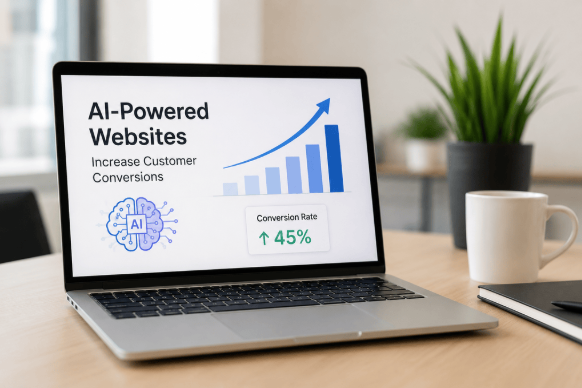
This is why more businesses now turn to an AI Web Development Company. Their websites don’t just look good. They act smart. They notice what a visitor is doing and respond to it, right then, instead of days later.
The idea of a “smart website” isn’t new. Companies have talked about personalization for years. What’s different now is speed. Machine learning and language models can react to a visitor’s behavior in real time. A cart left mid-checkout. A page visited twice in one day. The site can respond before the person clicks away.
This article looks at how that plays out in real businesses, online stores, SaaS platforms, and service companies, and what it actually takes to set something like this up.
What This Really Means
Forget the buzzwords for a second. The idea is simple. Instead of every visitor seeing the same homepage or product list, the site adapts based on what it knows. A first-time visitor from Google sees something different than someone who left items in their cart yesterday.
A few things work together to make this happen. Machine learning models guess how likely a visitor is to buy, based on patterns from past visitors. Language models write copy and chat replies that shift depending on who’s reading. Natural language processing helps chatbots actually understand a question instead of just matching keywords. Predictive tools flag visitors who are close to buying or close to leaving, while there’s still time to act.
Interactive elements pull weight here too, even a simple utility like this volume calculator keeps visitors on the page longer than something they just scroll past, which is exactly what these smart systems are trying to achieve.
Where the Conversion Gains Come From
Personalization that isn’t just “new vs. returning.” Smart systems now adjust headlines, offers, and product picks for each visit, based on what the visitor is likely to want. McKinsey found this kind of personalization can raise revenue by 5 to 8 percent, boost satisfaction scores by 15 to 20 percent, and cut service costs by 20 to 30 percent. These numbers hold up because they’re based on real behavior, not guesses about age or location.
Knowing who’s actually close to buying. Not every visitor is ready to act. Treating them all the same wastes your time and your ad budget. Scoring models trained on hesitation and repeat visits can flag high-intent visitors, so the right offer shows up at the right time. One company that did this saw targeting accuracy improve by 210 percent.
Chat that answers the actual question. Chatbots used to be frustrating. Now, with better language understanding, they can handle real questions instead of pushing every user to a contact form. In real estate, teams using this kind of chatbot saw productivity rise by about 20 percent, and support time drop by up to 30 percent.
Testing that doesn’t take three weeks. Old-school A/B testing runs one version at a time and waits weeks for a clear answer. Automated tools now run several versions at once and shift traffic toward the winner as results come in. This can cut testing time by up to 60 percent.
Better writing, not just more visitors. Sometimes the problem isn’t traffic. It’s the message. One online store rewrote its product listings using this approach and saw conversions jump from 26 percent to 46 percent in eight weeks. No new traffic. Just better words.
How to Actually Set This Up
You don’t need to rebuild your whole site. Most teams that do this well follow a similar path.
First, get your data in one place. Predictive tools are only as good as the data behind them. If your analytics, CRM, and sales history are spread across three different tools, start there.
Second, pick one problem to solve. Cart abandonment. Lead scoring. Churn. Don’t try to fix five things at once. Pick one you can measure clearly.
Third, run a small test before going further. Train a model on that one workflow. Check it every week. Adjust based on what’s really happening, not what you assumed would happen.
Fourth, add language models once your data is solid. With clean data in place, these tools can personalize messages and chat replies without sounding generic.
Fifth, always compare against a control group. Keep some traffic on the old version. Without that, you can’t tell if your gains are real or just luck.
This is roughly how an experienced AI Development Company handles it for clients. Data first. Personalization after. That order matters more than people expect.
The Good and the Bad
The benefits are real. Better conversion rates from timely personalization. Lower support costs since bots handle first-response questions. Faster testing. Sales teams are spending time on leads that are actually worth chasing.
But there are limits too. These models need enough traffic and clean data to work well. A low-traffic site won’t see much benefit yet. Language models can sound generic if there’s no strong brand voice guiding them. Hooking all this into your CRM and analytics takes real technical work. And any tracking you add has to follow rules like GDPR and CCPA. That part isn’t optional.
Off-the-Shelf Tools vs. Custom Builds
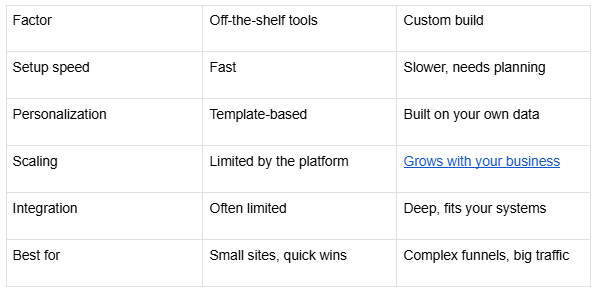
Off-the-shelf tools work fine for simple needs. But for businesses with complex funnels or multiple product lines, Custom AI Web Development usually wins out. The model trains on your own customers, not a generic dataset built for someone else’s audience.
Why Companies Hire a Partner for This
Building this in-house requires data engineers, machine learning professionals, and front-end developers working together. Most internal teams don’t have that mix sitting around. That’s the real reason more companies now work with an AI-Powered Web Development partner instead of building it piece by piece on their own.
A solid AI Website Development Company already has the frameworks in place for data, model training, and content pipelines. That cuts the time to real results significantly. This matters most for Enterprise AI Web Development work, where traffic and customer journeys are too complex to optimize by hand.
DenebrixAI builds exactly this kind of setup for businesses personalization engines, chat assistants, predictive scoring as an AI Web Development Company focused on real conversion results, not just a fresh coat of paint on your site.
Conclusion
This isn’t some future trend to keep a half-eye on. It’s already the line between businesses gaining ground and businesses losing it. A static site that treats every visitor the same is competing against ones that adjust in real time. That gap only gets wider the longer it’s ignored.
Start small if that fits your team. Go bigger if your traffic and data can support it. Either way, the businesses seeing real results are the ones pairing the right tools with a partner who’s actually done this before. That’s usually what separates a working setup from a chatbot bolted onto a site that never changed. Working with the right AI Web Development Company is often the difference.
FAQs
So what does this actually mean day-to-day?
It means your site reads visitor behavior and adjusts content, offers, and tests in real time. No more showing the same static page to every single person.
Why do conversion rates actually move?
Because decisions that used to happen after a weekly report now happen while the visitor is still on the page. The site reacts to what someone is doing, not to a guess about who they might be.
What’s the real payoff?
Lower support costs, since bots handle first questions. Faster testing. Sales teams chasing leads that are actually worth the time.
How do I start without a huge budget?
Centralize your data. Pick one problem you can measure. Test it against a control group before doing anything bigger.
What’s the catch?
Data quality and traffic. A site without enough visitors or with messy data won’t see much benefit yet. And AI-written content still needs a real brand voice, or it reads flat.
Does this replace regular web development?
No. Good structure, speed, and design still matter. This sits on top of that foundation. It doesn’t replace it.
Do I need to be a big company for this to work?
Not really. Big sites see bigger numbers because of traffic volume, but even a small business running one chatbot or one automated email flow can see a real lift.