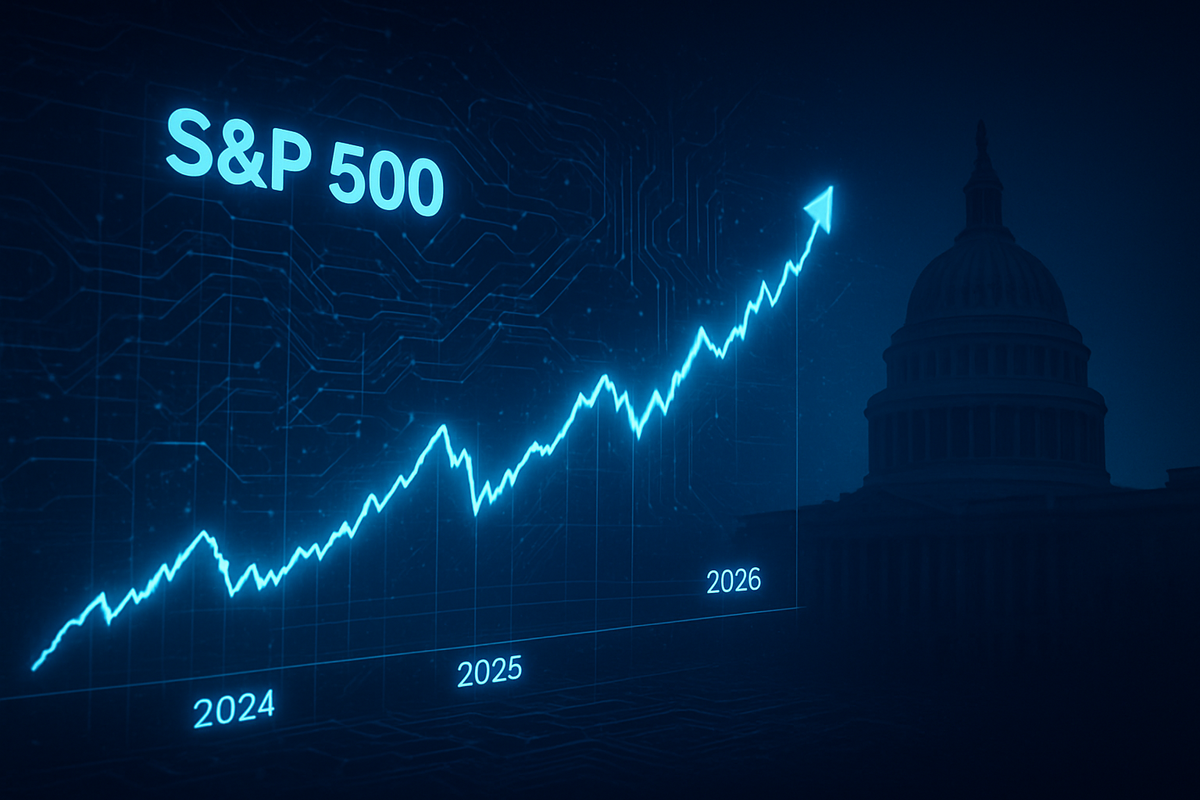
As the curtain closes on 2025, the S&P 500 (INDEXSP:.INX) stands at a historic crossroads, coming off a two-year run that has defied the skeptics and redefined the boundaries of the "AI era." Following a blistering 24.23% return in 2024 and a resilient gain of approximately 17% in 2025, investors are now peering into 2026 with a mixture of euphoria and seasonal trepidation. The immediate backdrop is one of recovery; the market is currently shaking off the dust from a disruptive 43-day U.S. government shutdown that paralyzed Washington in late 2025, creating a "coiled spring" effect that many analysts believe will launch the index into the new year with significant momentum.
However, 2026 is no ordinary year in the financial calendar. It marks the second year of the U.S. presidential cycle—the notorious "midterm year." Historically, this period is characterized by early-year policy paralysis and heightened volatility as the market grapples with the uncertainty of congressional shifts. Yet, if history is any guide, the resolution of these tensions often leads to some of the most powerful rallies in the market’s four-year cycle. As we stand on December 22, 2025, the intersection of technological transformation and historical seasonality suggests a 2026 that will test investors' nerves before rewarding their patience.
From Shutdown to Springboard: The 2025 Year-End Landscape
The journey to this moment has been anything but linear. While 2024 was defined by the "Goldilocks" combination of cooling inflation and the explosive growth of generative AI, 2025 introduced more complex "policy crosscurrents." The most significant hurdle was the 43-day government shutdown that began in late autumn and concluded just weeks ago. This fiscal stalemate reduced Q4 2025 GDP growth by an estimated 1.5%, temporarily clouding economic data and causing a mid-quarter dip in the Vanguard S&P 500 ETF (NYSEARCA:VOO). However, the resolution of the shutdown, coupled with the passage of the "One Big Beautiful Act" (OBBBA)—a sweeping tax and regulatory relief package—has set the stage for a sharp rebound in early 2026.
Key stakeholders, including Federal Reserve officials and Wall Street’s top strategists, have spent the final weeks of 2025 recalibrating their expectations. The Fed ended the year with interest rates in the 3.50%–3.75% range, a significant retreat from the peaks of the previous year. This easing bias, combined with the deferred economic activity from the shutdown, has led firms like Deutsche Bank (ETR:DBK) to project a "coiled spring" recovery for Q1 2026, with GDP growth expected to jump to the 3.0%–3.2% range. The initial market reaction to the OBBBA has been overwhelmingly positive, as corporations begin to price in the billions of dollars in tax savings expected over the next fiscal year.
The AI Titans and the Financial Rebound: Winners and Losers
As we look toward 2026, the leadership of the S&P 500 is undergoing a subtle but profound shift. The "AI Infrastructure" play remains the dominant theme, with NVIDIA (NASDAQ: NVDA) and Broadcom (NASDAQ: AVGO) continuing to reap the rewards of the massive build-out in data centers. However, the focus is shifting from pure hardware to "agentic AI" and software efficiency. Microsoft (NASDAQ: MSFT) and Alphabet (NASDAQ: GOOGL) are expected to be major winners as they begin to demonstrate significant "operating leverage"—using AI to drive higher margins even if top-line growth slows.
Conversely, the financial sector is poised for a major comeback. With interest rates stabilizing and a more favorable regulatory environment under the OBBBA, investment banking giants like Goldman Sachs (NYSE: GS), JPMorgan Chase (NYSE: JPM), and Morgan Stanley (NYSE: MS) are looking at a robust 2026. A backlog of M&A activity and highly anticipated IPOs, such as CoreWeave and Chime, are expected to provide a significant tailwind for these firms. On the losing end, companies with high debt loads that failed to refinance during the late-2025 rate dip may struggle, as the "higher for longer" sentiment—while diminished—has not entirely vanished from the corporate bond market. Additionally, traditional retail and consumer staples may face headwinds if the "stagflation lite" concerns of late 2025 persist into the new year.
Historical Precedents: Navigating the Midterm Dip
The most critical lens for 2026 is the historical "Midterm Year" cycle. Since 1950, the second year of a presidential term has traditionally been the weakest for the S&P 500. On average, the index sees a return of only 0.3% in the 12 months leading up to the midterm elections, often plagued by a "midterm dip" that averages a peak-to-trough drawdown of -17.5%. This volatility is usually driven by legislative gridlock and the market’s inherent dislike of political uncertainty. If 2026 follows this script, investors should prepare for a rocky first nine months as the campaign trail heats up.
However, the silver lining is what follows the uncertainty. The 12-month period following a midterm election is historically one of the strongest in the entire market cycle, with an average return of 16.3%. Remarkably, the S&P 500 has not seen a negative return in the year following a midterm election since 1939. This "U-shaped" pattern suggests that while 2026 may start with a whimper, it has a high probability of ending with a bang. This historical precedent is currently being weighed against the secular bull market driven by AI, leading many to believe that any midterm drawdown in 2026 will be a generational buying opportunity rather than the start of a bear market.
The Road Ahead: Targets and Strategic Pivots
Looking into the short-term, the first half of 2026 will likely be a battle between robust corporate earnings and political noise. Wall Street's price targets for the year reflect a cautious optimism. JPMorgan Chase (NYSE: JPM) has set a base case of 7,500 for the S&P 500, while Deutsche Bank (ETR:DBK) has issued a more aggressive bull case of 8,000, citing the massive buyback programs expected to be fueled by the OBBBA tax relief. The consensus target of 7,500–7,600 implies a roughly 10% gain for the year, a solid performance that nonetheless represents a deceleration from the breakneck pace of 2024.
For investors, the strategic pivot in 2026 will involve moving "down the stack" of the AI trade and looking for value in sectors that have been overlooked during the tech-heavy rally. The "broadening" of the market is expected to continue, with mid-cap stocks and cyclical sectors potentially outperforming the mega-cap tech giants on a relative basis. Furthermore, with gold reaching all-time highs above $4,000/oz in late 2025, defensive hedges through companies like Newmont (NYSE: NEM) may remain popular for those wary of fiscal sustainability and the long-term impact of the national debt.
Closing the Chapter on 2025: A Market in Transition
In summary, as we stand at the end of December 2025, the S&P 500 is a market characterized by structural strength but cyclical vulnerability. The key takeaways for the coming year are clear: expect volatility in the first three quarters as the midterm cycle plays out, but stay focused on the underlying earnings growth driven by AI and fiscal stimulus. The "coiled spring" of early 2026, fueled by the resolution of the government shutdown, provides a strong starting point, but the path to 7,500 will likely be fraught with the typical midterm turbulence.
The market moving forward will be less about "multiple expansion" (valuation growth) and more about "earnings execution." Investors should watch for the first-quarter earnings reports in April 2026 as a litmus test for whether the AI productivity gains are truly hitting the bottom line. While the ghosts of midterm years past suggest caution, the technological and fiscal tailwinds of 2026 suggest that the secular bull market remains very much intact. The next twelve months will be a test of discipline, but for those who can look past the political headlines, the historical cycles suggest the reward will be worth the wait.
This content is intended for informational purposes only and is not financial advice.