As of mid-January 2026, the tech industry is still vibrating from the seismic shifts caused by Google’s latest quantum breakthrough. The unveiling of the "Willow" quantum processor has moved the goalposts for the entire field, transitioning quantum computing from a theoretical curiosity into a tangible era of "quantum utility." By demonstrating a computation that took mere minutes—which the world’s most powerful classical supercomputer would require ten septillion years to complete—Alphabet Inc. (NASDAQ: GOOGL) has effectively retired the "physics risk" that has long plagued the sector.
While the "ten septillion years" figure captures the imagination—representing a timeframe quadrillions of times longer than the current age of the universe—the more profound achievement lies beneath the surface. Google has successfully demonstrated "below-threshold" quantum error correction. For the first time, researchers have proven that adding more physical qubits to a system can actually decrease the overall error rate, clearing the single largest hurdle toward building a functional, large-scale quantum computer.
The Architecture of Willow: Solving the Scaling Paradox
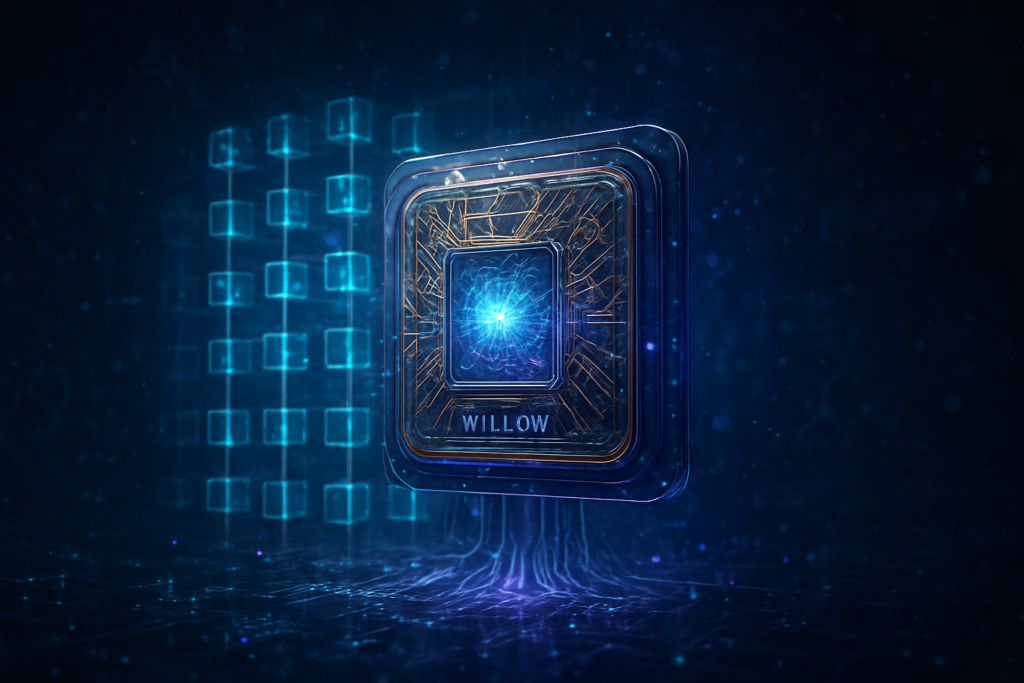
The Willow processor represents a monumental leap over its predecessor, the 2019 Sycamore chip. While Sycamore was a 53-qubit experiment designed to prove a point, Willow is a 105-qubit powerhouse built for stability. Featuring superconducting transmon qubits arranged in a square grid, Willow boasts an average coherence time of 100 microseconds—a fivefold improvement over previous generations. This longevity is critical for performing the complex, real-time error-correction cycles necessary for meaningful computation.
The technical triumph of Willow is its implementation of the "surface code." In quantum mechanics, qubits are notoriously fragile; a stray photon or a slight change in temperature can cause "decoherence," destroying the data. Google’s breakthrough involves grouping these physical qubits into "logical qubits." In a stunning demonstration, as Google increased the size of its logical qubit lattice, the error rate was halved at each step. Critically, the logical qubit’s lifetime was more than twice as long as its best constituent physical qubit—a milestone the industry calls "breakeven."
Industry experts, including quantum complexity theorist Scott Aaronson, have hailed Willow as a "real milestone," though some have noted the "verification paradox." If a task is so complex that a supercomputer takes septillions of years to solve it, verifying the answer becomes a mathematical challenge in itself. To address this, Google followed up the Willow announcement with "Quantum Echoes" in late 2025, an algorithm that achieved a 13,000x speedup over the Frontier supercomputer on a verifiable task, mapping the molecular structures of complex polymers.
The Quantum Arms Race: Google, IBM, and the Battle for Utility
The success of Willow has recalibrated the competitive landscape among tech giants. While Alphabet Inc. has focused on "purity" and error-correction milestones, IBM (NYSE: IBM) has taken a modular approach. IBM is currently deploying its "Kookaburra" processor, a 1,386-qubit chip that can be linked via the "System Two" architecture to create systems exceeding 4,000 qubits. IBM’s strategy targets immediate "Quantum Advantage" in finance and logistics, prioritizing scale over the absolute error-correction benchmarks set by Google.
Meanwhile, Microsoft (NASDAQ: MSFT) has pivoted toward "Quantum-as-a-Service," partnering with Quantinuum and Atom Computing to offer 24 to 50 reliable logical qubits via the Azure Quantum cloud. Microsoft’s play is focused on the "Level 2: Resilient" phase of computing, betting on ion-trap and neutral-atom technologies that may eventually offer higher stability than superconducting systems. Not to be outdone, Amazon.com Inc. (NASDAQ: AMZN) recently introduced its "Ocelot" chip, which utilizes "cat qubits." This bosonic error-correction method reportedly reduces the hardware overhead of error correction by 90%, potentially making AWS the most cost-effective path for enterprises entering the quantum space.
A New Engine for AI and the End of RSA?
The implications of Willow extend far beyond laboratory benchmarks. In the broader AI landscape, quantum computing is increasingly viewed as the "nuclear engine" for the next generation of autonomous agents. At the start of 2026, researchers are using Willow-class hardware to generate ultra-high-quality training data for Large Language Models (LLMs) and to optimize the "reasoning" pathways of Agentic AI. Quantum accelerators are proving capable of handling combinatorial explosions—problems with near-infinite variables—that leave even the best NVIDIA (NASDAQ: NVDA) GPUs struggling.
However, the shadow of Willow’s power also looms over global security. The "Harvest Now, Decrypt Later" threat—where bad actors store encrypted data today to decrypt it once quantum computers are powerful enough—has moved from a theoretical concern to a boardroom priority. As of early 2026, the migration to Post-Quantum Cryptography (PQC) is in full swing, with global banks and government agencies rushing to adopt NIST-standardized algorithms like FIPS 203. For many, Willow is the "Sputnik moment" that has turned cryptographic agility into a mandatory requirement for national security.
The Road to One Million Qubits: 2026 and Beyond
Google’s roadmap for the remainder of the decade is ambitious. Having retired the "physics risk" with Willow (Milestone 2), the company is now focused on "Milestone 3": the long-lived logical qubit. By late 2026 or early 2027, Google aims to unveil a successor system featuring between 500 and 1,000 physical qubits, capable of maintaining a stable state for days rather than microseconds.
The ultimate goal, targeted for 2029, is a million-qubit machine capable of solving "Holy Grail" problems in chemistry and materials science. This includes simulating the nitrogenase enzyme to revolutionize fertilizer production—a process that currently consumes 2% of the world's energy—and designing solid-state batteries with energy densities that could triple the range of electric vehicles. The transition is now one of "systems engineering" rather than fundamental physics, as engineers work to solve the cooling and wiring bottlenecks required to manage thousands of superconducting cables at near-absolute zero temperatures.
Conclusion: The Dawn of the Quantum Spring
The emergence of Google’s Willow processor marks the definitive end of the "Quantum Winter" and the beginning of a vibrant "Quantum Spring." By proving that error correction actually works at scale, Google has provided the blueprint for the first truly useful computers of the 21st century. The 10-septillion-year benchmark may be the headline, but the exponential suppression of errors is the achievement that will change history.
As we move through 2026, the focus will shift from "can we build it?" to "what will we build with it?" With major tech players like IBM, Microsoft, and Amazon all pursuing distinct architectural paths, the industry is no longer a monolith. For investors and enterprises, the next few months will be critical for identifying which quantum-classical hybrid workflows will deliver the first real-world profits. The universe may be billions of years old, but in the five minutes it took Willow to run its record-breaking calculation, the future of computing was irrevocably altered.
This content is intended for informational purposes only and represents analysis of current AI and quantum developments.
TokenRing AI delivers enterprise-grade solutions for multi-agent AI workflow orchestration, AI-powered development tools, and seamless remote collaboration platforms.
For more information, visit https://www.tokenring.ai/.