A communications team can see that a claim is spreading. The harder task is deciding who needs to verify it, what the organization can say with confidence, and when an issue deserves a response.
Narrative intelligence platforms help teams examine connected claims, sources, and patterns across online information. Their focus differs: one may prioritize risk, another may map networks, and another may help an analyst follow changes in a storyline. Those differences matter when a finding needs to move beyond a dashboard and into an operational decision.
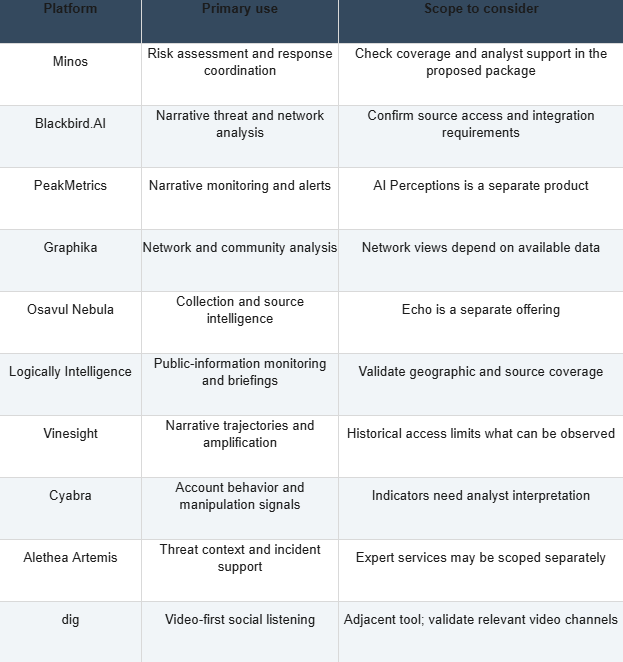
This guide compares ten options, including specialized narrative intelligence platforms and an adjacent video-first social listening tool. The descriptions draw on publicly available vendor information; the products were not independently tested for this article, and the order is not a performance ranking.
Why Narrative Intelligence Matters
Two recent findings illustrate why organizations need to assess information carefully:
In a 2025 Pew Research Center survey across 25 countries, the median of the country-level percentages was 72% for adults who said false information online was a major threat to their country. This is a measure of public concern, not the percentage of online content that is false.
The European External Action Service's fourth report on foreign information manipulation and interference analyzed 540 incidents involving 10,500 unique channels during 2025. These were incidents within the report's research scope; the figures are not a count of all such incidents or of attacks on businesses.
Neither figure measures the effectiveness of a particular tool. Together, they show why an enterprise may need to distinguish a genuine stakeholder concern from an unverified claim, understand where that claim is appearing, and give the right team enough context to investigate.
A narrative platform also has limits. Its coverage may not include a private message, a regional forum, or the internal record that would confirm what happened. A lower mention count after a company statement does not establish that the statement caused the change. Human review and other business evidence remain necessary.
Compare the Platforms at a Glance
1. Minos
A scattered set of posts can demand input from different teams before anyone decides whether to respond. Minos, developed by Molfar Intelligence, is built around that handoff: it brings monitoring, assessment, investigation, and response coordination into one workflow.
Its described monitoring covers news, social media, video, and Telegram. Teams can review the signals behind its Risk assessment, while Minos Research provides analyst-led work for questions that require deeper investigation.
Question for the buyer: Can a risk analyst explain the assessment to the response owner using the evidence available in the platform?
2. Blackbird.AI
Blackbird.AI's Constellation presents narrative details alongside risk indicators, associated posts, audience cohorts, and a timeline of activity. Its API provides access to narrative, account, and post data for use in other systems.
Question for the buyer: Can analysts open the posts and behavioral indicators behind a risk view, and explain which judgments remain their own?
3. PeakMetrics
A single news cycle can generate multiple claims requiring different decisions. PeakMetrics offers narrative clustering to organize related coverage and customizable threat score alerts to help teams choose what to review. The resulting groups still need to be checked against their underlying items.
For teams also responsible for AI-channel reputation, the company offers a separate product, AI Perceptions, to track brand representation in AI-generated answers. Confirm the available package and platforms in scope.
Question for the buyer: Do the clusters preserve meaningful differences between claims, and can the team adjust the alert settings?
4. Graphika
A claim's route through online communities can matter as much as the total number of mentions. Graphika approaches that question through network analysis, modeling relationships among accounts and communities and combining platform analysis with human expertise.
This can be relevant for an investigation into how a story moved between audiences, provided the team understands which parts of the information environment are visible in the data.
Question for the buyer: What evidence supports an apparent connection, and how would missing sources change the network view?
5. Osavul Nebula
Osavul's Nebula is designed for analysts collecting and investigating information relevant to hybrid threats. Its search and source-enrichment features organize material from multiple data types; graphs and timelines provide ways to examine what was collected.
The vendor's Echo product has a separate strategic communications focus. Determine which capabilities and access are included in each proposal.
Question for the buyer: Can the analyst retrieve the relevant source material for the specific channels and period under investigation?
6. Logically Intelligence
A platform can surface activity, but a decision-maker often needs a concise account of what changed. Logically Intelligence describes public-source monitoring, related-story grouping, alerts, and reports, including views of amplifiers and geographic context.
Question for the buyer: Does the briefing link each important conclusion to source material, and can the analyst explain the geographic context?
7. Vinesight
For teams deciding whether a storyline calls for action, Vinesight describes tracking narrative movement, amplifiers, and momentum across platforms. Its observed timeline depends on the channels and history available to the system, so users should treat any starting point as the earliest observed rather than a proven origin.
Question for the buyer: What evidence supports the timeline and the assessment of amplification?
8. Cyabra
Cyabra focuses on signals associated with potentially inauthentic accounts, amplification, and online manipulation. Its offering for analysts describes account indicators, behavioral timelines, network clusters, and content analysis.
These indicators can help an analyst decide which accounts or behaviors need closer review.
Check in a demo: Which observations support an account-level indicator, and how can an analyst challenge or qualify it?
9. Alethea Artemis
Alethea positions Artemis as an online threat and narrative risk platform. Its product description combines risk context with access to incident management expertise for communications, legal, and security teams.
The combination may appeal to an organization that needs both monitoring and support in planning an incident response. The platform and expert services should be evaluated as separate procurement requirements.
Check in a demo: Which analyst support, response planning, and integrations are included in the proposed package?
10. dig
dig's enterprise product is a video-first social listening platform. The company describes analyzing spoken words, visual elements, and scenes inside videos to provide context around social discussion.
It is an adjacent tool in this comparison. Understanding the content of a creator video can help a consumer brand identify what audiences are discussing; a separate investigation may still be needed to assess suspicious amplification.
Check in a demo: Can a user move from a detected theme to the original clip, and does the proposed package cover the relevant channels and languages?
From an Alert to a Decision: A Practical Handoff Template
A strong alert is not yet a decision. The next team needs to know which statement is being examined, what has been verified, and who is responsible for filling gaps. The following template is a proposed workflow, not a claim that every platform supports each field natively.
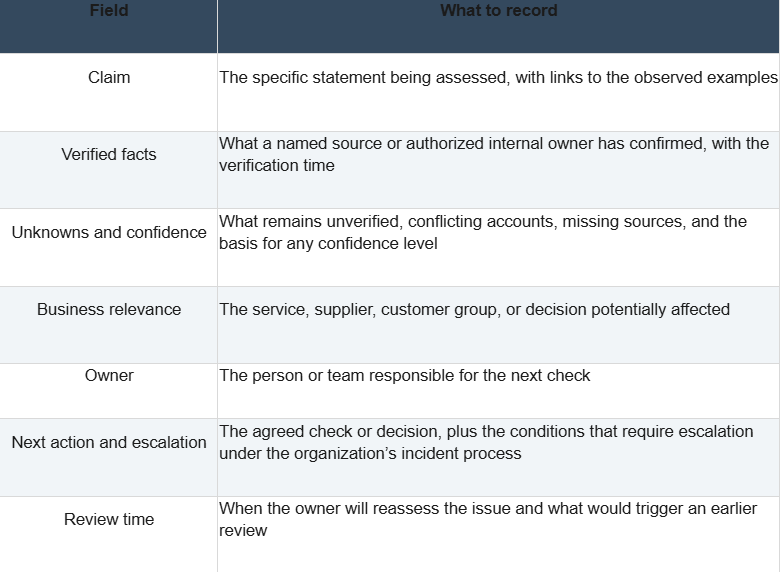
Keep the claim separate from established facts. An analyst might observe that several posts repeat a statement; that does not by itself establish the statement's accuracy or a relationship among the accounts. Record source gaps and contradictions instead of inferring a conclusion. Limit sensitive financial details in the brief and share internal records only with authorized personnel.
Example: A Supplier Payment Claim
Consider a hypothetical organization whose suppliers encounter posts claiming that its payment instructions have changed. The posts name the company, but the team has not yet established whether the instructions are legitimate.
The communications analyst records the claim and links to examples without treating the alleged payment details as verified. Finance checks the approved process through a previously verified channel or independently confirmed contact details, not contact information in the suspicious post. The security owner reviews any suspected impersonation. Until those checks are complete, the brief records the instruction as unverified, with an owner and a time to review it.
If finance confirms that instructions changed, communications can tell suppliers how to verify them through established channels. If finance confirms no change, the team can consider a factual clarification and security escalation. A suspected payment already made or account compromise should be reported through the organization’s incident procedure. If internal information is unavailable or conflicts, the brief should say so rather than choosing a conclusion. These are illustrative paths, not results from a real incident.
How to Evaluate a Platform Before Buying
Start with the decision and data your organization actually needs, then ask shortlisted vendors to demonstrate the same question. Confirm channels, regions, languages, content formats, historical access, and update frequency in writing. Ask which evidence can be exported and what analyst support, integrations, or modules are included in the price.
Use a historical case to review search results and narrative grouping, but do not treat a retrospective reconstruction as proof that an alert would have arrived at a particular time. If timing is important, run a prospective parallel pilot with documented start times, configurations, authorized sources, and actual alert-delivery logs. Record differences in coverage rather than treating an inaccessible source as a detection failure.
Compare the work required to reach a defensible decision, including the analyst time and services needed to verify a signal.
Frequently Asked Questions
What is narrative intelligence?
Narrative intelligence is the analysis of related claims and storylines to understand how they develop, spread, and may affect an organization. Depending on the product, it can include monitoring, source analysis, network context, risk assessment, and reporting.
How is narrative intelligence different from social listening?
Social listening can help a team understand audience conversations around a topic. Narrative intelligence products may go further into recurring claims, their movement between sources, or associated behavior. Since products overlap, compare the questions each can answer for your team.
Can a platform prove that a campaign is coordinated?
A platform can surface patterns that warrant investigation, but an alert or risk score alone does not establish coordination, identity, or sponsorship. Analysts must review the underlying evidence and alternative explanations.
Which narrative intelligence platform is best for an enterprise?
The best fit depends on the organization's decisions, source coverage, and workflow. A risk team investigating possible manipulation may need different capabilities from a communications team studying audience reaction or video content.