A location QR Code can be built two entirely different ways, and choosing the wrong one is why some of them open a map and others do nothing at all.
The first way encodes coordinates directly, using a geo: string holding a latitude and a longitude. It works with no connection, it points at an exact spot rather than an approximation, and support for it varies between phones in ways nobody warns you about. The second way encodes an ordinary web link to Google Maps or Apple Maps, which every phone handles identically and which needs a data connection to load.
Five tools below produce location codes properly, and prices for four were checked on 25 July 2026, and the format question matters more than any feature comparison here.
What a location QR Code actually contains
Either a coordinate pair or a URL, and the difference decides where the code will work.
A geo: code carries something like geo:51.5007,-0.1246, which is a point on the earth and nothing else. The scanning phone decides what to do with it, usually by offering to open whichever mapping app is installed. Because the coordinates sit inside the pattern, no server is involved and no connection is needed at the moment of scanning, which matters at a rural venue or in a car park with no signal.
A maps URL code carries an ordinary link instead, so it behaves like any other web address, so every phone treats it the same way, and it opens a named place with reviews, opening hours and a photograph rather than a bare pin. It also needs a connection, and the page loads through whoever hosts the link.
The practical guidance here is unglamorous. Use coordinates for a spot with no address, such as a field entrance, a trailhead, a loading bay or a marquee in a park. Use a maps URL for anywhere that exists as a listed place, because the named result is more useful to the person receiving it and behaves predictably across devices.
Why most venues should test both formats
Because geo: handling is genuinely inconsistent, and you will only discover how inconsistent on the devices your visitors actually carry.
Some phones open the default mapping app immediately, some present a chooser, and some show the raw coordinate string and leave the person to work it out, which at the entrance to an event car park is precisely the wrong moment for a puzzle. None of that is the generator's fault, and none of it appears in any feature list.
A maps URL avoids the ambiguity and introduces a dependency instead. The link resolves through a mapping provider, so it works everywhere with signal and nowhere without. For an indoor venue, a basement loading bay or a site with patchy coverage, that dependency is the thing that fails.
Print both, scan both on an iPhone and an Android handset, and keep whichever behaves. It takes ten minutes and it is the only reliable way to answer this.
The 5 best free location QR Code generators
Ranked on the quality of the printable file first, since these end up on signage, then on which formats they support.
1. QR Code Monkey
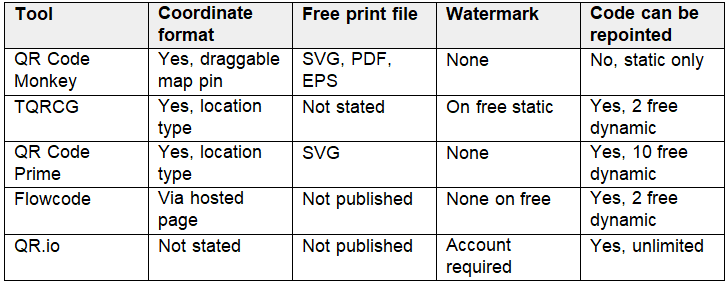
QR Code Monkey handles the coordinate format properly and hands you SVG and EPS at no cost, which is the combination a venue actually needs.
Its location type is built around a map with a draggable marker, and it exposes latitude and longitude as editable fields, so you can place the pin visually or paste exact coordinates. For a field entrance or a temporary site with no address, that visual placement is quicker and more accurate than looking coordinates up elsewhere.
Downloads come as PNG, SVG, PDF and EPS at no cost, which matters because location codes end up on outdoor signage, A-boards, event wayfinding and vehicle livery, all printed large. A raster file scaled up for a two-metre sign produces soft edges, and soft edges are what a scanner cannot resolve at distance.
There is no account, no signup and no watermark, and codes never expire and carry no scan limit. Design control covers gradients, custom eye colours and independent shape options, plus a logo slot.
The limits here are inherent rather than incidental. Every code is static, so a pin cannot be moved after printing, and there is no dashboard or scan data. For a permanent site entrance that is correct, and for a venue that relocates it is a reprint.
2. The QR Code Generator (TQRCG)
The QR Code Generator's location QR Codes come with free branding and, more usefully, with a route around the problem that makes location codes awkward, which is that places move.
Start with the branding, because wayfinding signage is seen by people who are already slightly lost. Brand colours, an embedded logo, dot styling and a call-to-action frame all sit on the free plan, and a frame reading Scan for directions removes the ambiguity that a bare square creates on a post at a car park entrance. Several tools here have no frame option at all.
The stronger argument is the changeable version of the same thing. Unlimited free static QR Codes cover fixed locations permanently, and 2 free dynamic QR Codes that never expire let you point a code at a maps link you can change later. That matters for a market stall that moves pitch, a construction site with a shifting entrance, a pop-up, or an event whose parking arrangements are decided the week before.
Those free dynamic codes stay live through a downgrade or a cancellation, which is worth knowing for a sign that will be bolted to a gatepost for years. Scan data on the free plan covers total scans, unique users, city, country and device across 14 days, so you can also see whether anybody is using the sign at all.
Two honest limits apply. Free static downloads carry a watermark, which is visible on a printed sign, and both Free and Flex are single-user. TQRCG's Flex upgrade clears the watermark and lifts you to 5 dynamic QR Codes at $5 per month billed yearly, reaching $10 per month billed yearly for 45, which is enough for a code per entrance across a multi-site operation.
3. QR Code Prime
QR Code Prime's location QR Code type is one of twelve dedicated types, so this is a proper location code rather than a text field with coordinates pasted into it, and it costs nothing at all.
Unlimited static codes come with no watermark at any tier and no account needed to generate or download one. Colour control, dot styles, logo embedding and eight brand presets are included, and downloads arrive as PNG and SVG, which covers most signage printers.
Static codes are also built inside your browser, so the coordinates never reach their servers. For a business address that is unremarkable, and for a private residence, a survey point or a site whose location is not public, it is the cleanest answer available.
A free account adds 10 dynamic QR Codes with 500 tracked scans a month, so the changeable maps-link approach is available here too, and ten of them covers a venue with several entrances. The gaps are PDF and EPS export, so a large-format printer may need a conversion, and there is no call-to-action frame. One independent developer maintains it, with no published compliance certifications.
4. Flowcode
Flowcode suits venues with something to explain rather than a single pin to share.
Its free plan costs $0 a month and includes 2 dynamic codes, two hosted mobile landing pages and analytics on the first 500 scans, with no advertising served. Instead of dropping somebody into a mapping app, the code opens a page you control, and that page can hold the map link alongside parking instructions, an access code, a photograph of the entrance and a phone number for when it all goes wrong.
For a venue that receives the same three questions every week, that page answers them once. A bare pin cannot say which gate to use, that the entrance is round the back, or that the barrier needs a code.
Pro Plus costs $25 per month billed annually for 50 codes and landing pages plus analytics on 6,000 scans. The trade is dependency plus a ceiling. The page needs a connection, which is the wrong property for a rural site, and analytics stop at 500 scans on free while the code keeps working.
5. QR.io
QR.io suits an operation with many locations rather than one, and it removes the code count from the conversation entirely.
There is no free plan, and a 7-day trial covers everything, with an account required even to download from the generator. Two options exist with identical features: $39.99 per month billed every month, or $350 for 12 months, which lands near $29 a month. Both carry unlimited QR Codes, unlimited scans, bulk creation and five team members.
Unlimited is the whole argument for a multi-site business. A property manager with forty buildings, a delivery operation with a hundred drop points, or a festival with thirty marked areas has an asset list rather than a code budget, and reconciling those two numbers annually is work with no upside.
The reporting is thin, listing scan count, date and location only with no device breakdown stated, which for wayfinding is largely sufficient. No batch size is published either, so a hundred-code upload is untested until you run it.
Format support and output, side by side
Which one suits your site?
Three questions, and the first is the one people skip.
Is there signal where people will scan?
This decides the format before it decides the tool. A car park behind a building, a basement loading bay, a rural venue or a festival field are all places where a maps URL fails and a coordinate code works. A high street address with full coverage makes the URL version better, because the named place carries opening hours and reviews.
If you do not know, assume the worst case. A code that fails at the moment somebody is lost is worse than no code, because they stopped walking to try it.
Will the location ever move?
Permanent addresses take a static code and cost nothing forever. Anything temporary, seasonal or under construction should use a dynamic code pointing at a maps link, because moving a pin then costs nothing while reprinting signage does not.
Events are the obvious case, and they are also where these codes get used most. Bitly's 2025 survey of 250 marketers found events among the most common QR Code deployment channels at 43%, and event locations change more often than almost any other category.
How large will it be printed?
Wayfinding codes get scanned from further away than most, which means printed larger, which means vector output matters. QR Code Monkey provides SVG, PDF and EPS free, and QR Code Prime provides SVG. Size the code against scanning distance rather than the space left on the sign, since a code read from three metres needs to be considerably bigger than one read at arm's length.
One security note that applies specifically to outdoor signage. Statista, citing TitanHQ, reported that nearly 21% of employees at global organisations experienced a QR Code phishing attack between February 2024 and February 2025, and an unattended sign at a car park entrance is an easy target for a sticker. Print the code into the sign rather than applying a label, and check it during whatever site inspection already happens.
Walk to the sign and scan it from where people stand
Generate the code, print it at final size, fix it where it will live, then stand where a visitor would stand and scan it. Not from a desk, and not from a metre away.
Three things surface at that distance and nowhere else. Whether the code is physically large enough, whether glare from the sign's finish defeats the camera, and whether what opens on the phone is actually useful. A pin in the middle of a field with no label tells a driver nothing, whereas the same pin with the venue name attached tells them they have arrived.
Then repeat it on the other operating system, because Mordor Intelligence attributing 64.92% of 2025 market revenue to dynamic codes says nothing about how a given handset treats a geo: string, and the two mobile platforms do not behave identically.
Directions and mapping questions people raise
Do location QR Codes work without internet?
A coordinate-based code does, because the latitude and longitude sit inside the pattern and the phone reads them locally. What happens next depends on the mapping app, which may need a connection to draw the map even though it already knows the destination. A code carrying a Google Maps link needs a connection from the start and will not resolve at all without one.
Should I use coordinates or a Google Maps link?
Use coordinates for places with no address, such as a field gate, a trailhead or a temporary site, and use a maps link for anywhere that exists as a listed place. The link version behaves identically on every phone and carries the venue name, opening hours and reviews, whereas the coordinate version works offline and points at an exact spot rather than an approximate one.
Can I move the pin after printing the code?
Only if the code is a dynamic one. A static coordinate code fixes the position permanently, so moving the pin means new artwork and new signage. TQRCG offers 2 free dynamic codes and QR Code Prime offers 10, either of which lets you point at an updated maps link without touching the printed sign.
How big should a location QR Code be on a sign?
Larger than an indoor code, because wayfinding signage is read from a distance and often from a moving vehicle. Size it against the furthest realistic scanning distance rather than against the space available, and test it by standing where a visitor would actually stand. Vector output matters here more than in most use cases, since these codes get printed at sizes that expose a low-resolution file immediately.
Why does my location code open a different app on different phones?
Because a geo: string tells the phone where to go and not which app should take it there, so the handset decides based on what is installed and what the user has set as default. That variation is normal and it is the main reason to test on both major platforms before committing to signage. A maps URL removes the ambiguity by naming the destination service explicitly.