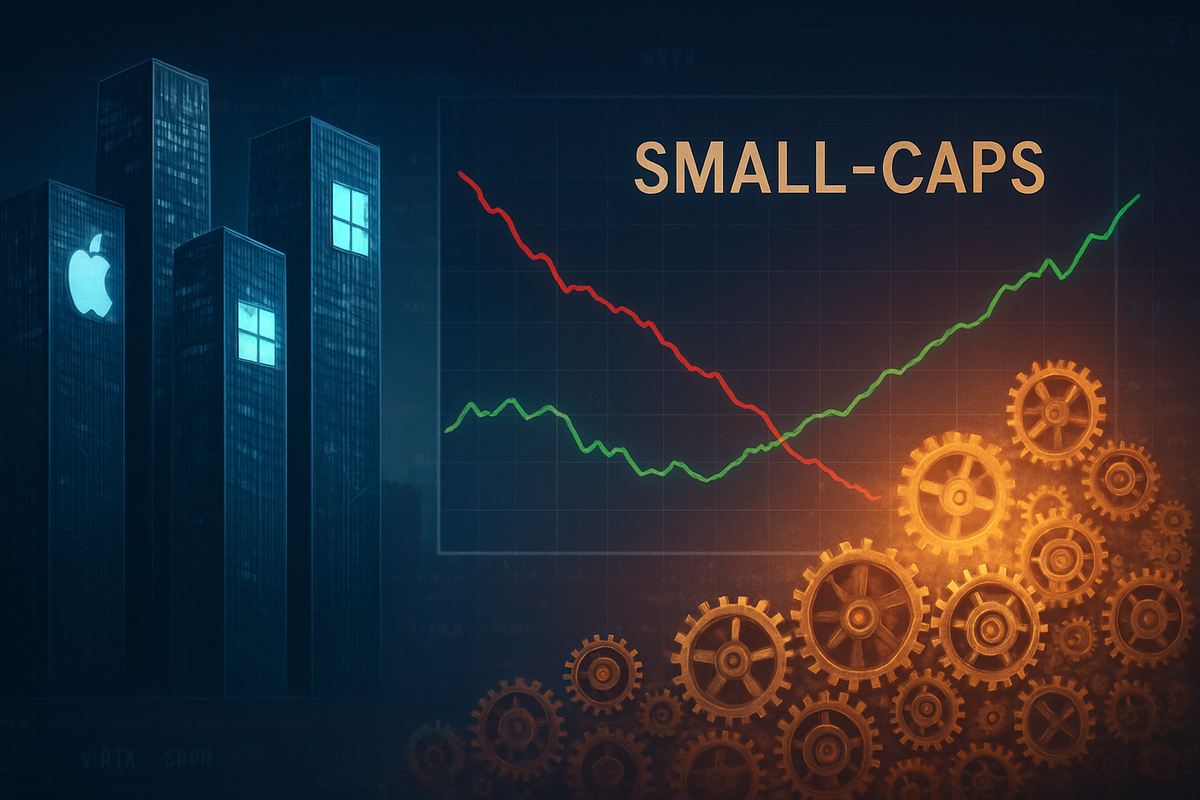
As of mid-December 2025, the long-awaited "Great Rotation" in the financial markets has shifted from a theoretical prediction to a dominant reality. For the better part of the last three years, small-cap stocks have lived in the shadow of the "Magnificent Seven" tech titans, but the tide has turned. Today, the Russell 2000 index is hitting record highs, nearing the 2,600 mark, as investors flee the overextended valuations of mega-cap technology and seek refuge in the domestic, cyclically sensitive engines of the American economy.
This resurgence is not merely a technical bounce; it is the culmination of a fundamental shift in the macro environment. With the Federal Reserve delivering its third interest rate cut of the year just one week ago on December 11, 2025, the crushing weight of high borrowing costs—which disproportionately affected smaller firms—has finally lifted. As we approach the end of 2025, the Russell 2000 is on track to outperform the S&P 500 by its widest margin in over a decade, signaling a new era for small-cap leadership.
The Road to the 2025 Breakout
The path to today's small-cap dominance began in the volatile closing months of 2024. Following the U.S. presidential election, a "Trump Trade" initially ignited interest in domestic-focused companies, betting on deregulation and corporate tax cuts. However, that momentum was briefly stalled in December 2024 when long-term bond yields spiked, leading to an 8.3% drop in small-cap value stocks. Throughout the first half of 2025, the market remained in a "wait-and-see" mode as inflation hovered near the 2.5% "sweet spot"—high enough to suggest economic growth but low enough to allow the Federal Reserve to begin its easing cycle.
The true catalyst arrived in the second half of 2025. While large-cap leaders like Microsoft (NASDAQ: MSFT) began to face "AI fatigue" as investors questioned the immediate return on massive capital expenditures, small-cap earnings growth began to accelerate. Consensus estimates for Russell 2000 earnings per share (EPS) growth in 2025 reached a staggering 44%, a sharp contrast to the slowing growth seen in the tech-heavy indices. This "earnings handoff" has been the primary driver of the current rally, as institutional capital flows out of crowded mega-cap trades and into the broader, undervalued segments of the market.
Key stakeholders in this transition include institutional asset managers who have been underweight small-caps for years. By late 2025, the valuation gap had reached a historic extreme, with the Russell 2000 trading at its lowest level relative to the large-cap Russell 1000 in nearly 25 years. This valuation "coiled spring" finally released this autumn, triggered by the Fed's decisive pivot toward a neutral interest rate policy.
Winners and Losers in the New Small-Cap Era
The beneficiaries of this macro shift are diverse, spanning biotechnology, regional banking, and industrial manufacturing. In the biotech space, Viking Therapeutics (NASDAQ: VKTX) has emerged as a leader, with its obesity drug VK2735 entering Phase 3 trials and driving significant index gains. Similarly, GeneDx Holdings (NASDAQ: WGS) has continued its meteoric rise, benefiting from a revitalized funding environment that has re-opened the "IPO window" for high-growth healthcare firms.
In the industrial and technology sectors, companies that apply AI rather than just build it have taken the lead. SoundHound AI (NASDAQ: SOUN) has seen its valuation soar as enterprise demand for voice-AI solutions moved from large-cap "builders" to small-cap "appliers." Meanwhile, AAON, Inc. (NASDAQ: AAON), a leader in HVAC manufacturing, has capitalized on the domestic infrastructure boom and reshoring trends that have defined the 2025 economic landscape.
However, the road has not been without its casualties. The regional banking sector, while generally benefiting from a steepening yield curve, faced a sharp "mini-crisis" in October 2025. Major players like Zions Bancorporation (NASDAQ: ZION) and Western Alliance Bancorporation (NYSE: WAL) saw their shares plunge 13% and 11% respectively in a single day following disclosures of loan fraud and non-performing loan charges related to defunct commercial borrowers. While smaller "pure play" banks like 1st Source Corporation (NASDAQ: SRCE) and Amerant Bancorp (NASDAQ: AMTB) have since stabilized the sector, the event served as a reminder that small-caps remain sensitive to credit quality. On the losing end of the rotation, mega-caps like Oracle Corporation (NYSE: ORCL) have struggled, with Oracle shares falling 13% earlier this month as investors grew wary of its heavy AI-related spending.
Broadening the Market: A Structural Shift
The significance of the Russell 2000's performance in 2025 extends beyond simple price action; it represents a healthy broadening of the market. For years, the S&P 500's gains were concentrated in a handful of companies, creating a "top-heavy" market that many analysts feared was fragile. The 2025 rotation suggests that the U.S. economy is resilient enough to support growth across a wider array of industries, particularly those with a domestic focus.
This shift also has profound regulatory and policy implications. The current administration's focus on domestic manufacturing and "lighter-touch" regulation has provided a tailwind for small-cap industrials. Furthermore, the "patent cliff" facing major pharmaceutical companies has sparked a frenzy of M&A activity, with large-cap firms using their cash piles to acquire small-cap biotech innovators. This consolidation trend is expected to continue into 2026, providing a consistent floor for small-cap valuations.
Historical precedents, such as the post-dot-com bubble era of the early 2000s, suggest that when small caps begin to outperform after a long period of dormancy, the trend can last for several years. In those previous cycles, the catalyst was often a combination of attractive valuations and a shift in the interest rate environment—exactly the conditions we are witnessing today.
The Outlook for 2026 and Beyond
Looking ahead to 2026, the primary question for investors is whether this small-cap momentum is sustainable. Short-term, the "January Effect" could provide another boost as tax-loss harvesting concludes and investors rebalance their portfolios for the new year. Long-term, the trajectory of the Federal Reserve will remain the most critical factor. If the Fed continues to move toward a neutral rate of roughly 3.5%, the interest expense relief for small-cap firms—many of which carry floating-rate debt—will continue to fuel earnings growth.
Strategic pivots will be required for companies that have relied on cheap capital. In the "new normal" of 2026, profitability and cash flow will be prioritized over "growth at any cost." We may see a surge in strategic partnerships and consolidations, particularly in the fragmented regional banking and ad-tech sectors, as companies seek to achieve the scale necessary to compete with larger peers.
Potential scenarios include a "soft landing" where small caps continue to lead as the economy stabilizes, or a more volatile "no landing" scenario where persistent inflation forces the Fed to pause its rate cuts, potentially stalling the Russell 2000's progress. However, given the massive 44% EPS growth projections for the coming year, the fundamental case for small-cap outperformance remains the strongest it has been in a generation.
Wrap-Up: A New Market Leadership
The events of late 2025 have confirmed that the era of mega-cap tech exceptionalism is being challenged by a revitalized domestic industrial and small-cap base. The Russell 2000 has transformed from a laggard into a leader, driven by a perfect storm of lower interest rates, historic valuation gaps, and a robust domestic economy.
Moving forward, the market appears more balanced and less reliant on a few tech giants. For investors, the takeaway is clear: the "Great Rotation" is no longer a forecast—it is the current state of play. While risks such as credit quality in regional banking and global trade tensions remain, the underlying fundamentals of the Russell 2000 suggest that the stage is finally set for sustained small-cap outperformance.
In the coming months, investors should closely watch the fourth-quarter earnings reports of mid-and-small-cap firms to see if the projected 44% earnings growth is materializing. If the numbers hold up, the Russell 2000's record-breaking run in December 2025 may only be the beginning of a multi-year cycle of small-cap dominance.
This content is intended for informational purposes only and is not financial advice