During Q4, one of the major subplots to spin out of the artificial intelligence (AI) investing theme has been the rise of Oracle (ORCL), a legacy Tech 1.0 stock that has now reinvented itself as a data center powerhouse. The company’s surge to new record highs briefly pushed co-founder Larry Ellison into the spot of world’s richest man earlier this year – but ORCL’s AI-fueled rally fell apart rapidly.
Concerns over the company’s debt-fueled growth helped to spark a pullback in ORCL from its highs, even earning a special call-out from notorious permabear Michael Burry in his critique of the AI bubble. Barchart’s own Senior Market Strategist John Rowland, CMT, flagged the stock’s debt-to-equity ratio as a “cautionary tale”; the metric currently stands at a stomach-churning 3.33.
However, some analysts have now decided the sharp pullback in ORCL is a buying opportunity, even as shares of the debt-strapped tech giant trade at a forward price/earnings-to-growth (PEG) ratio of 1.36. That’s a premium valuation compared to AI heavyweights like Advanced Micro Devices (AMD), Micron (MU), and even asset-light, cash-rich Nvidia (NVDA).
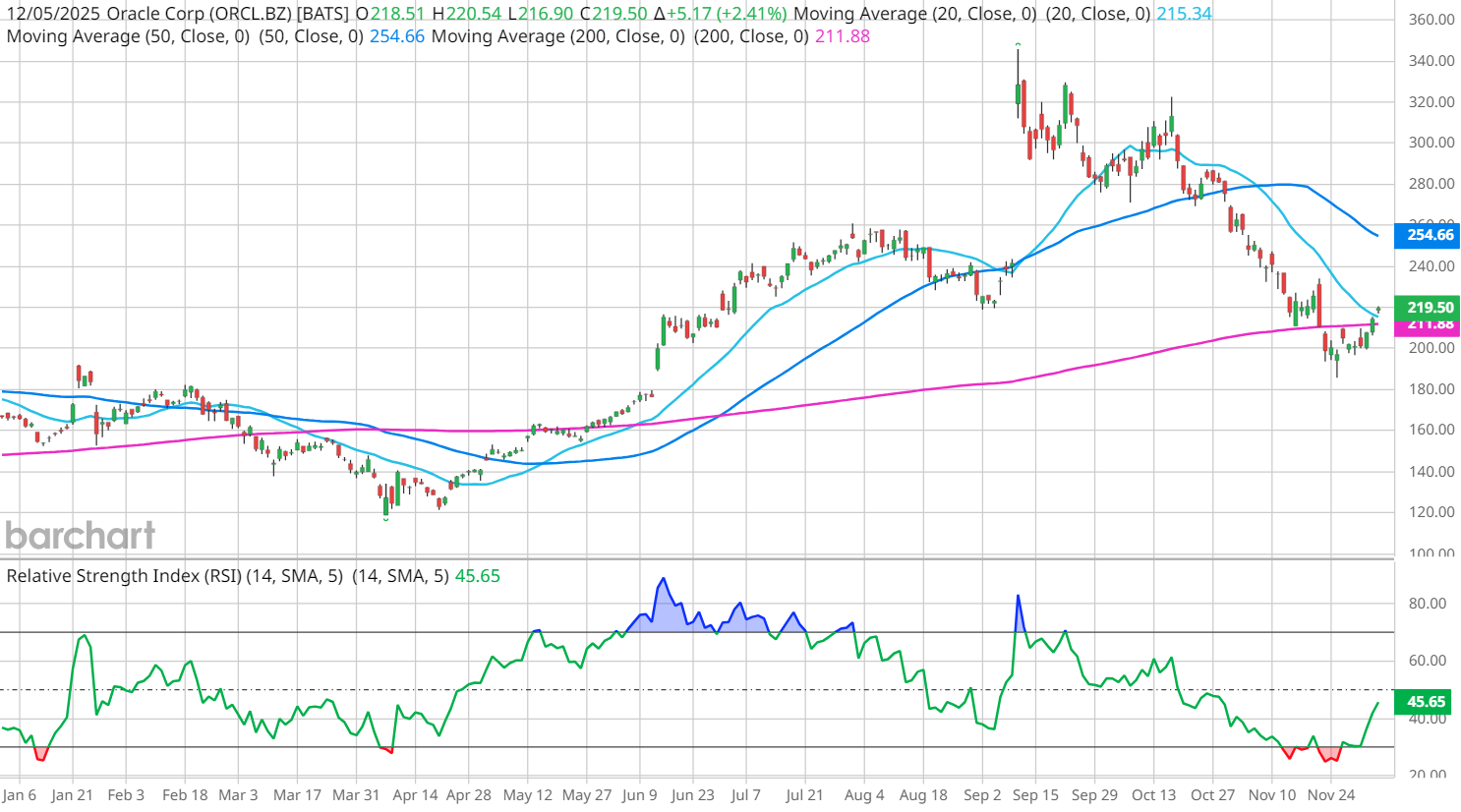
Oracle’s chart reflects the wild volatility in the shares, and a mixed technical picture for the near term. Up 83% from its April lows, Oracle has pulled back by a dizzying 36.8% from its September highs. The stock is attempting to regain a foothold above its 200-day moving average, while its 20-day and 50-day moving averages remain bearishly crossed overhead. The 14-day Relative Strength Index (RSI) is on the rise, but is still below the 50 threshold.
For investors intrigued by the potential upside in Oracle, but understandably wary of the high debt load and extreme stock volatility, John Rowland offers another way to participate in the company’s data center growth story.
The Oracle Pipeline Trade
As Rowland has been tracking for some time now, a largely overlooked investing story for data centers is power – namely, where are they getting it, and is there enough of it? While many hyperscalers are investing in solar farms and nuclear energy with an eye toward the future, there’s one primary energy source that’s available and working in the here and now: natural gas.
Traditionally, midstream energy companies – those that transport gas and oil via pipeline networks – have been considered relatively stable investments. By providing the architecture for transport, they’re one step removed from the daily volatility of energy prices, and are often able to return some of their cash reserves to shareholders, as well.
So it caught Rowland’s attention when Barron’s recently reported that “Energy Transfer… is building natural-gas pipelines to three Oracle data centers, two of which are in Texas.”
Energy Transfer (ET) is a Dallas-based limited partnership that manages about 140,000 miles of pipeline across 44 states, with operations spanning natural gas (NGF26), crude oil (CLF26), and natural gas liquids (NGLs). Like most other midstream stocks, ET has underperformed the broader market this year, keeping pace with softness in energy prices.
But for investors seeking lower risk, upside potential, and steady passive income, ET is worth a look as a “side trade” on the AI theme, says Rowland:
“What makes this interesting is that ET's Chair recently bought 4 million shares worth $67 million over two purchases,” notes Rowland. “This stock has been one of my largest energy holdings, and I have been fist-pounding that pipeline infrastructure is the weak link in the AI power story.”
He adds, as a caveat, that Energy Transfer is an MLP, and might not be suitable for every investor (particularly if you don’t have an accountant to handle your K1 forms!).
“But my second favorite in this space, Kinder Morgan (KMI), is not,” says Rowland. “The pipeline business is boring, and it's not a high-flier sector like AI stocks. Still, if we are heading into a period of low growth and recessionary concerns, companies like ET (7.8%) and KMI (4.2%) pay some pretty hefty dividends.”
Bonus: Watch This Chart for a Breakout
Looking north of the border, there’s also TC Energy (TRP), with a 4.4% yield.
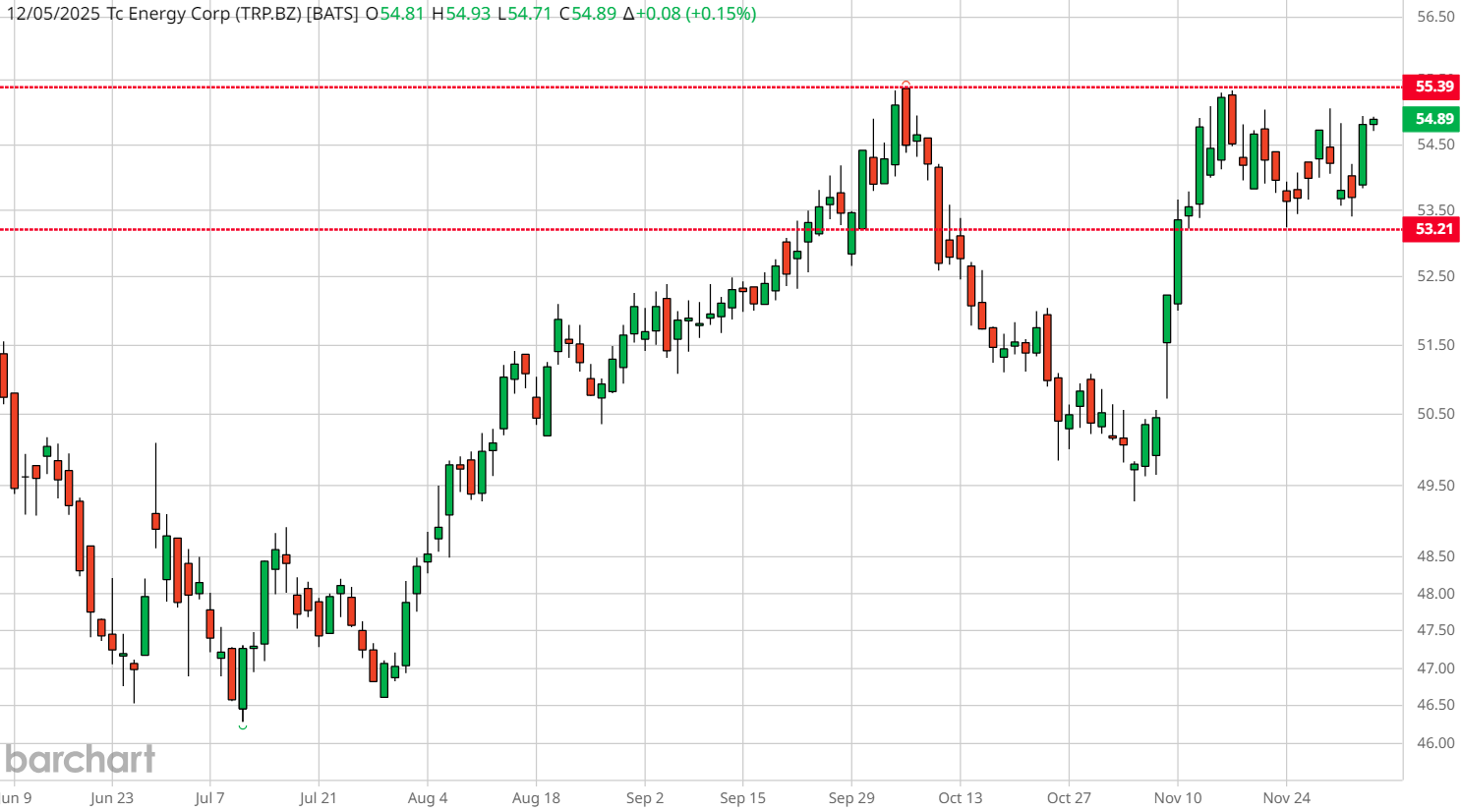
“That stock chart looks stronger than the previous two; it has been knocking on the $55 all-time high (ATH) ceiling,” says Rowland. “But it looks like a cup-and-handle pattern – meaning a relatively low risk to $53, the low of the handle.”
For more from Rowland on trading cup and handle patterns, check out this lesson.
On the date of publication, Elizabeth H. Volk had a position in: AMD , NVDA . All information and data in this article is solely for informational purposes. For more information please view the Barchart Disclosure Policy here.
More news from Barchart