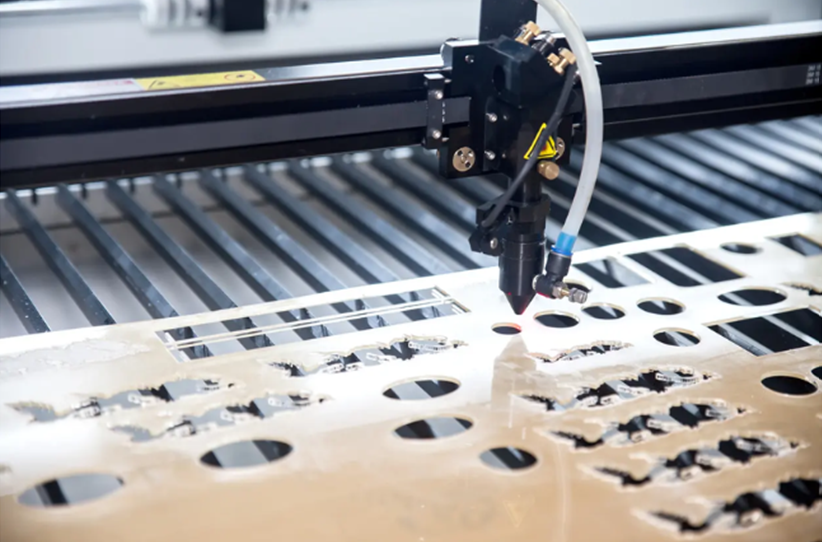
Laser cutting PEEK material
Due to the unique properties of the material, precision PEEK cutting is a specialised process that requires meticulous attention to detail. PEEK is a high-performance thermoplastic that is perfect for crucial applications in the automotive, aerospace, medical, and industrial sectors because of its exceptional mechanical strength, chemical resistance, thermal stability and excellent peek machinability.
High tensile strength, stiffness, and fatigue resistance are just a few of the exceptional mechanical qualities of PEEK materials that contribute to superior peek machinability.. Because of these qualities, for precision parts produced through peek machining that need to be reliable and durable in harsh environments.
PEEK is extensively utilized in industries that require precision, such as aerospace, electronics, automotive, and medical devices, where peek machining delivers high-quality results. Professional laser cutting service enables clean cuts, intricate shapes, and incredibly precise components, which are often lacking in traditional PEEK machining, and it can be challenging to achieve.
What Is PEEK Material?
Polyether Ether Ketone, or PEEK, is a high-performance engineering thermoplastic that is renowned for its remarkable strength, heat resistance, and chemical stability, as well as its exceptional resistance to harsh chemicals.
It is heavily used in industries like electronics, automotive, medical, and aerospace that need high-temperature, dependable, and long-lasting materials. It provides resistance to hydrolysis in water, steam, and saltwater.
Advantages of Laser Cutting PEEK
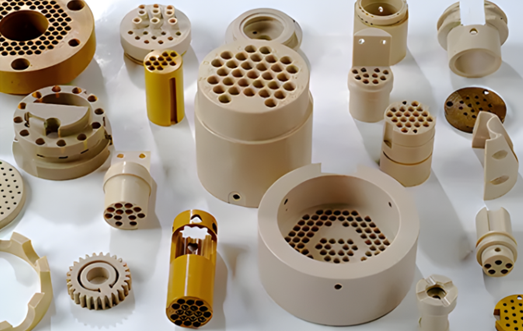
Various PEEK components
Industrial machinery components that need to have precise dimensions, high wear resistance, and low friction can use laser-cut or peek machining parts. Gears benefit from PEEK's remarkable strength and durability, while bearings and slides benefit from its high wear resistance and low friction.
High Accuracy and Precision: Laser cutting enables incredibly close tolerances, producing sharp, clean edges free of mechanical errors. Ideal for intricate, small, or detailed parts produced with peek plastic precision machining.
Non-Contact Process: Since there is no physical blade contact, there is no chipping or roughness, and less post-processing is required because the cuts are polished and clean, making it perfect for delicate or thin PEEK parts.
Ideal for Complicated Shapes: Cuts complex patterns, micro-features, small holes, and unique geometry with ease, complementing capabilities of peek plastic precision machining.
No Material Contamination: The absence of oils, lubricants, or mechanical debris preserves PEEK's purity, which is crucial for electronic and medical applications.
Works Well for Different Grades of PEEK: All can be cut efficiently with laser systems.
Unfilled PEEK
Glass-filled PEEK
Carbon-fiber-filled PEEK
What is the Laser Cutting PEEK Process?
Preparing the PEEK sheet, importing the part design into a laser-cutting system, and adjusting power, speed, and focus according to material thickness are all necessary steps in laser cutting PEEK.
While assist gases help remove residue and cool the surface, a concentrated laser beam melts or vaporizes the PEEK along the programmed path during cutting.
The non-contact method produces precise, smooth edges with minimal heat-affected areas. After cutting, the parts are quickly cooled, checked for quality, and, if necessary, lightly cleaned.
This method offers excellent precision, clean edges, and minimal post-processing, making it ideal for complex or high-performance PEEK components.
Laser Cutting PEEK Method Comparison
Compared to conventional cutting techniques, laser cutting PEEK offers several advantages. Laser cutting is a non-contact method that avoids contamination, material deformation, and tool wear, in contrast to CNC machining, which uses physical tools to cut the material.
While CNC machining works better for thicker or three-dimensional parts, laser cutting offers greater accuracy, particularly for complex shapes, micro-features, and thin PEEK sheets.
Waterjet cutting works better when heat must be avoided entirely, but laser cutting produces smoother, cleaner edges and prevents moisture absorption.
Laser cutting can handle complex geometries with more accuracy and less setup time than die cutting, which can be used for mass production but is restricted to simple shapes.
All things considered, laser cutting is notable for its accuracy, edge quality, speed, and capacity to create intricate and superior PEEK components with little finishing.
PEEK Laser-Cut Medical Parts
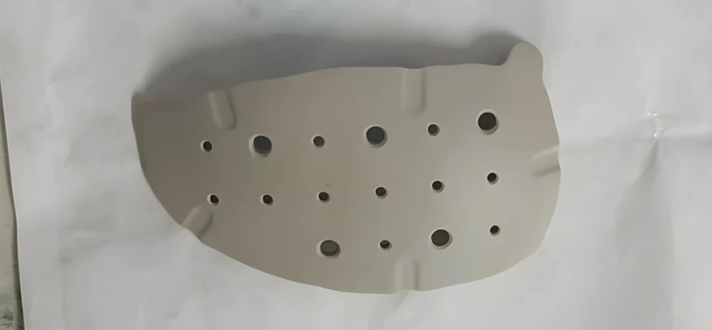
Beige PEEK machined part
Laser-cut PEEK is frequently utilized in medical applications due to its strength, accuracy, and biocompatibility.
It is frequently used to make parts for surgical instruments, implantable devices, orthopedic tools, dental devices, and catheters.
Spacers, fixation plates, catheter rings, microfluidic channels, and medical device housings are just a few of the incredibly precise and smooth-edged components that can be made with laser cutting.
It is ideal for components that need to be dependable, safe, and suitable for repeated sterilization because it is non-contact and clean, preventing contamination and maintaining the material's integrity.
Laser-cut PEEK is an excellent option for intricate, high-performance medical components.
Role of PEEK in Modern Engineering Applications
Diversity in engineering applications calls for materials that can perform optimally over a wide range of temperature conditions. One such material bearing the benefit of being a lightweight polymer in addition to bearing good properties at high and broad temperature ranges is Polyetheretherketone (PEEK).
In multiple domains of engineering, PEEK is used to achieve performance and demanding applications similar to those delivered by metals. Multiple applications demanding long-term pressure and wear excellent resistance, along with tensile strength with high performance, such as those in the oil and gas industry, can leverage all of the potential benefits that PEEK materials have to offer.
PEEK components are widely used in applications such as aerospace, automotive, electronics, and medical industries when traditional plastics are not enough. High-performance PEEK components include gears, bearings, seals, structural brackets, electrical insulators, and precision connectors.
PEEK is resistant to wear and corrosion while also maintaining its properties at high temperatures. It is ideal for making lightweight, durable, and long-lasting components needed in cutting-edge engineering applications.
Machining vs Laser Cutting
Both technologies overlap in many of the materials they can cut, although the process is completely different. The differences between each are more apparent in the following factors:
Heat Affect: PEEK laser cutting does not induce any heat affect, nor does it for any materials cut in the process. However, PEEK laser cutting can have a heat effect, and the most common is carbon residue. This can discolor the cutting edge and may require additional cleaning.
Feature size: Laser cutting of PEEK or other materials will have options for smaller features, such as holes and radius cuts, due to a smaller cutting tool of .001” inches. Waterjet cutting has nozzle sizes as low as .004” inches.
Material thickness: Waterjet cutting has a larger range of cutting thickness of materials as opposed to laser cutting, and can cut up to 12 inches of thick materials. However, laser cutting does have the ability to cut thinner gauges of materials, starting from 0.0005” of an inch up to 0.160”, depending on the laser system.
Geometry profiles: Waterjet cutting can produce accurate 3D parts and components, while laser technology is used primarily to create flat 2D profiles.
Waste: Waterjet cutting will have more cleanup of debris and abrasive particulates, while laser technology does not produce large amounts of debris and does not require extensive cleaning between project runs.
Engraving: Waterjet cutting cannot engrave on the surface, while laser cutting can engrave and cut through.
When choosing between waterjet and laser cutting for your next project, it's essential to consider how each technology differs and what will yield the desired results. There will ultimately be differences that impact throughput and cost.
Conclusion
PEEK materials offer outstanding performance in extreme conditions, making these materials some of the best-performing thermoplastics in the world. They offer strength, stiffness, long-term fatigue, and other properties that set them apart from other materials.
PEEK is a well-known polymer biomaterial. Due to its excellent biomechanical properties, it is often used as a substitute for metal implants in orthopedic applications. As an emerging medical application of PEEK materials, the PEEK membrane has broad prospects. The application of PEEK in the field of orthopedic implants has attracted more and more attention.
All things considered, PEEK's advanced material properties can be fully utilized by manufacturers through laser cutting to create dependable, high-quality components.