News Source: Citizens Commission on Human Rights
LOS ANGELES, Calif., Nov. 17, 2025 (SEND2PRESS NEWSWIRE) — A groundbreaking Karolinska Institutet study, published in The Lancet Regional Health – Europe, found that individuals subjected to involuntary psychiatric hospitalization faced a markedly elevated risk of suicide after discharge.[1] The mental-health industry watchdog Citizens Commission on Human Rights International (CCHR) says the findings add to extensive evidence that coercive detainment and treatment—now being promoted for homelessness in the U.S.—is unworkable, unsafe, and can endanger lives.
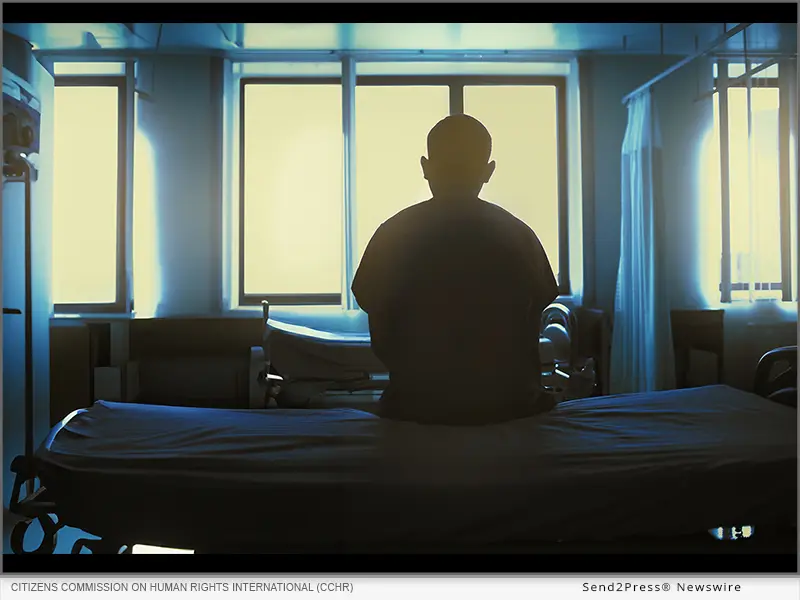
Image caption: Image caption: As the U.S. considers policies to forcibly detain the homeless and others in psychiatric institutions, a new study shows people subjected to involuntary psychiatric hospitalization face a dramatically higher suicide risk and human rights violations.
One in 64 Discharges Ends in Suicide
The population-based Swedish study analyzed 72,275 people discharged from involuntary psychiatric care between 2010 and 2020, covering 134,514 inpatient episodes for patients aged six to 101. Over a median follow-up of 4.4 years, 2,104 individuals (2.9%) died by suicide—roughly one suicide for every 64 discharges. Of these, 38 (1·8%) died during hospitalization.[2]
Lead author Leoni Grossmann, a doctoral student at Karolinska’s Department of Clinical Neuroscience, reported that suicide risk was highest during the first month after discharge and remained elevated for years. Over five years, suicide risk was 1.6 times higher than for all psychiatric inpatients and nearly four times higher than for psychiatric outpatients. “Among other things, the results also show that involuntary treatment is a risk marker for suicide,” says John Wallert, one of the study’s principal investigators.[3]
U.S. Studies Show the Same Pattern
Each year, an estimated 1.2 million Americans are involuntarily hospitalized for psychiatric reasons. A July 2025 U.S. study found these individuals were nearly twice as likely to die by suicide or overdose within just three months of release.[4] A 2017 JAMA Psychiatry meta-analysis further confirmed that suicide risk is 100 times greater than the global suicide rate during the first three months after psychiatric discharge.[5]
A 2023 Congressional report warned that involuntary commitment may violate Fourteenth Amendment due-process protections, stating:
“Courts have recognized and applied due process rights when persons face deprivations of liberty and property due to their mental health status, particularly in the context of involuntary hospitalization.”
The report recommended expanding federal statutes protecting institutionalized individuals from physical or mental abuse, corporal punishment, and restraints imposed for convenience.[6] CCHR says Congress should go further—penalizing facilities that violate these rights by cutting off Medicare and Medicaid funding.
In August 2025, researchers at the University of Manizales (Colombia), led by Felipe Agudelo Hernández, also found that coercive psychiatric interventions—such as forced drugging, seclusion, and restraint—worsen recovery outcomes for those who have attempted suicide. The study concluded that coercion remains “common” and reflects systems that contradict human-rights principles and impede recovery.[7]
CCHR says these international findings strengthen the case for implementing World Health Organization (WHO) and United Nations (UN) guidance calling for an end to coercive psychiatric practices and a transition to voluntary, rights-based services.
Tragic U.S. Cases Reveal the Human Cost
Once confined, individuals often face inhumane conditions. In March 2024, Kenneth Hass, 25, died after months in seclusion at Oregon State Hospital. Federal inspectors found staff failed to clean his isolation cell, document restraints, or respond promptly when he collapsed. He lay motionless for over four minutes before staff entered—by then, he had no pulse. His sister has called for accountability.[8]
In Michigan, State Senator Michael Webber requested an audit after parents reported filthy conditions, lack of food, and abuse in public psychiatric facilities. The audit uncovered serious neglect, including delayed responses to nearly 30% of abuse complaints and broken video-monitoring systems.[9]
In Texas, investigators cited Laurel Ridge Treatment Center, operated by a subsidiary of Universal Health Services (UHS), for “immediate danger” to patients stemming from staffing shortages and safety violations. UHS operates hundreds of behavioral hospitals across the U.S. and U.K. and has come under close government and U.S. Department of Justice investigation over conditions in its behavioral facilities.[10]
“These are only a few of the alarming reports emerging nationwide,” said Jan Eastgate, president of CCHR International. “They demonstrate why forced detainment and treatment do not protect vulnerable people—they harm them.”
Punitive Approach to Homelessness
CCHR warns that psychiatric associations and some policymakers are reviving coercive approaches under the guise of addressing homelessness. Estimates suggest 183,000 homeless individuals could be labeled mentally ill and institutionalized, at an annual cost exceeding $1.28 billion—without evidence of improved outcomes.[11]
“We cannot solve social crises with incarceration disguised as treatment,” Eastgate said. “Resources should go toward housing and non-psychiatric medical treatment and support—not expanding psychiatric detention wards or forced community mental health treatment.”
CCHR, which was established in 1969 by the Church of Scientology and eminent professor of psychiatry, Dr. Thomas Szasz, has a long history of investigating and exposing involuntary commitment assault on human rights. The group emphasizes that forced psychiatric interventions contravene international law, including the UN Convention on the Rights of Persons with Disabilities (CRPD) and WHO’s Guidance on Mental Health, which urge nations to abolish coercive practices such as involuntary commitment, forced drugging, restraint, and seclusion.
Despite these global directives, coercion continues to escalate in the U.S.—and, as the new Lancet study underscores, may drive suicides rather than prevent them. “Ethically and legally, U.S. health and justice authorities must confront the data,” Eastgate said. “Involuntary psychiatric detainment and treatment have failed as public health strategies and persist as a human rights crisis that costs lives.”
To learn more, visit: https://www.cchrint.org/2025/11/14/study-involuntary-commitment-fails-to-prevent-suicide/
Sources:
[1] “Elevated Suicide Risk Following Involuntary Psychiatric Treatment: New Findings,” Scienmag, 5 Nov. 2025, https://scienmag.com/elevated-suicide-risk-following-involuntary-psychiatric-treatment-new-findings/
[2] “Suicide after involuntary psychiatric care: a nationwide cohort study in Sweden,” The Lancet Regional Health – Europe, Volume 60, Jan. 2026, https://www.sciencedirect.com/journal/the-lancet-regional-health-europe
[3] “High risk of suicide found after involuntary psychiatric care, especially for young men,” By Karolinska Institutet, Medical Xpress, 5 Nov. 2025, https://medicalxpress.com/news/2025-11-high-suicide-involuntary-psychiatric-young.html#google_vignette
[4] “A Danger to Self and Others: Health and Criminal Consequences of Involuntary Hospitalization,” Federal Reserve Bank of New York Staff Reports, no. 1158, July 2025, https://www.newyorkfed.org/medialibrary/media/research/staff_reports/sr1158.pdf?sc_lang=en
[5] https://jamanetwork.com/journals/jamapsychiatry/fullarticle/2629522
[6] https://www.congress.gov/crs-product/R47571
[7] https://link.springer.com/article/10.1007/s10597-025-01503-7
MULTIMEDIA
Image link for media: https://www.send2press.com/300dpi/25-1117-s2p-cchr-homeless-300dpi.webp
Image caption: As the U.S. considers policies to forcibly detain the homeless and others in psychiatric institutions, a new study shows people subjected to involuntary psychiatric hospitalization face a dramatically higher suicide risk and human rights violations.
This press release was issued on behalf of the news source (Citizens Commission on Human Rights), who is solely responsible for its accuracy, by Send2Press Newswire.
To view the original story, visit: https://www.send2press.com/wire/cchr-new-study-shows-forced-psychiatric-detainment-increases-suicide-risk/
Copr. © 2025 Send2Press® Newswire, Calif., USA. -- REF: S2P STORY ID: S2P131098 FCN24-3B
INFORMATION BELOW THIS PAGE, IF ANY, IS UNRELATED TO THIS PRESS RELEASE.