
Elevator manufacturer Otis (NYSE: OTIS) reported Q4 CY2024 results beating Wall Street’s revenue expectations, with sales up 1.5% year on year to $3.68 billion. On the other hand, the company’s full-year revenue guidance of $14.25 billion at the midpoint came in 2.1% below analysts’ estimates. Its non-GAAP profit of $0.93 per share was 2.8% below analysts’ consensus estimates.
Is now the time to buy Otis? Find out by accessing our full research report, it’s free.
Otis (OTIS) Q4 CY2024 Highlights:
- Revenue: $3.68 billion vs analyst estimates of $3.64 billion (1.5% year-on-year growth, 1% beat)
- Adjusted EPS: $0.93 vs analyst expectations of $0.96 (2.8% miss)
- Adjusted EBITDA: $600 million vs analyst estimates of $646.6 million (16.3% margin, 7.2% miss)
- Management’s revenue guidance for the upcoming financial year 2025 is $14.25 billion at the midpoint, missing analyst estimates by 2.1% and implying -0.1% growth (vs 0.4% in FY2024)
- Adjusted EPS guidance for the upcoming financial year 2025 is $4.05 at the midpoint, missing analyst estimates by 1.8%
- Operating Margin: 14.4%, in line with the same quarter last year
- Free Cash Flow Margin: 17.7%, up from 15.3% in the same quarter last year
- Organic Revenue rose 1.9% year on year (3.8% in the same quarter last year)
- Market Capitalization: $38.3 billion
Company Overview
Credited with inventing the first hydraulic passenger elevator, Otis Worldwide (NYSE: OTIS) is an elevator and escalator manufacturing, installation and service company.
General Industrial Machinery
Automation that increases efficiency and connected equipment that collects analyzable data have been trending, creating new demand for general industrial machinery companies. Those who innovate and create digitized solutions can spur sales and speed up replacement cycles, but all general industrial machinery companies are still at the whim of economic cycles. Consumer spending and interest rates, for example, can greatly impact the industrial production that drives demand for these companies’ offerings.
Sales Growth
A company’s long-term performance is an indicator of its overall quality. While any business can experience short-term success, top-performing ones enjoy sustained growth for years. Over the last five years, Otis grew its sales at a sluggish 1.7% compounded annual growth rate. This fell short of our benchmarks and is a rough starting point for our analysis.
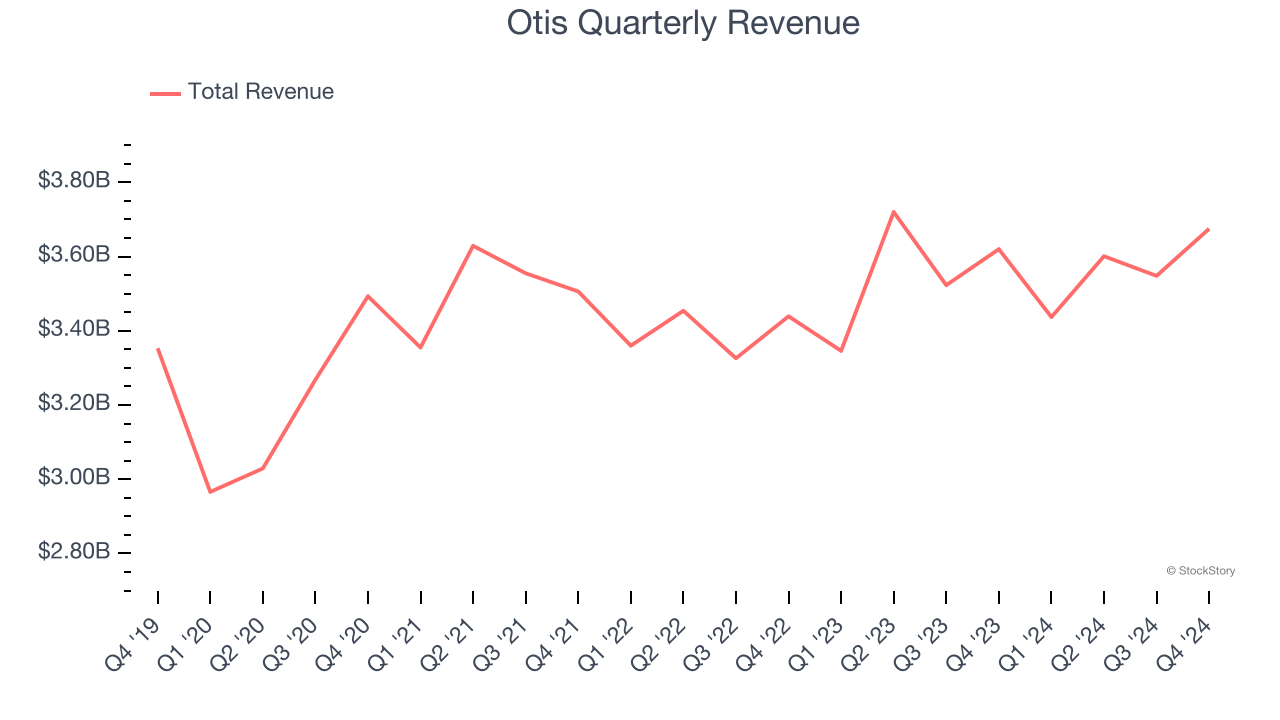
Long-term growth is the most important, but within industrials, a half-decade historical view may miss new industry trends or demand cycles. Otis’s annualized revenue growth of 2.5% over the last two years aligns with its five-year trend, suggesting its demand was consistently weak. 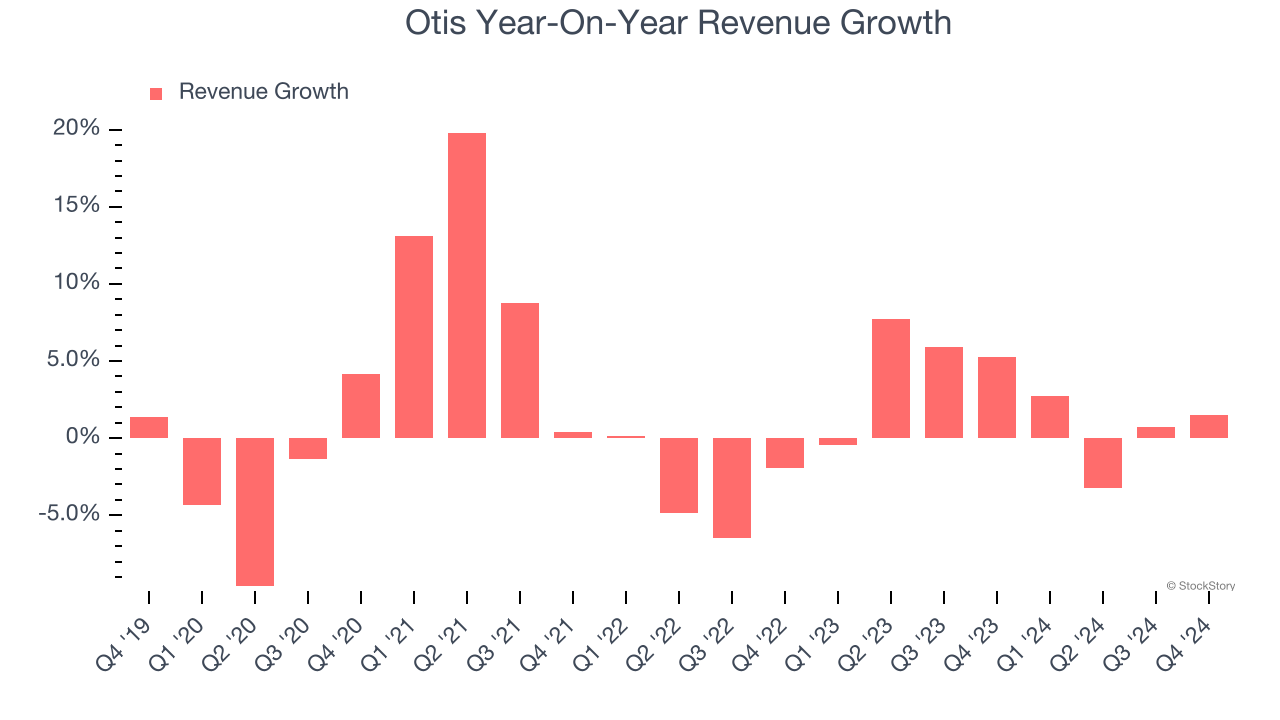
We can dig further into the company’s sales dynamics by analyzing its organic revenue, which strips out one-time events like acquisitions and currency fluctuations because they don’t accurately reflect its fundamentals. Over the last two years, Otis’s organic revenue averaged 3.5% year-on-year growth. Because this number aligns with its normal revenue growth, we can see the company’s core operations (not acquisitions and divestitures) drove most of its results. 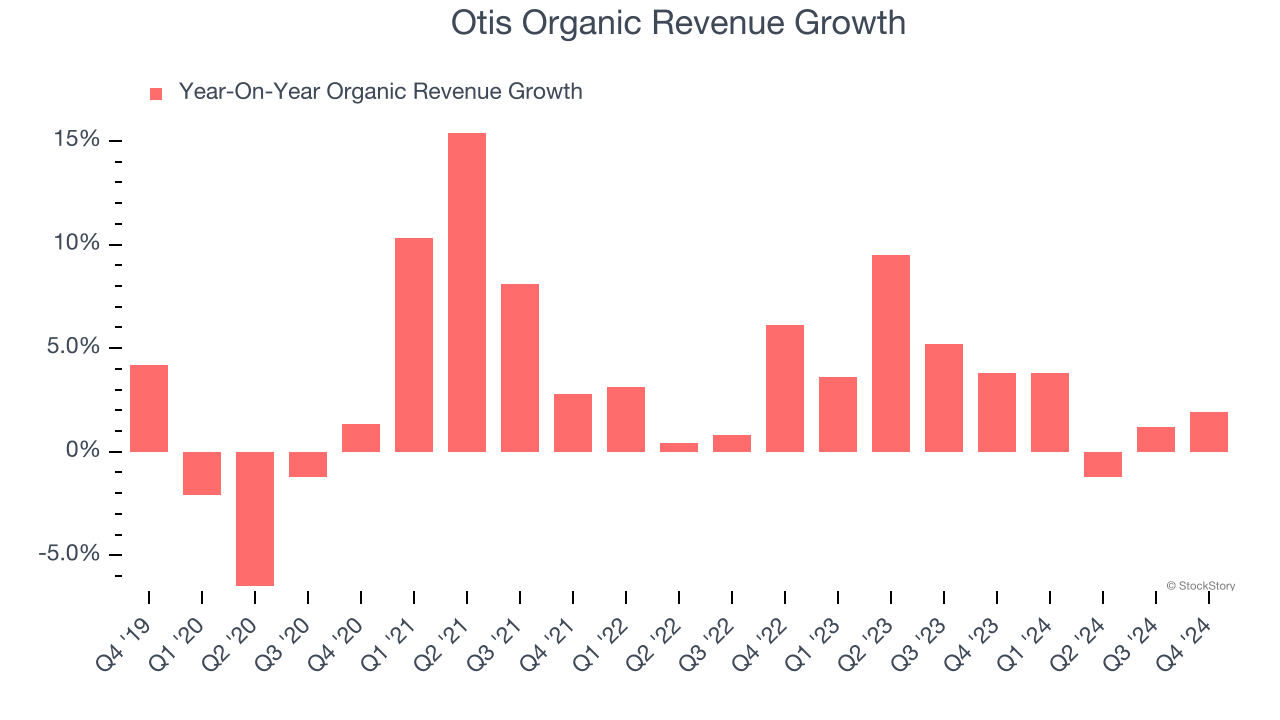
This quarter, Otis reported modest year-on-year revenue growth of 1.5% but beat Wall Street’s estimates by 1%.
Looking ahead, sell-side analysts expect revenue to remain flat over the next 12 months, a slight deceleration versus the last two years. This projection doesn't excite us and suggests its products and services will see some demand headwinds.
Here at StockStory, we certainly understand the potential of thematic investing. Diverse winners from Microsoft (MSFT) to Alphabet (GOOG), Coca-Cola (KO) to Monster Beverage (MNST) could all have been identified as promising growth stories with a megatrend driving the growth. So, in that spirit, we’ve identified a relatively under-the-radar profitable growth stock benefiting from the rise of AI, available to you FREE via this link.
Operating Margin
Operating margin is an important measure of profitability as it shows the portion of revenue left after accounting for all core expenses–everything from the cost of goods sold to advertising and wages. It’s also useful for comparing profitability across companies with different levels of debt and tax rates because it excludes interest and taxes.
Otis has been an optimally-run company over the last five years. It was one of the more profitable businesses in the industrials sector, boasting an average operating margin of 14.5%. This result was particularly impressive because of its low gross margin, which is mostly a factor of what it sells and takes huge shifts to move meaningfully. Companies have more control over their operating margins, and it’s a show of well-managed operations if they’re high when gross margins are low.
Analyzing the trend in its profitability, Otis’s operating margin rose by 1.2 percentage points over the last five years, showing its efficiency has improved.
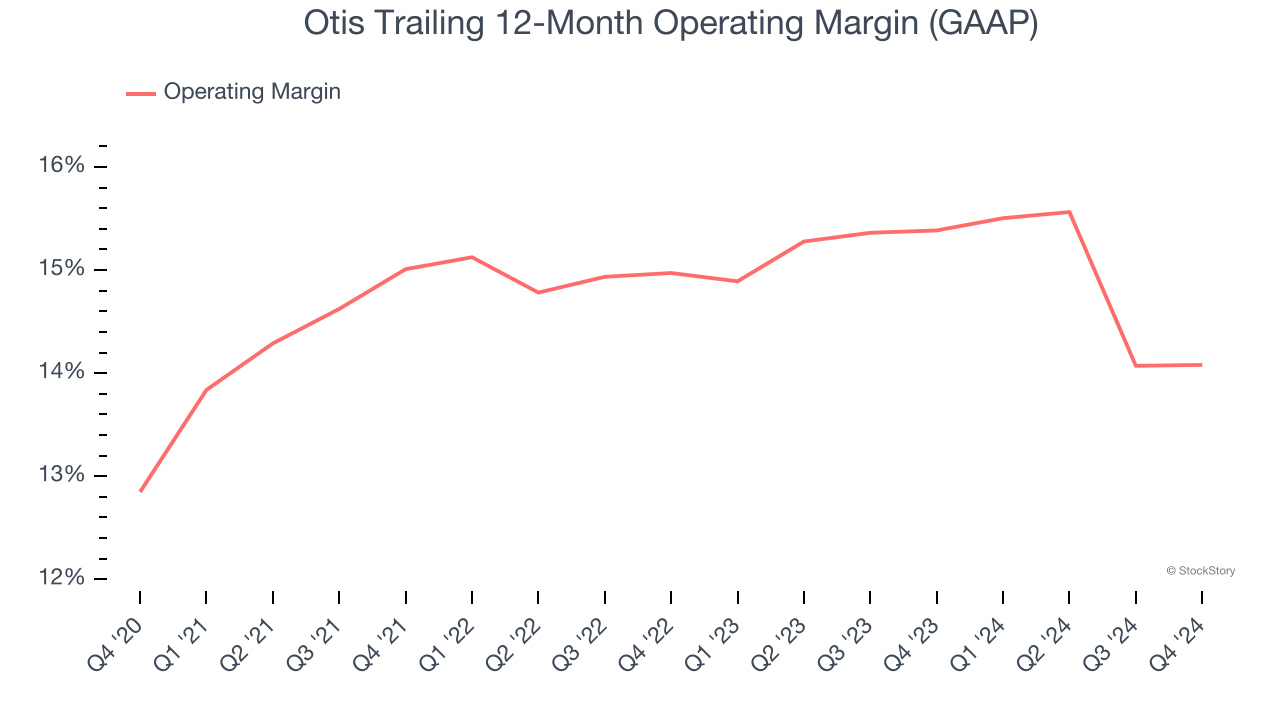
This quarter, Otis generated an operating profit margin of 14.4%, in line with the same quarter last year. This indicates the company’s cost structure has recently been stable.
Earnings Per Share
We track the long-term change in earnings per share (EPS) for the same reason as long-term revenue growth. Compared to revenue, however, EPS highlights whether a company’s growth is profitable.
Otis’s EPS grew at a solid 11.3% compounded annual growth rate over the last five years, higher than its 1.7% annualized revenue growth. This tells us the company became more profitable on a per-share basis as it expanded.
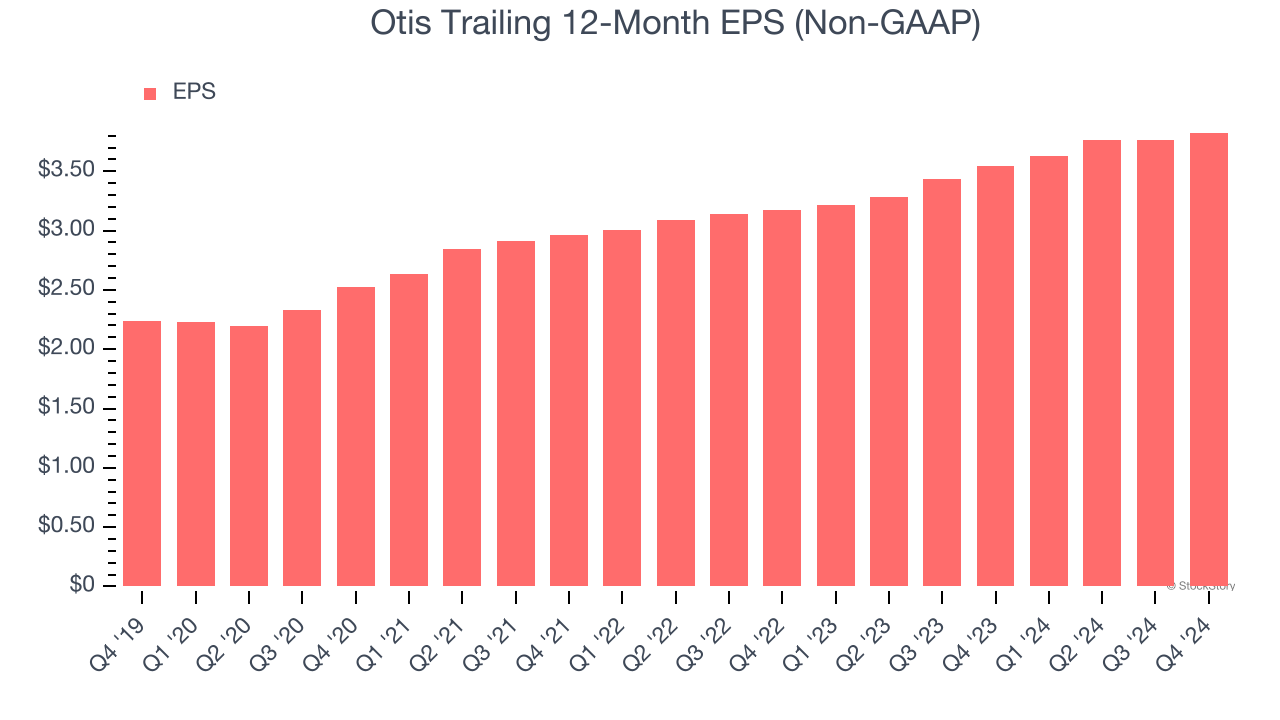
We can take a deeper look into Otis’s earnings quality to better understand the drivers of its performance. As we mentioned earlier, Otis’s operating margin was flat this quarter but expanded by 1.2 percentage points over the last five years. On top of that, its share count shrank by 7.3%. These are positive signs for shareholders because improving profitability and share buybacks turbocharge EPS growth relative to revenue growth. 
Like with revenue, we analyze EPS over a shorter period to see if we are missing a change in the business.
For Otis, its two-year annual EPS growth of 9.8% was lower than its five-year trend. We hope its growth can accelerate in the future.
In Q4, Otis reported EPS at $0.93, up from $0.87 in the same quarter last year. Despite growing year on year, this print missed analysts’ estimates, but we care more about long-term EPS growth than short-term movements. Over the next 12 months, Wall Street expects Otis’s full-year EPS of $3.83 to grow 5.4%.
Key Takeaways from Otis’s Q4 Results
It was good to see Otis narrowly top analysts’ revenue expectations this quarter on slightly better-than-expected organic revenue. On the other hand, its EBITDA missed. Adding to the bad news, its full-year revenue and EPS guidance both fell short of Wall Street’s estimates. Overall, this was a softer quarter. The stock traded down 2.9% to $93.05 immediately after reporting.
Otis’s latest earnings report disappointed. One quarter doesn’t define a company’s quality, so let’s explore whether the stock is a buy at the current price. We think that the latest quarter is only one piece of the longer-term business quality puzzle. Quality, when combined with valuation, can help determine if the stock is a buy. We cover that in our actionable full research report which you can read here, it’s free.