Electronic component provider Littelfuse (NASDAQ: LFUS) met Wall Streets revenue expectations in Q3 CY2025, with sales up 10.1% year on year to $624.6 million. On the other hand, next quarter’s revenue guidance of $580 million was less impressive, coming in 1.7% below analysts’ estimates. Its non-GAAP profit of $2.95 per share was 5.5% above analysts’ consensus estimates.
Is now the time to buy Littelfuse? Find out by accessing our full research report, it’s free for active Edge members.
Littelfuse (LFUS) Q3 CY2025 Highlights:
- Revenue: $624.6 million vs analyst estimates of $621.9 million (10.1% year-on-year growth, in line)
- Adjusted EPS: $2.95 vs analyst estimates of $2.80 (5.5% beat)
- Adjusted EBITDA: $134.3 million vs analyst estimates of $129.5 million (21.5% margin, 3.7% beat)
- Revenue Guidance for Q4 CY2025 is $580 million at the midpoint, below analyst estimates of $589.7 million
- Adjusted EPS guidance for Q4 CY2025 is $2.50 at the midpoint, below analyst estimates of $2.63
- Operating Margin: 15.6%, in line with the same quarter last year
- Free Cash Flow Margin: 0%, down from 11.5% in the same quarter last year
- Market Capitalization: $6.51 billion
“We are pleased with our third quarter performance as we delivered strong revenue growth versus the prior year while our adjusted diluted earnings exceeded the high end of our guidance range reflecting solid execution amid mixed end market conditions,” said Greg Henderson, Littelfuse President and Chief Executive Officer.
Company Overview
The developer of the first blade-type automotive fuse, Littelfuse (NASDAQ: LFUS) provides electrical protection and control components for the automotive, industrial, electronics, and telecommunications industries.
Revenue Growth
Reviewing a company’s long-term sales performance reveals insights into its quality. Any business can have short-term success, but a top-tier one grows for years. Thankfully, Littelfuse’s 10.9% annualized revenue growth over the last five years was impressive. Its growth beat the average industrials company and shows its offerings resonate with customers.
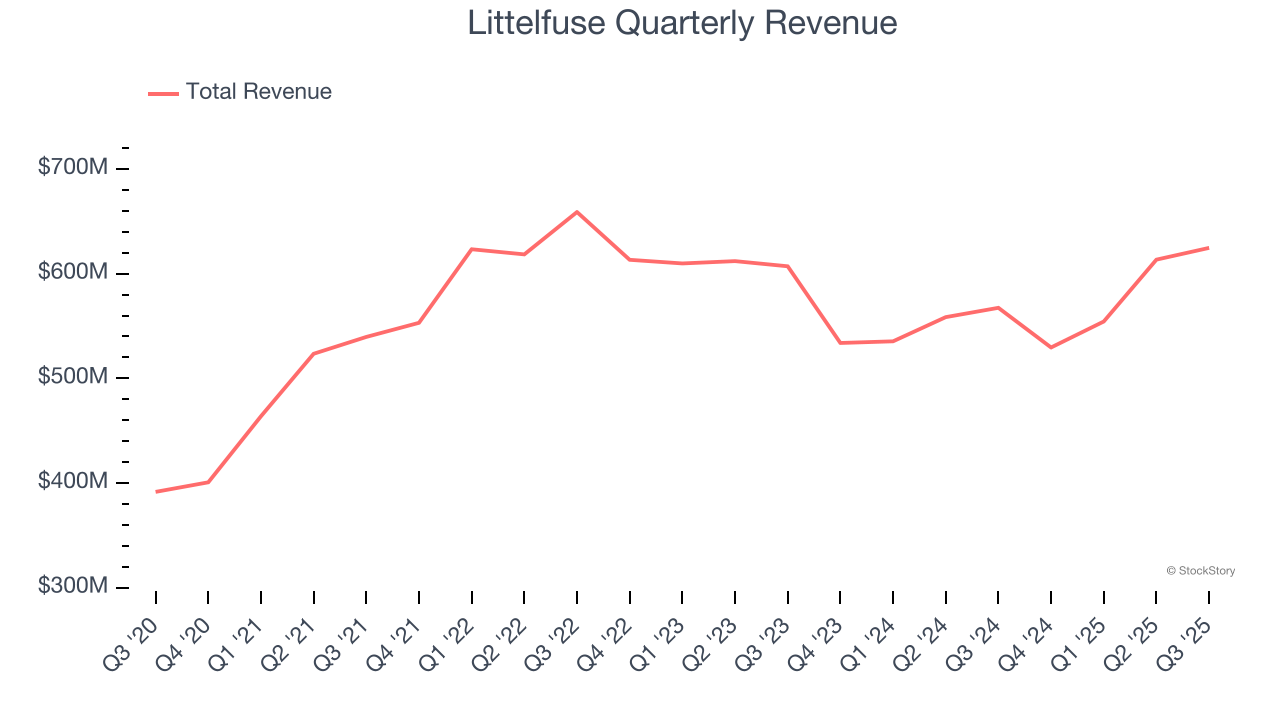
We at StockStory place the most emphasis on long-term growth, but within industrials, a half-decade historical view may miss cycles, industry trends, or a company capitalizing on catalysts such as a new contract win or a successful product line. Littelfuse’s recent performance marks a sharp pivot from its five-year trend as its revenue has shown annualized declines of 2.5% over the last two years. Littelfuse isn’t alone in its struggles as the Electronic Components industry experienced a cyclical downturn, with many similar businesses observing lower sales at this time. 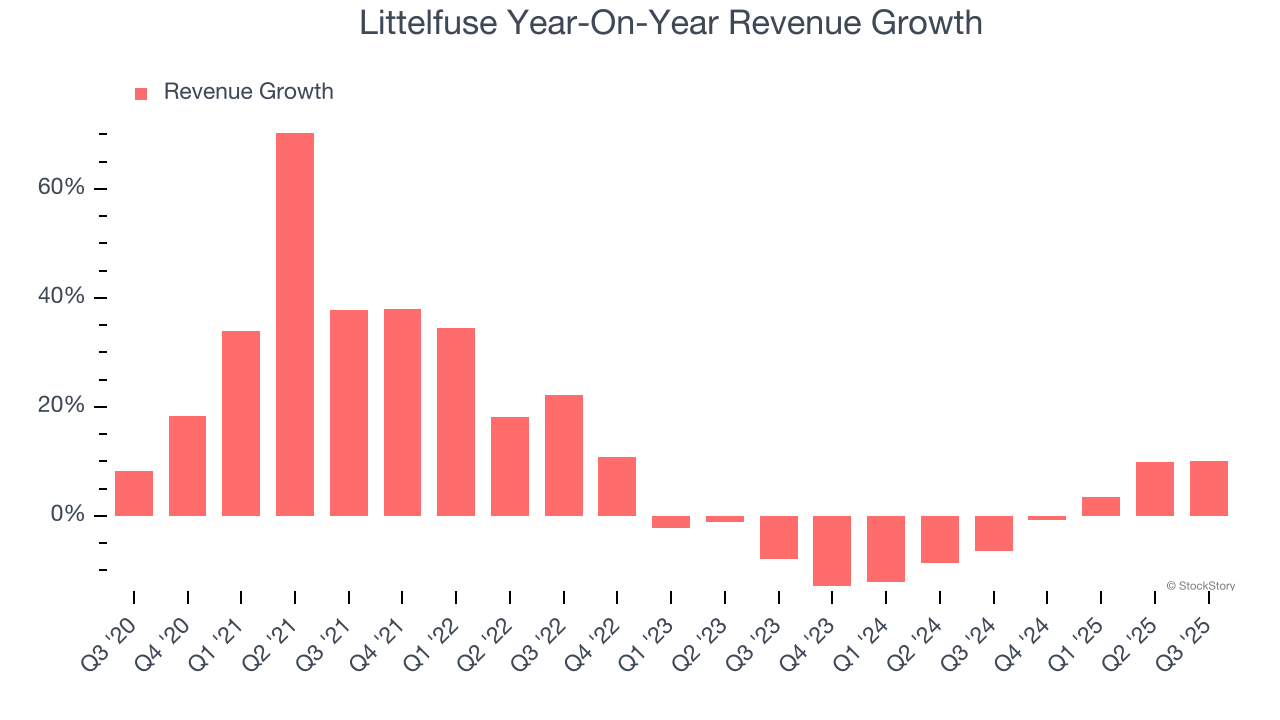
We can better understand the company’s revenue dynamics by analyzing its most important segments, Electronics and Automotive, which are 57.2% and 27.4% of revenue. Over the last two years, Littelfuse’s Electronics revenue (fuses and switches) averaged 4.2% year-on-year declines while its Automotive revenue (trucks, commercial machinery, marine) was flat. 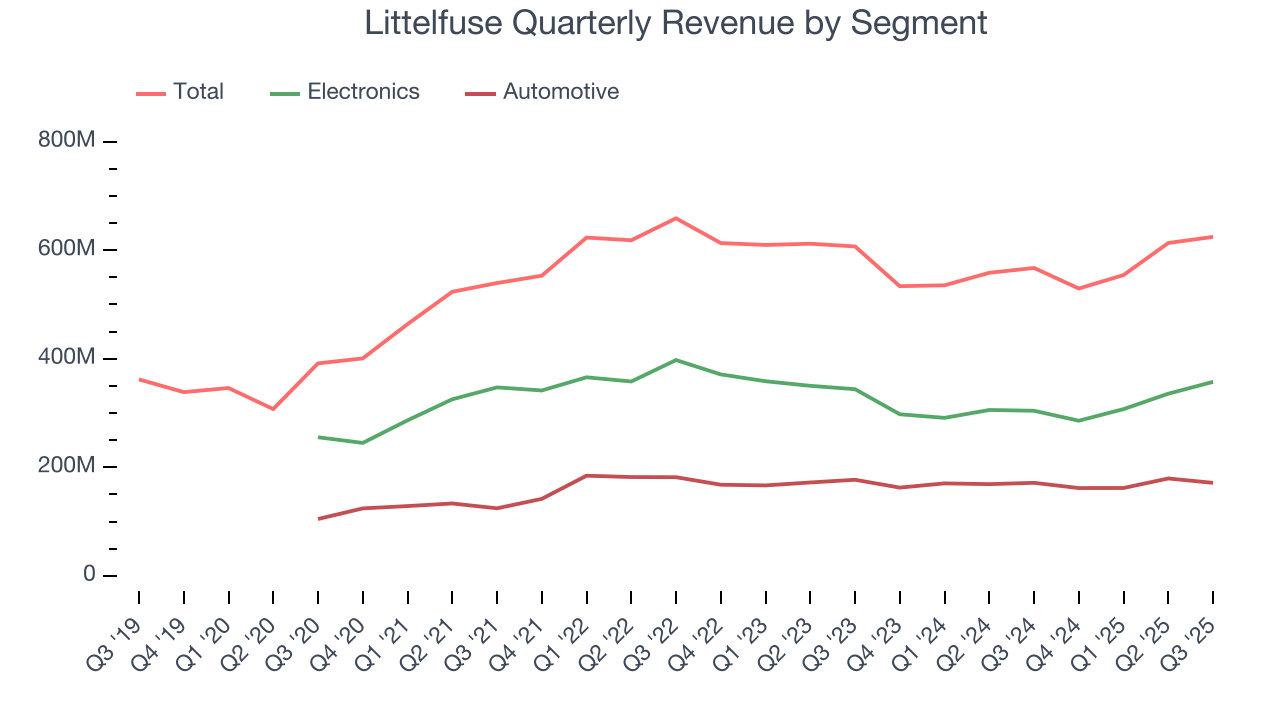
This quarter, Littelfuse’s year-on-year revenue growth was 10.1%, and its $624.6 million of revenue was in line with Wall Street’s estimates. Company management is currently guiding for a 9.5% year-on-year increase in sales next quarter.
Looking further ahead, sell-side analysts expect revenue to grow 9.4% over the next 12 months, an improvement versus the last two years. This projection is noteworthy and indicates its newer products and services will spur better top-line performance.
Unless you’ve been living under a rock, it should be obvious by now that generative AI is going to have a huge impact on how large corporations do business. While Nvidia and AMD are trading close to all-time highs, we prefer a lesser-known (but still profitable) stock benefiting from the rise of AI. Click here to access our free report one of our favorites growth stories.
Operating Margin
Littelfuse has been an efficient company over the last five years. It was one of the more profitable businesses in the industrials sector, boasting an average operating margin of 15.4%. This result isn’t surprising as its high gross margin gives it a favorable starting point.
Analyzing the trend in its profitability, Littelfuse’s operating margin decreased by 8.9 percentage points over the last five years. This raises questions about the company’s expense base because its revenue growth should have given it leverage on its fixed costs, resulting in better economies of scale and profitability.
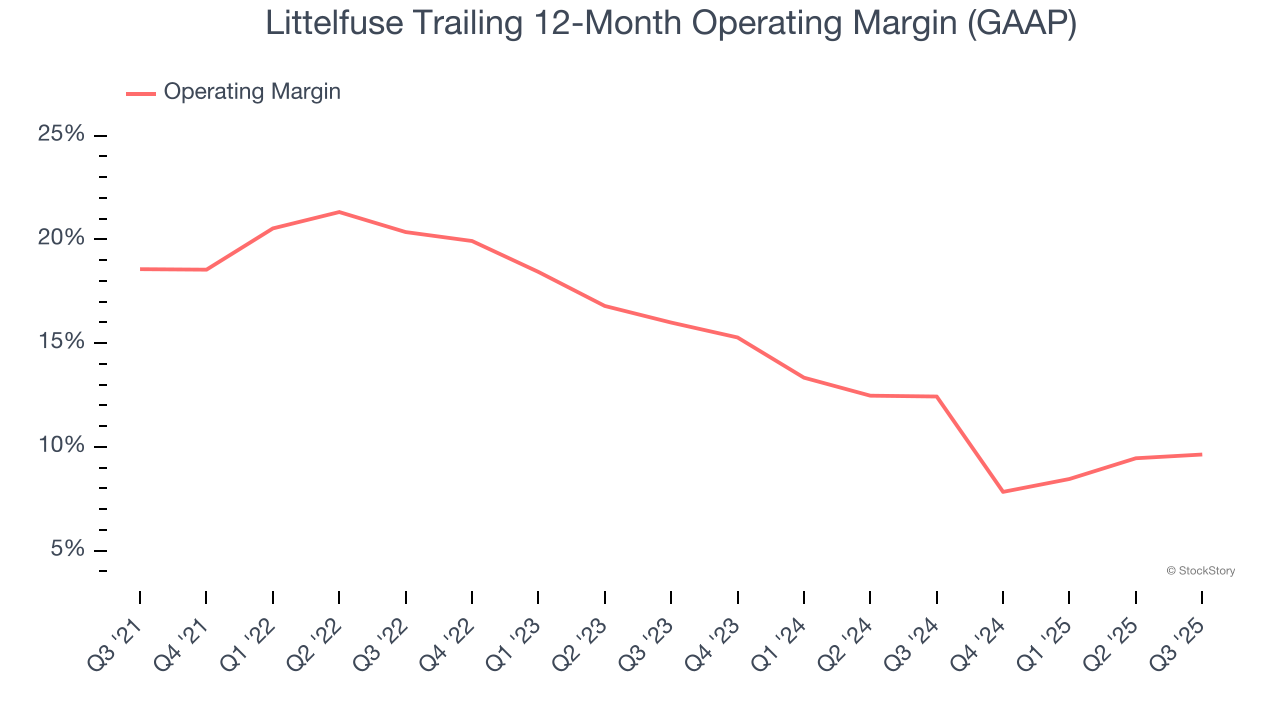
This quarter, Littelfuse generated an operating margin profit margin of 15.6%, in line with the same quarter last year. This indicates the company’s cost structure has recently been stable.
Earnings Per Share
We track the long-term change in earnings per share (EPS) for the same reason as long-term revenue growth. Compared to revenue, however, EPS highlights whether a company’s growth is profitable.
Littelfuse’s EPS grew at a remarkable 13.5% compounded annual growth rate over the last five years, higher than its 10.9% annualized revenue growth. However, we take this with a grain of salt because its operating margin didn’t improve and it didn’t repurchase its shares, meaning the delta came from reduced interest expenses or taxes.
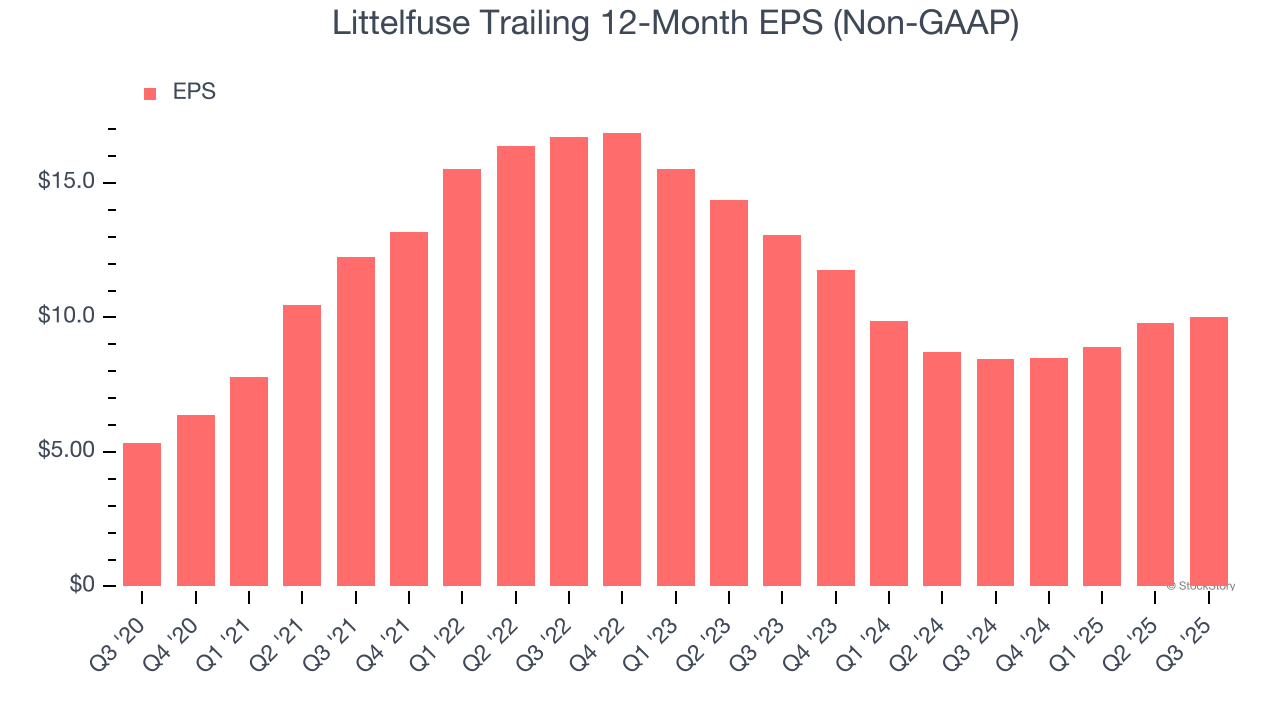
Like with revenue, we analyze EPS over a more recent period because it can provide insight into an emerging theme or development for the business.
For Littelfuse, its two-year annual EPS declines of 12.4% mark a reversal from its (seemingly) healthy five-year trend. We hope Littelfuse can return to earnings growth in the future.
In Q3, Littelfuse reported adjusted EPS of $2.95, up from $2.71 in the same quarter last year. This print beat analysts’ estimates by 5.5%. Over the next 12 months, Wall Street expects Littelfuse’s full-year EPS of $10.03 to grow 20.4%.
Key Takeaways from Littelfuse’s Q3 Results
Revenue was just in line. Looking forward, revenue and EPS guidance for next quarter both fell short. Overall, it was a weak quarter. The stock traded down 3% to $254.48 immediately after reporting.
Should you buy the stock or not? We think that the latest quarter is only one piece of the longer-term business quality puzzle. Quality, when combined with valuation, can help determine if the stock is a buy. We cover that in our actionable full research report which you can read here, it’s free for active Edge members.