
Regional bank holding company CVB Financial (NASDAQ: CVBF) missed Wall Street’s revenue expectations in Q2 CY2025, with sales flat year on year at $126.4 million. Its GAAP profit of $0.36 per share was 3.4% above analysts’ consensus estimates.
Is now the time to buy CVB Financial? Find out by accessing our full research report, it’s free.
CVB Financial (CVBF) Q2 CY2025 Highlights:
- Net Interest Income: $111.6 million vs analyst estimates of $114 million (flat year on year, 2.1% miss)
- Net Interest Margin: 3.3% vs analyst estimates of 3.4% (26 basis point year-on-year increase, 4.3 bps miss)
- Revenue: $126.4 million vs analyst estimates of $128 million (flat year on year, 1.3% miss)
- Efficiency Ratio: 45.6% vs analyst estimates of 45.8% (0.3 percentage point beat)
- EPS (GAAP): $0.36 vs analyst estimates of $0.35 (3.4% beat)
- Market Capitalization: $2.87 billion
David Brager, President and Chief Executive Officer of Citizens Business Bank, commented, “Citizens Business Bank’s performance in the second quarter demonstrates our continued financial strength and focus on our vision of serving the comprehensive financial needs of small to medium sized businesses and their owners. Our consistent financial performance is highlighted by our 193 consecutive quarters, or more than 48 years, of profitability, and our 143 consecutive quarters of paying cash dividends. I would like to thank our customers and associates for their continuing commitment and loyalty.”
Company Overview
With roots dating back to 1974 and a focus on serving small and medium-sized businesses, CVB Financial (NASDAQ: CVBF) operates Citizens Business Bank, providing banking, lending, and trust services to businesses and individuals across California.
Sales Growth
Net interest income and and fee-based revenue are the two pillars supporting bank earnings. The former captures profit from the gap between lending rates and deposit costs, while the latter encompasses charges for banking services, credit products, wealth management, and trading activities.
Over the last five years, CVB Financial grew its revenue at a tepid 1.3% compounded annual growth rate. This was below our standards and is a poor baseline for our analysis.
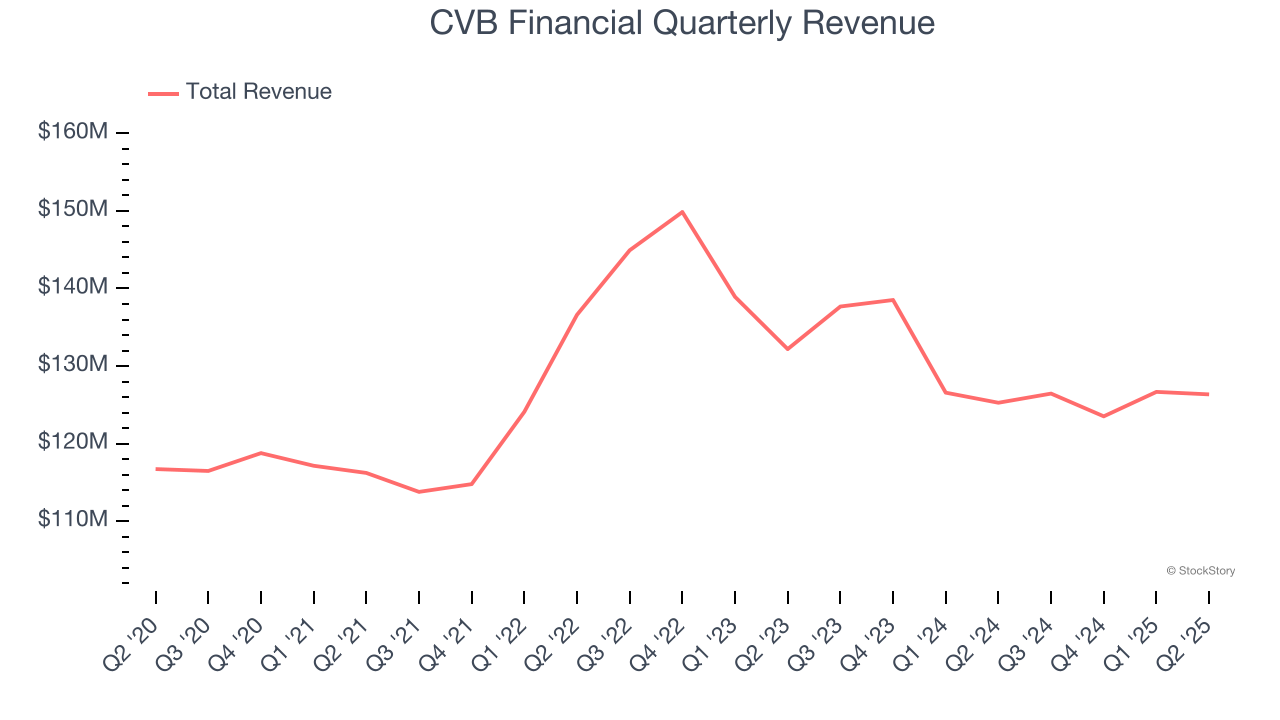
Long-term growth is the most important, but within financials, a half-decade historical view may miss recent interest rate changes and market returns. CVB Financial’s performance shows it grew in the past but relinquished its gains over the last two years, as its revenue fell by 5.7% annually. 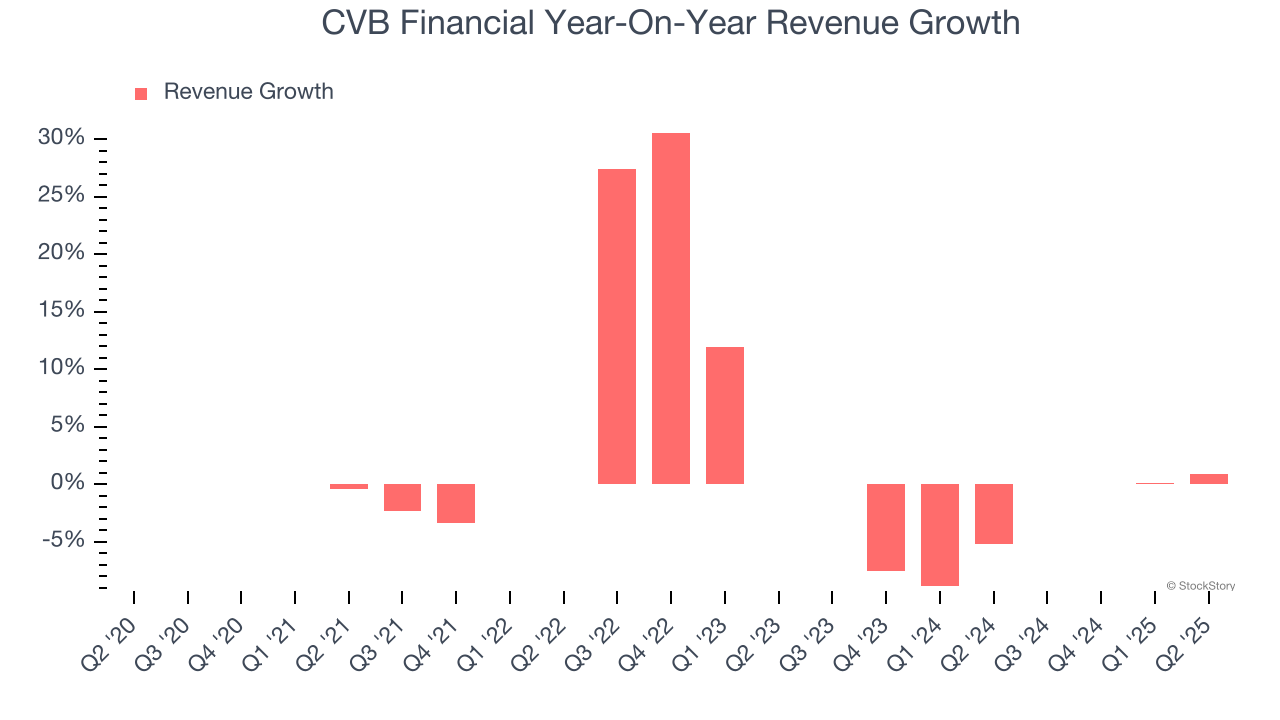 Note: Quarters not shown were determined to be outliers, impacted by outsized investment gains/losses that are not indicative of the recurring fundamentals of the business.
This quarter, CVB Financial’s $126.4 million of revenue was flat year on year, falling short of Wall Street’s estimates.
Net interest income made up 79.5% of the company’s total revenue during the last five years, meaning lending operations are CVB Financial’s largest source of revenue.
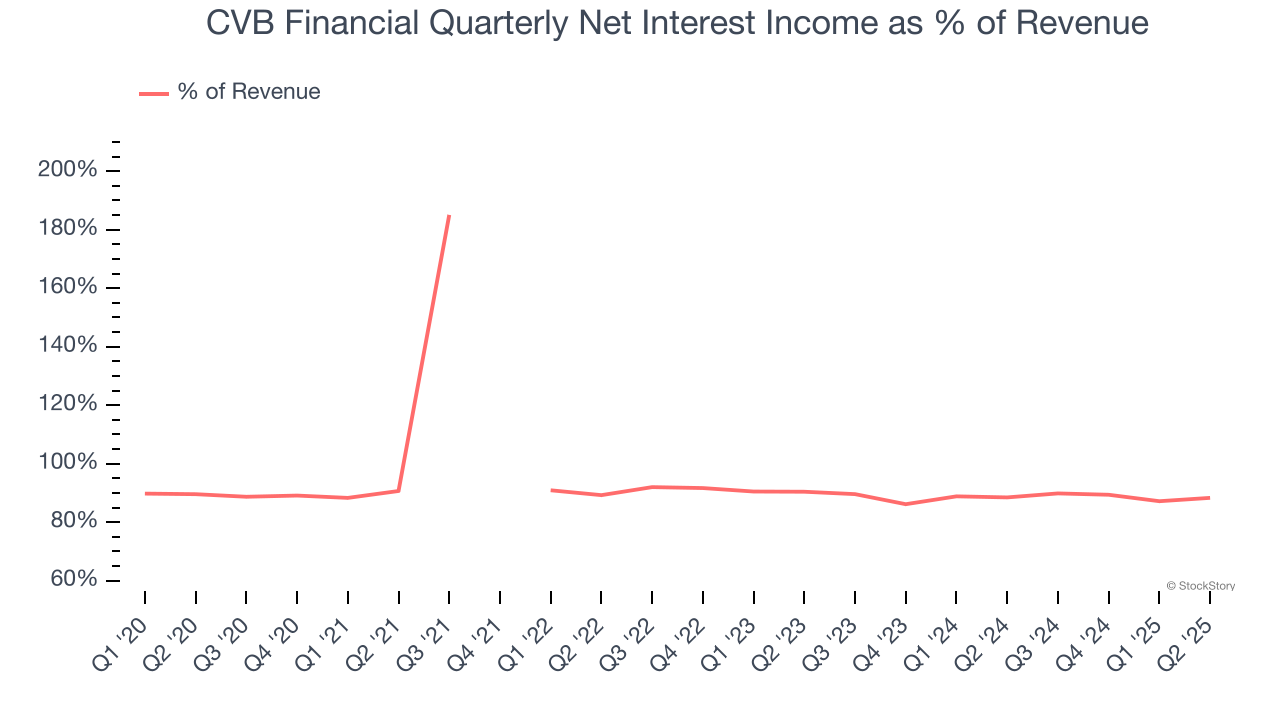 Note: Quarters not shown were determined to be outliers, impacted by outsized investment gains/losses that are not indicative of the recurring fundamentals of the business.
While banks generate revenue from multiple sources, investors view net interest income as the cornerstone - its predictable, recurring characteristics stand in sharp contrast to the volatility of non-interest income.
Unless you’ve been living under a rock, it should be obvious by now that generative AI is going to have a huge impact on how large corporations do business. While Nvidia and AMD are trading close to all-time highs, we prefer a lesser-known (but still profitable) stock benefiting from the rise of AI. Click here to access our free report one of our favorites growth stories.
Tangible Book Value Per Share (TBVPS)
Banks are balance sheet-driven businesses because they generate earnings primarily through borrowing and lending. They’re also valued based on their balance sheet strength and ability to compound book value (another name for shareholders’ equity) over time.
When analyzing banks, tangible book value per share (TBVPS) takes precedence over many other metrics. This measure isolates genuine per-share value by removing intangible assets of debatable liquidation worth. EPS can become murky due to acquisition impacts or accounting flexibility around loan provisions, and TBVPS resists financial engineering manipulation.
CVB Financial’s TBVPS grew at a sluggish 2.8% annual clip over the last five years. However, TBVPS growth has accelerated recently, growing by 10.4% annually over the last two years from $8.74 to $10.64 per share.
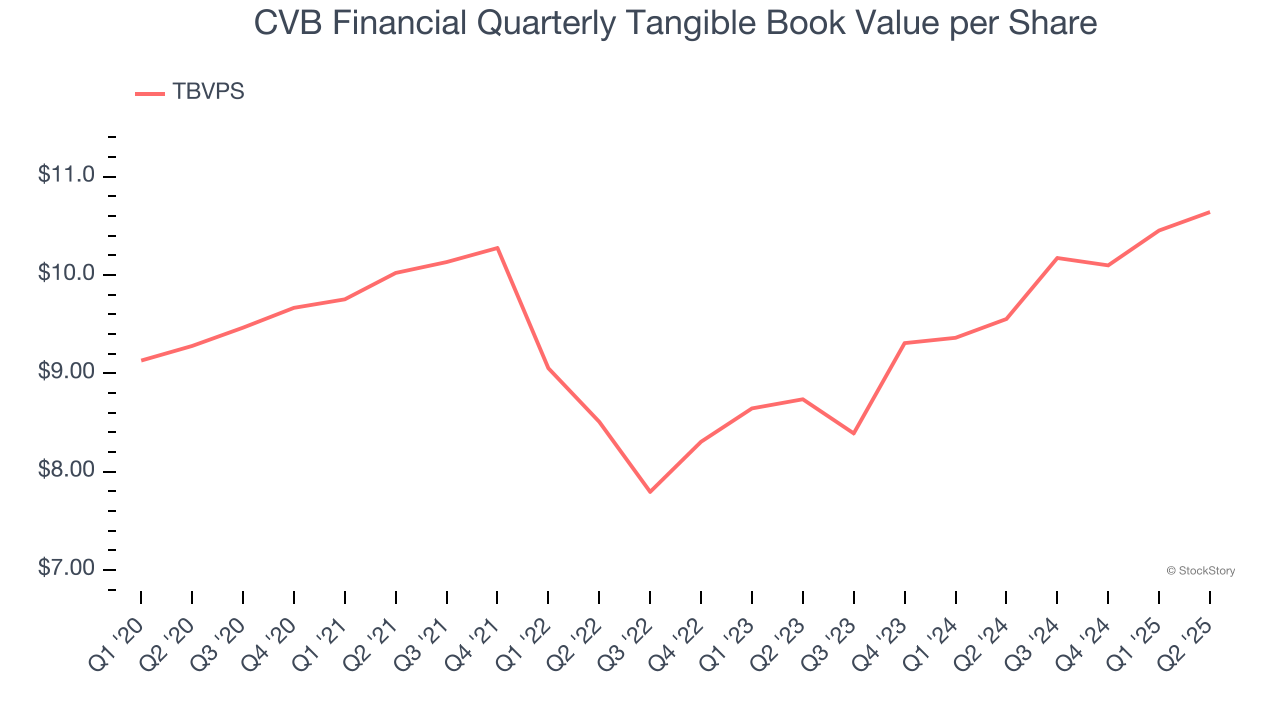
Over the next 12 months, Consensus estimates call for CVB Financial’s TBVPS to grow by 6.8% to $11.36, mediocre growth rate.
Key Takeaways from CVB Financial’s Q2 Results
It was good to see CVB Financial top analysts’ EPS and tangible book value per share expectations this quarter. On the other hand, its net interest income and revenue fell short of Wall Street’s estimates. Overall, this was a weaker quarter. The stock traded down 3.1% to $20.30 immediately following the results.
CVB Financial may have had a tough quarter, but does that actually create an opportunity to invest right now? What happened in the latest quarter matters, but not as much as longer-term business quality and valuation, when deciding whether to invest in this stock. We cover that in our actionable full research report which you can read here, it’s free.