Identification solutions manufacturer Brady (NYSE: BRC) reported revenue ahead of Wall Street’s expectations in Q2 CY2025, with sales up 15.7% year on year to $397.3 million. Its non-GAAP profit of $1.26 per share was 2% above analysts’ consensus estimates.
Is now the time to buy Brady? Find out by accessing our full research report, it’s free.
Brady (BRC) Q2 CY2025 Highlights:
- Revenue: $397.3 million vs analyst estimates of $386.9 million (15.7% year-on-year growth, 2.7% beat)
- Adjusted EPS: $1.26 vs analyst estimates of $1.24 (2% beat)
- Adjusted EPS guidance for the upcoming financial year 2026 is $5 at the midpoint, beating analyst estimates by 1.6%
- Operating Margin: 14.9%, down from 19.3% in the same quarter last year
- Free Cash Flow Margin: 12.4%, down from 21.3% in the same quarter last year
- Market Capitalization: $3.68 billion
Commentary:“Our investments in new products once again led to strong results in the Americas & Asia region, with 4.3 percent organic sales growth in the fourth quarter and 4.8 percent organic sales growth in fiscal 2025. The result was a new all-time company record quarter and record year of adjusted earnings per share,” said Brady’s President and Chief Executive Officer, Russell R. Shaller.
Company Overview
Founded in 1914 and evolving through more than a century of industrial innovation, Brady (NYSE: BRC) manufactures and supplies identification solutions and workplace safety products that help companies identify and protect their premises, products, and people.
Revenue Growth
A company’s long-term sales performance can indicate its overall quality. Any business can have short-term success, but a top-tier one grows for years.
With $1.51 billion in revenue over the past 12 months, Brady is a small player in the business services space, which sometimes brings disadvantages compared to larger competitors benefiting from economies of scale and numerous distribution channels. On the bright side, it can grow faster because it has more room to expand.
As you can see below, Brady grew its sales at a decent 7% compounded annual growth rate over the last five years. This shows its offerings generated slightly more demand than the average business services company, a useful starting point for our analysis.
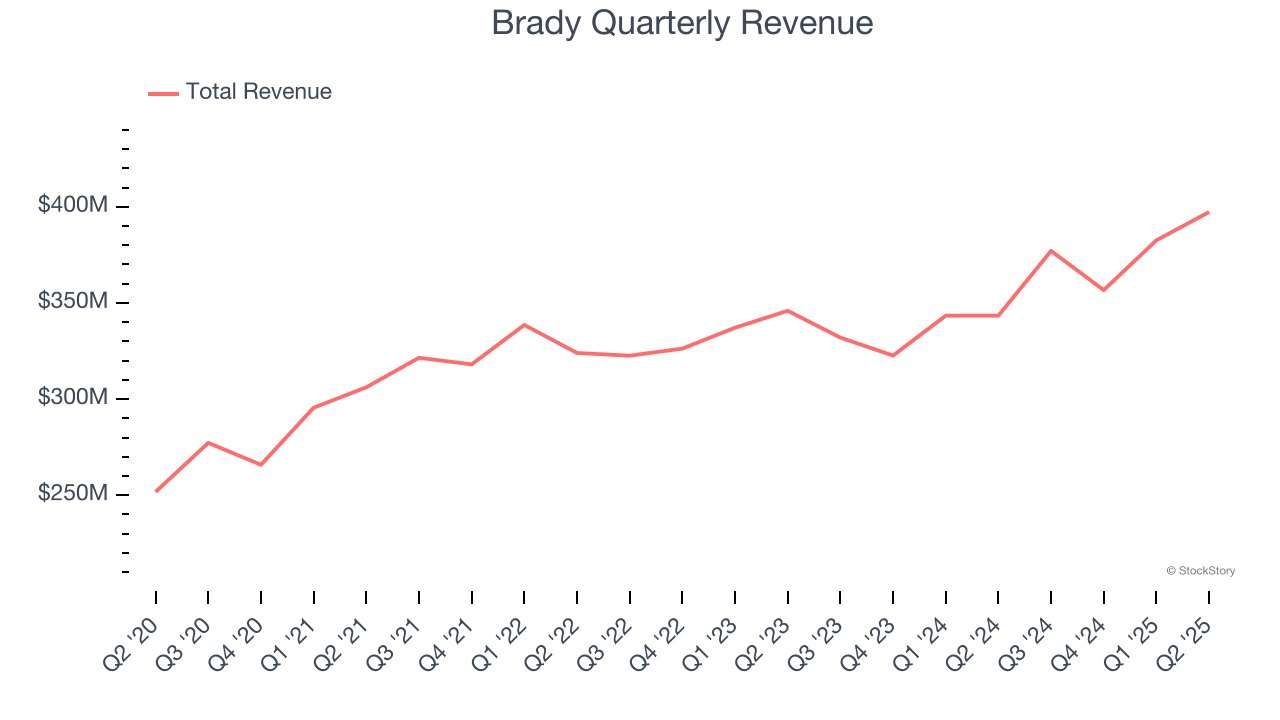
Long-term growth is the most important, but within business services, a half-decade historical view may miss new innovations or demand cycles. Brady’s annualized revenue growth of 6.6% over the last two years aligns with its five-year trend, suggesting its demand was stable. 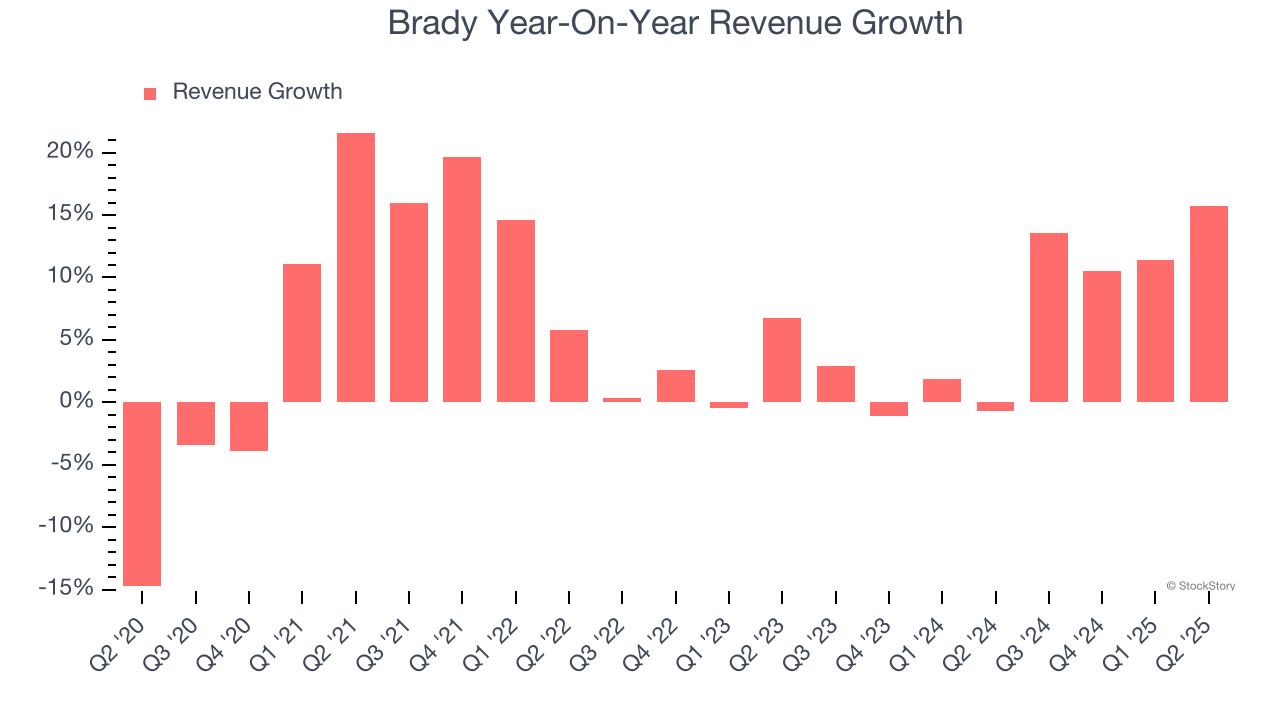
This quarter, Brady reported year-on-year revenue growth of 15.7%, and its $397.3 million of revenue exceeded Wall Street’s estimates by 2.7%.
Looking ahead, sell-side analysts expect revenue to grow 3.7% over the next 12 months, a slight deceleration versus the last two years. This projection doesn't excite us and indicates its products and services will face some demand challenges.
Unless you’ve been living under a rock, it should be obvious by now that generative AI is going to have a huge impact on how large corporations do business. While Nvidia and AMD are trading close to all-time highs, we prefer a lesser-known (but still profitable) stock benefiting from the rise of AI. Click here to access our free report one of our favorites growth stories.
Operating Margin
Brady has been an efficient company over the last five years. It was one of the more profitable businesses in the business services sector, boasting an average operating margin of 16.2%.
Analyzing the trend in its profitability, Brady’s operating margin rose by 1.7 percentage points over the last five years, as its sales growth gave it operating leverage.
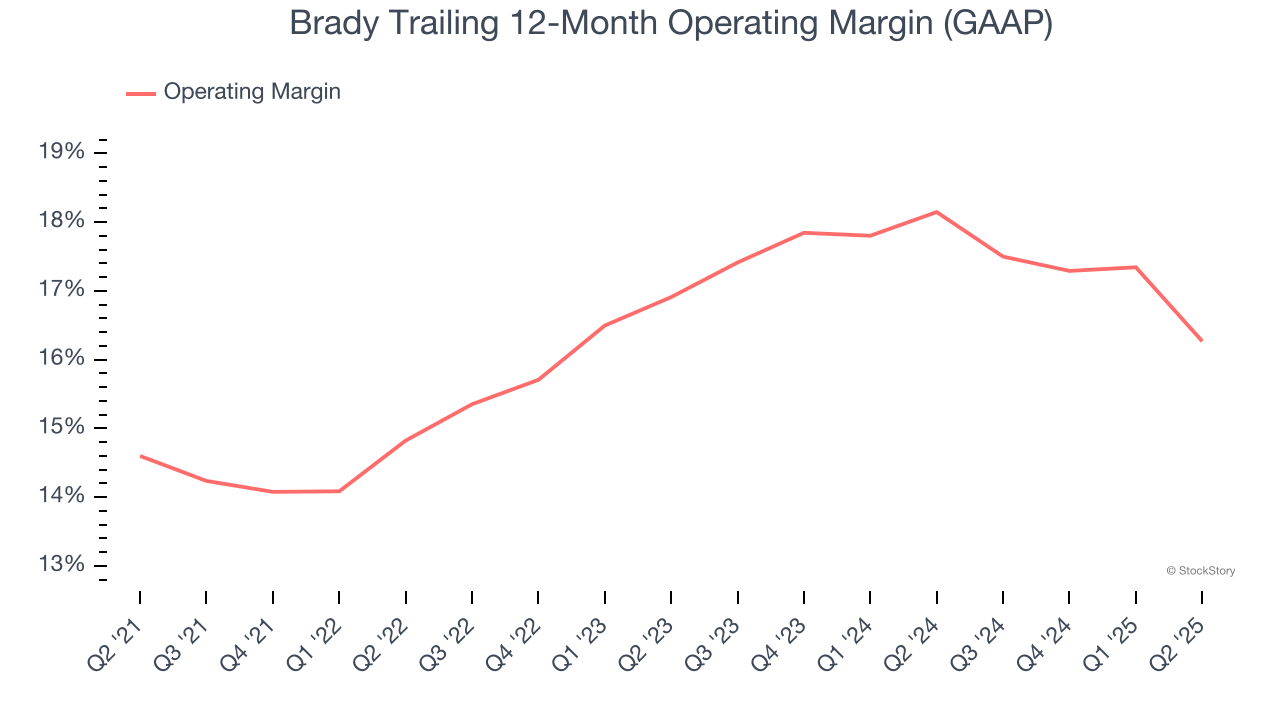
This quarter, Brady generated an operating margin profit margin of 14.9%, down 4.4 percentage points year on year. This contraction shows it was less efficient because its expenses grew faster than its revenue.
Earnings Per Share
Revenue trends explain a company’s historical growth, but the long-term change in earnings per share (EPS) points to the profitability of that growth – for example, a company could inflate its sales through excessive spending on advertising and promotions.
Brady’s EPS grew at a spectacular 14.7% compounded annual growth rate over the last five years, higher than its 7% annualized revenue growth. This tells us the company became more profitable on a per-share basis as it expanded.
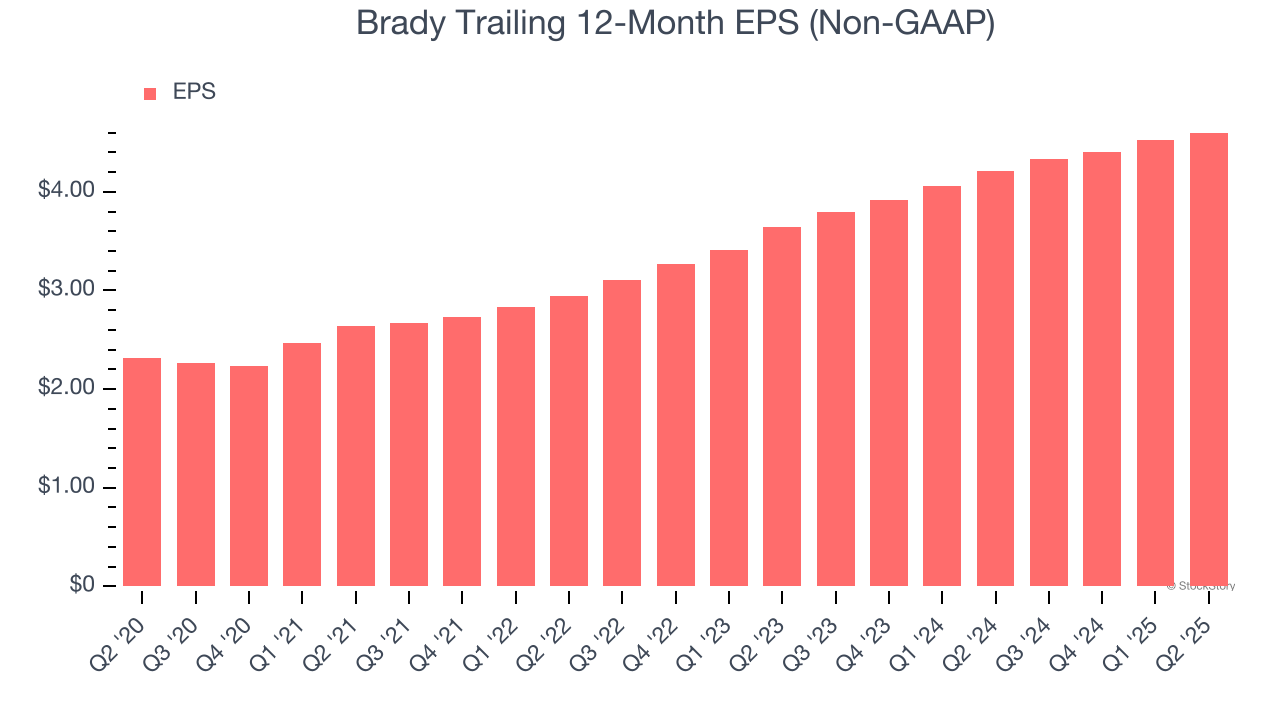
Diving into Brady’s quality of earnings can give us a better understanding of its performance. As we mentioned earlier, Brady’s operating margin declined this quarter but expanded by 1.7 percentage points over the last five years. Its share count also shrank by 8.8%, and these factors together are positive signs for shareholders because improving profitability and share buybacks turbocharge EPS growth relative to revenue growth. 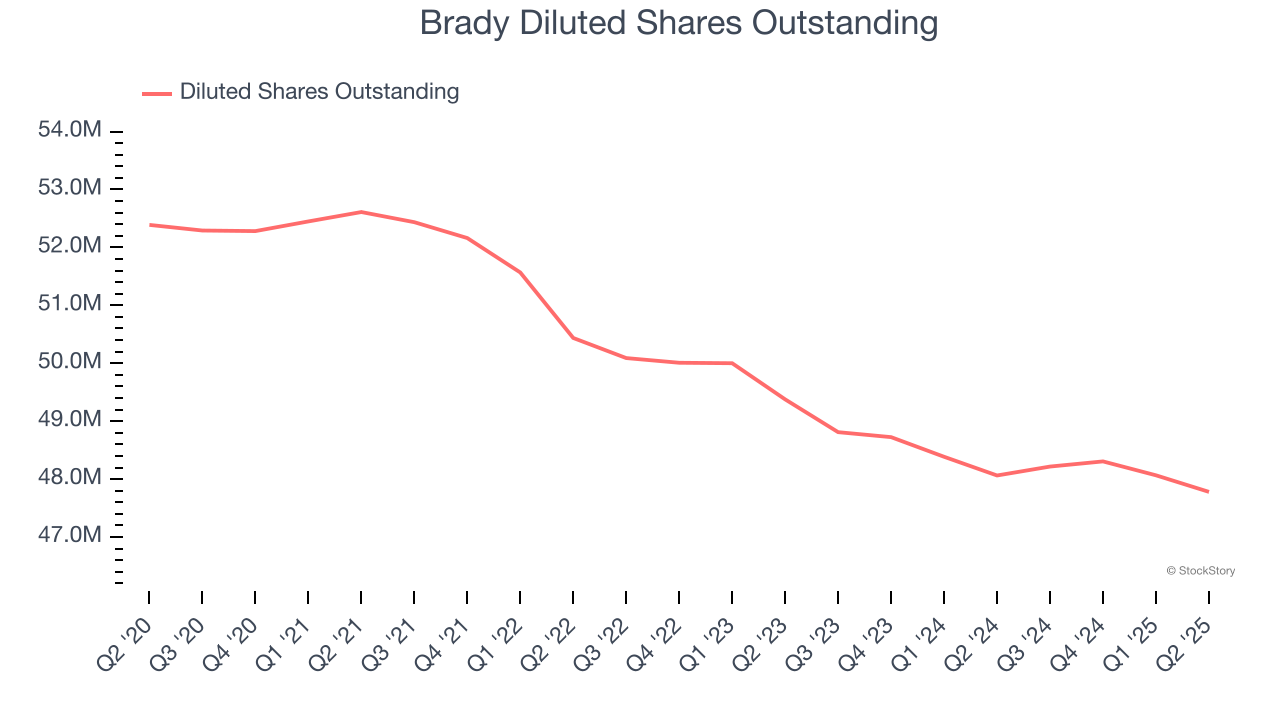
Like with revenue, we analyze EPS over a shorter period to see if we are missing a change in the business.
For Brady, its two-year annual EPS growth of 12.4% was lower than its five-year trend. We still think its growth was good and hope it can accelerate in the future.
In Q2, Brady reported adjusted EPS of $1.26, up from $1.19 in the same quarter last year. This print beat analysts’ estimates by 2%. Over the next 12 months, Wall Street expects Brady’s full-year EPS of $4.60 to grow 6.8%.
Key Takeaways from Brady’s Q2 Results
We enjoyed seeing Brady beat analysts’ revenue expectations this quarter. We were also happy its full-year EPS guidance outperformed Wall Street’s estimates. Overall, we think this was a solid quarter with some key areas of upside. The stock remained flat at $78 immediately after reporting.
Brady put up rock-solid earnings, but one quarter doesn’t necessarily make the stock a buy. Let’s see if this is a good investment. When making that decision, it’s important to consider its valuation, business qualities, as well as what has happened in the latest quarter. We cover that in our actionable full research report which you can read here, it’s free.