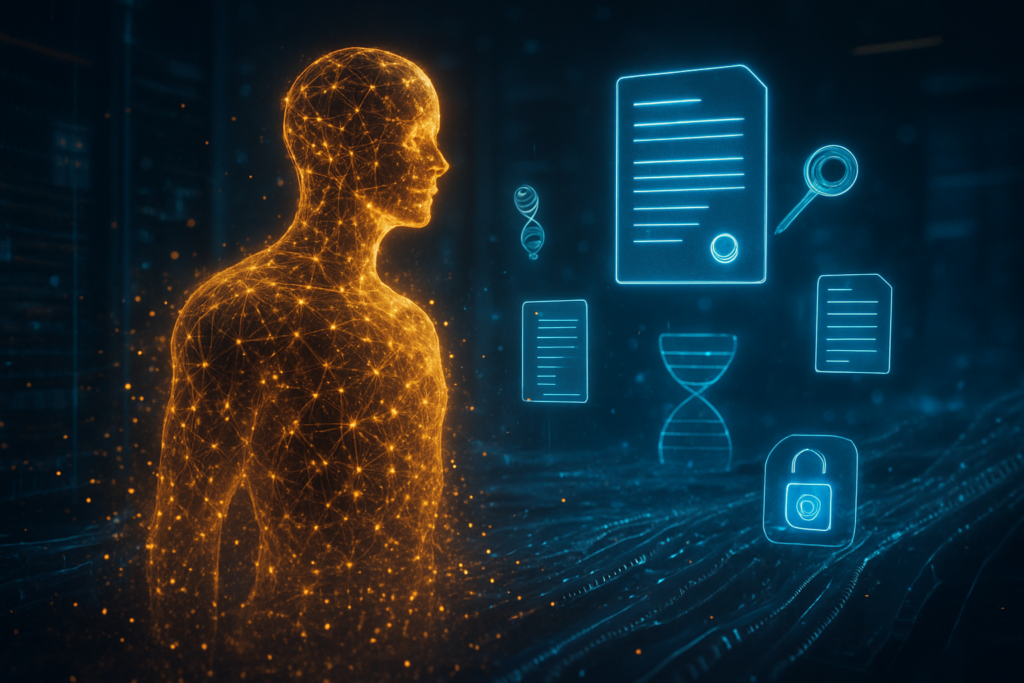
As we enter 2026, the concept of "identity theft" has evolved from stolen credit card numbers to the wholesale replication of the human soul. The rise of "Digital Persona Sovereignty" marks a pivotal shift in the AI landscape, moving beyond simple deepfakes into a realm where an individual's likeness, voice, and behavioral patterns are codified as a new class of intellectual property. With the recent passage of landmark legislation and the stabilization of federal frameworks, the battle for who owns "you" in the digital æther has reached its most critical juncture.
This movement is not merely a reaction to celebrity parodies but a fundamental restructuring of personal rights in the age of generative AI. For the first time, individuals are being granted the legal tools to treat their digital replicas as transferable assets, allowing them to license their "AI twins" for commercial use while maintaining a "kill switch" over unauthorized iterations. This development represents a significant departure from the unregulated "scraping" era of 2023, signaling a future where digital presence is as legally protected as a deed to a house.
The Technical Evolution: From 2D Deepfakes to Volumetric Sovereignty
The technical underpinnings of this shift reside in the transition from Generative Adversarial Networks (GANs) to real-time, 3D "volumetric" personas. Unlike the flickering, often-uncanny face-swaps of 2024, the high-fidelity digital personas of 2026 utilize 3D Gaussian Splatting (3DGS). This technology allows for the explicit representation of millions of overlapping ellipsoids to reconstruct a person’s geometry with sub-millimeter precision. Combined with Latent Space Anchoring, these models maintain identity consistency across complex lighting and movement, enabling 60 FPS rendering on standard mobile devices.
At the heart of the legal enforcement of these personas is the Coalition for Content Provenance and Authenticity (C2PA) version 2.3. This standard has moved from optional software metadata to hardware-level "Digital Passports" embedded in the silicon of modern smartphones and cameras. New techniques like FreqMark—a form of latent frequency optimization—now embed invisible watermarks within the generative process itself. This makes it virtually impossible to strip a persona's identity signature without destroying the content, providing a technical "chain of custody" that is now recognized by courts as evidence of ownership.
The AI research community has responded with both awe and caution. While researchers at Stanford and MIT have praised the "unprecedented fidelity" of these identity-aware models, ethics groups have raised concerns about "latent latency" and the "Proof-of-Humanity." To combat the misuse of these hyper-realistic tools, 2026 has seen the widespread adoption of Liveness Detection protocols like FakeCatcher, which analyzes pixel-level skin flushing caused by a human pulse—a biological signature that synthetic Gaussian personas still fail to replicate.
Industry Giants and the Rise of Persona Licensing
The shift toward Digital Persona Sovereignty has fundamentally altered the business models of tech titans. Meta Platforms, Inc. (NASDAQ: META) has transitioned from being a social network to a persona marketplace. In late 2025, Meta launched its "Imagine Me" initiative, which allows creators to opt-in to a royalty-sharing ecosystem. By signing multi-million dollar deals with actors like Judi Dench and John Cena, Meta has established a precedent for "official voices" that act as authorized extensions of a celebrity's brand within its AI-powered ecosystem.
Alphabet Inc. (NASDAQ: GOOGL), via YouTube, is currently beta-testing "AI Creator Portraits." This feature allows top-tier influencers to deploy AI clones that can interact with millions of fans simultaneously, with Google managing the digital rights and ensuring revenue flows back to the original creator. Similarly, Microsoft Corp. (NASDAQ: MSFT) has updated its enterprise terms to include "Persona-based Licensing" within Microsoft Foundry. This provides corporations with a "safe harbor" of licensed identities, ensuring that the AI agents used in customer service or internal training are legally compliant and "identity-clean."
This new economy has birthed a wave of "Persona Startups" that specialize in digital estate management. These companies act as digital talent agencies, managing the "post-mortem rights" of high-profile individuals. The competitive advantage has shifted from those who have the best models to those who have the most secure and legally defensible data sets. Major AI labs like OpenAI and Anthropic have increasingly pivoted toward these partnership-led models to avoid the massive "pay-for-data" settlements that defined 2025.
Legal Milestones and the Post-Truth Frontier
The broader significance of Digital Persona Sovereignty is perhaps best illustrated by the DEFIANCE Act, which passed the U.S. Senate in mid-January 2026. This bill provides a federal civil right of action for victims of non-consensual deepfakes, allowing for damages up to $150,000. Combined with the NO FAKES Act (currently in the 119th Congress), identity is being treated as a federal intellectual property right for the first time in American history. This is a massive leap from previous decades, where the "Right of Publicity" was a patchwork of inconsistent state laws.
In a landmark move earlier this month, actor Matthew McConaughey successfully trademarked his voice and physical likeness through the USPTO. This strategy allows his legal team to bypass state-level privacy concerns and sue for federal trademark infringement under the Lanham Act whenever an AI clone causes "consumer confusion." This sets a staggering precedent: a person’s very existence can now be classified as a commercial brand, protected with the same ferocity as a corporate logo.
However, these developments have intensified the "post-truth" crisis. As synthetic content becomes legally indistinguishable from real footage, the burden of proof has shifted to the viewer. Potential concerns involve the "privatization of identity," where only the wealthy can afford to legally defend their likeness from digital encroachment. Comparisons have been drawn to the early days of copyright in the music industry, but the stakes here are significantly higher: we are not just talking about songs, but the right to own the appearance of one’s own face.
The Future of Representation: Digital Immortality and Beyond
Looking ahead, the next frontier for Digital Persona Sovereignty is "Automated Representation." Experts predict that by 2027, individuals will use personal AI agents to attend meetings, negotiate contracts, and manage social interactions on their behalf. These "Authorized Avatars" will be legally recognized proxies, capable of entering into binding agreements. This will require a new level of legal framework to determine who is liable if an authorized AI persona makes a mistake or commits a crime.
Another emerging application is "Digital Immortality." With the California AB 1836 now in full effect as of January 2026, the estates of deceased performers have a 70-year window to control and monetize their digital replicas. We are likely to see the rise of "Eternal Contracts," where a person’s likeness continues to work and earn for their descendants long after they have passed away. Challenges remain in defining the "soul" of a persona—can a machine truly replicate the nuance of human intuition, or are we just creating sophisticated parrots?
What experts are watching for next is the first "AI Proxy" case to hit the Supreme Court. As individuals begin to "send their digital replicas on strike," as facilitated by recent SAG-AFTRA contracts, the legal definition of "work" and "presence" will be challenged. The long-term trajectory suggests a world where every human being has a digital "shadow" that is legally, financially, and technically tethered to their physical self.
Summary of the Sovereignty Shift
The push for Digital Persona Sovereignty represents one of the most significant milestones in the history of artificial intelligence. It marks the end of the "AI Wild West" and the beginning of a regulated, commercially viable ecosystem for human likeness. Key takeaways include the federalization of identity rights via the DEFIANCE and NO FAKES Acts, the technological shift to 3D Gaussian Splatting, and the emergence of multi-billion dollar licensing deals by companies like Meta and Alphabet.
This development is not just about protecting celebrities; it is about establishing the ground rules for the next century of human-computer interaction. As we move deeper into 2026, the long-term impact will be a societal revaluation of what it means to be "present." In the coming months, watch for more high-profile trademark filings and the first major "Deepfake Liability" trials, which will finalize the boundaries of our new digital selves.
This content is intended for informational purposes only and represents analysis of current AI developments.
TokenRing AI delivers enterprise-grade solutions for multi-agent AI workflow orchestration, AI-powered development tools, and seamless remote collaboration platforms.
For more information, visit https://www.tokenring.ai/.