Dee Agarwal reveals how mastering the balance between strategic pausing and decisive action enables leaders to navigate high-stakes decisions with clarity, confidence, and long-term impact.
Atlanta, GA, 13th September 2025, ZEX PR WIRE, Every leader faces moments when hesitation costs millions and haste destroys everything. Yet, most never learn to navigate these crossroads effectively. The ability to discern when to hold back and when to move forward with conviction is a skill that many leaders aspire to master, but few truly refine. According to business strategist and entrepreneur Dee Agarwal, the art of knowing when to pause and when to push is not about following a rigid formula. It’s about developing a disciplined intuition rooted in clarity, perspective, and timing.
The Power of Strategic Pausing
In an age of rapid decision-making and instant results, Dee Agarwal believes that the discipline of pausing is often underestimated. “People equate speed with decisiveness,” he explains. “But pausing, even briefly, can create space for clarity. It prevents you from reacting impulsively to noise and helps ensure your choices align with your larger goals.”
Pausing, however, does not mean procrastination. Dee Agarwal stresses the distinction. “Procrastination stems from fear or uncertainty. A pause, on the other hand, is intentional. It’s an active step to assess variables, gather input, and check your biases before making a move.”
He likens strategic pausing to a pilot reviewing instruments mid-flight. The plane is moving, but the pilot takes a moment to double-check before shifting altitude. “That pause can mean the difference between turbulence and a smooth flight,” Dee Agarwal says.
Knowing When to Push
While pausing has its virtues, Dee Agarwal notes that decisive action is equally essential, particularly when opportunities are fleeting. “Momentum has its own kind of value,” he says. “If you wait too long to act, doors close, competitors advance, and your team loses confidence. There are moments when hesitation is riskier than moving forward.”
For Dee Agarwal, pushing ahead often hinges on two factors: confidence in the available information and alignment with long-term objectives. “You don’t need perfect data to act. You need sufficient clarity to believe that forward motion will create more opportunities than standing still.”
He emphasizes that pushing is not about aggression, but about conviction. “Leaders who push at the right moment create a sense of inevitability. They inspire their teams by showing that the path forward, while uncertain, is worth committing to.”
Signals That It’s Time to Pause
Dee Agarwal identifies several signals that suggest a pause is warranted:
-
Emotional charge: “If your decision is driven primarily by frustration, excitement, or fear, step back. Emotions cloud judgment.”
-
Unclear criteria for success: “If you can’t define what success looks like in measurable terms, you may need more reflection.”
-
Uneven alignment: “If stakeholders or team members are fundamentally misaligned, pushing prematurely may only deepen resistance.”
He adds that a pause does not need to be overly long. Sometimes, 24 hours of reflection or a single candid conversation is enough to recalibrate perspective.
Signals That It’s Time to Push
Conversely, Dee Agarwal points to moments when waiting could be more damaging than acting:
-
Information plateau: “If more research won’t materially change your decision, it’s time to move.”
-
Window of opportunity: “Markets, clients, and competitors don’t wait for your comfort level. If the window is closing, act.”
-
Team readiness: “When your team has energy, alignment, and momentum, delaying can deflate morale.”
“Leaders must recognize that perfect certainty is a myth,” Dee Agarwal says. “If you’re 70% sure and waiting for the other 30% would cost you the opportunity, it’s time to push.”
Creating a Culture That Supports Both Pausing and Pushing
Beyond his personal approach, Dee Agarwal emphasizes the importance of organizational culture in navigating high-stakes choices. “Leaders don’t make decisions in isolation. If your team feels punished for pausing, they’ll rush. If they feel punished for acting, they’ll hesitate. The real goal is to create psychological safety for both reflection and bold action.”
He advises leaders to celebrate not only outcomes but also the quality of their decision-making processes. “When people see that thoughtfulness is valued, they’re more likely to pause productively. When they see that courage is valued, they’re more likely to push when it matters.”
The Long Game
Ultimately, Dee Agarwal frames pausing and pushing as complementary, not opposing, forces. “Think of it like breathing. You inhale, you exhale. Pausing is the inhale. It brings in information and perspective. Pushing is the exhale. It releases energy into the world. Both are necessary to keep moving forward.”
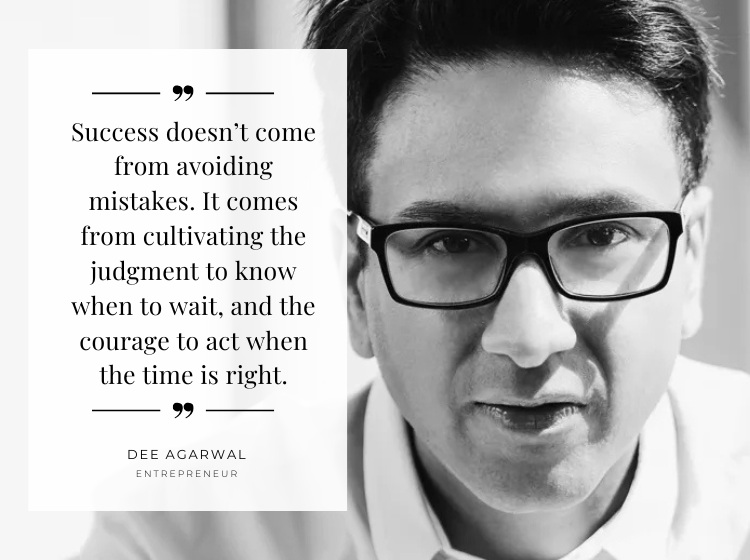
For leaders facing high-stakes decisions, the lesson is clear: the wisdom lies not in always charging ahead or always waiting, but in knowing which moment calls for which move. As Dee Agarwal puts it, “Success doesn’t come from avoiding mistakes. It comes from cultivating the judgment to know when to wait, and the courage to act when the time is right.”