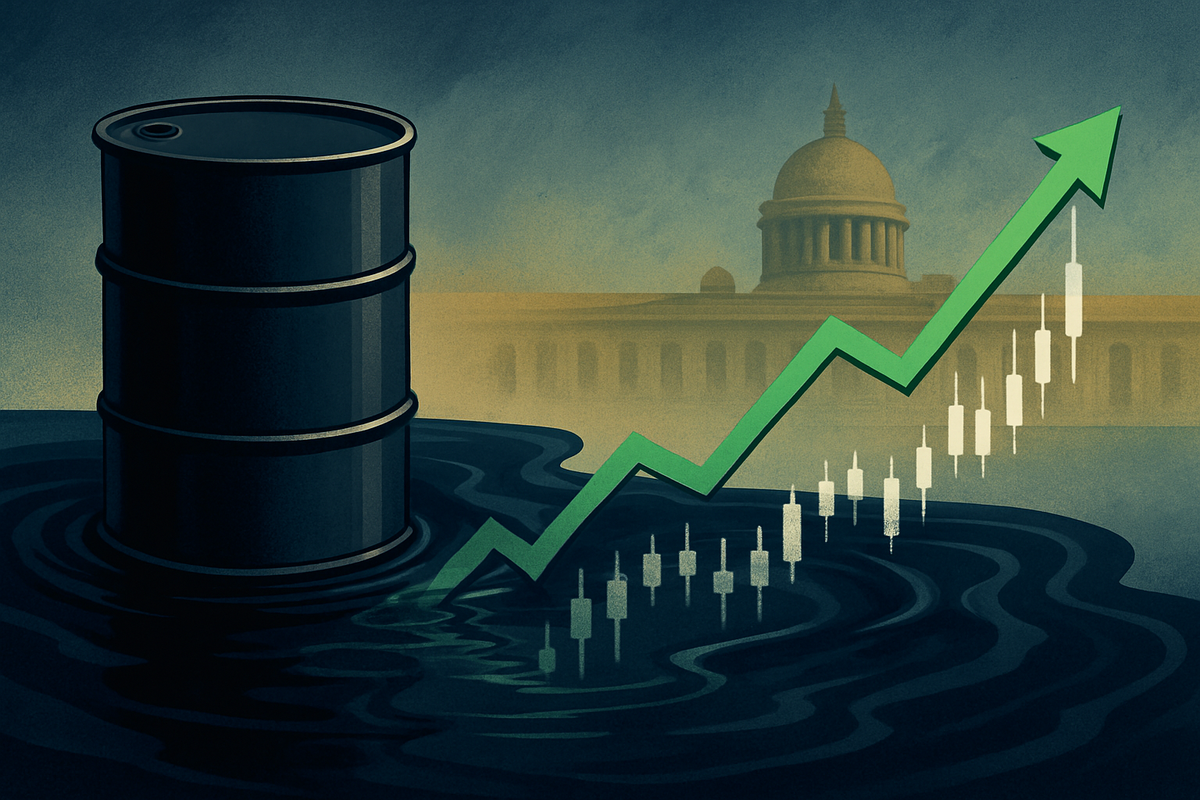
The financial markets are witnessing a compelling phenomenon, aptly termed the 'Oil Recoil,' where significant shifts in global crude oil prices trigger a pronounced reaction in the stock performance of oil firms. This dynamic has recently brought state-owned Indian Oil Marketing Companies (OMCs) like Bharat Petroleum Corporation Ltd (NSE: BPCL) and Hindustan Petroleum Corporation Ltd (NSE: HPCL) into sharp focus, as their stock prices have shown remarkable resilience and firming trends, despite the inherent volatility of the energy sector. This article delves into the intricate market dynamics, specific company performances, and broader implications of this 'recoil' as of November 25, 2025.
At its core, the 'Oil Recoil' refers to the powerful market response to sudden changes in crude oil prices. For OMCs, a decline in global crude prices often translates into improved profitability, particularly if retail fuel prices remain stable or do not decrease proportionally. This widens their marketing margins – the crucial difference between the cost of crude inputs and the selling price of refined products. Conversely, a sharp increase in crude prices can swiftly erode these margins, posing significant challenges. The recent strong performance of BPCL and HPCL stocks underscores how effectively these firms have navigated such fluctuations, leveraging favorable market conditions and strategic governmental support to bolster their financial health.
Navigating the Currents: Market Dynamics and OMC Performance
The firming stock prices of Indian state-owned OMCs like BPCL and HPCL are a testament to several underlying market dynamics. A primary driver is the movement in global crude oil prices; when these prices decline or stabilize at lower levels, OMCs benefit from reduced input costs, enhancing their profitability. This allows them to maintain or improve marketing margins, especially when retail fuel prices in India remain relatively stable, often due to a cautious pricing approach. Conversely, a sharp surge in crude oil prices can quickly squeeze these margins if OMCs cannot fully pass on the increased costs to consumers.
Robust domestic demand for petroleum products in India also plays a crucial role. India continues to be one of the fastest-growing major oil consumption markets globally, driven by sustained economic growth, urbanization, and increasing transportation needs. This consistent demand ensures high sales volumes for OMCs. Furthermore, supportive government policies, including compensation for under-recoveries on subsidized products like LPG and allowing for healthy marketing margins, significantly contribute to OMC profitability and investor confidence. For instance, the government's approval of a substantial support package (₹30,000 crore in Q2 FY26) to offset LPG under-recoveries has been a notable positive factor.
Analyzing recent stock performance, both BPCL and HPCL have shown strong upward trends. Bharat Petroleum (NSE: BPCL) shares rallied approximately 28% in the month leading up to November 17, 2025, hitting a new all-time high of ₹381.60. Similarly, Hindustan Petroleum (NSE: HPCL) surged to a record high in November 2025, rallying approximately 18% in the month leading up to November 17, 2025, and breaking out of its long-term resistance zone. However, the market on November 25, 2025, also saw some downward pressure; for instance, Investec downgraded all PSU OMCs, citing weakening diesel marketing margins, leading to a dip in their stock prices. This illustrates the delicate balance OMCs must maintain between crude price volatility and the crucial marketing margins.
Winners and Losers: Impact on BPCL and HPCL
The interplay of crude oil prices and marketing margins directly dictates whether OMCs like Bharat Petroleum (NSE: BPCL) and Hindustan Petroleum (NSE: HPCL) emerge as 'winners' or 'losers' in the market. When global crude oil prices decline, OMCs typically 'win' as their input costs decrease, directly boosting their gross refining margins (GRMs) and overall profitability. For example, in October 2024, HPCL shares surged over 4.5% and BPCL rose 2.2% following a sharp decline in global crude oil prices. Conversely, a surge in crude oil prices leads to a 'loss,' as higher costs squeeze margins, especially if retail fuel prices remain constrained. In October 2025, HPCL shares fell 3.19% and BPCL slipped 2.34% as Brent crude surged over 3%.
Currently, marketing margins are a significant positive for both companies. Crisil Ratings projects that Indian OMCs will see over 50% growth in operating profits in the current financial year (FY26), primarily driven by robust marketing margins. These margins are anticipated to jump to $14 per barrel (₹8 per liter) in FY26, a substantial increase from previous levels. This improvement is expected to more than offset any moderation in refining margins, supporting the OMCs' capital expenditure plans and strengthening their credit metrics.
Recent financial results illustrate this dynamic. While Q2 FY25 (July-September 2024) saw a decline in net profits for both companies due to weaker refining margins and inventory losses, Q3 FY25 (October-December 2024) marked a strong recovery for HPCL, with its consolidated net profit skyrocketing 257% year-on-year. Looking ahead, Q2 FY26 (July-September 2025) showed even stronger performance, with BPCL reporting a robust 169.52% year-on-year growth in consolidated net profit, and HPCL's net profit surging an astounding 2605.05% year-on-year. This demonstrates their capacity to rebound strongly when market conditions, particularly marketing margins, turn favorable.
Broader Strokes: Wider Significance and Industry Trends
The current market dynamics affecting state-owned OMCs like BPCL and HPCL are not isolated events but are deeply embedded within broader industry trends and have significant ripple effects. India's surging oil demand stands out globally, projected to be the fastest-growing major oil consumption market and a leading driver of global oil demand growth in 2024 and 2025. This contrasts with slowing demand in many other economies and underscores India's unique position in the global energy landscape. This robust demand is propelling Indian refiners to expand capacity and diversify crude sourcing, enhancing energy security.
These trends have ripple effects across the energy sector. Other public sector OMCs, such as Indian Oil Corporation (NSE: IOCL), face similar dynamics, with their profitability also tied to refining and marketing margins, crude prices, and government policies. The strong demand and government support for state-owned players create a competitive environment for private sector competitors like Reliance Industries (NSE: RELIANCE) and Nayara Energy, pushing them to innovate and differentiate. Internationally, India's increasing demand and diversified sourcing create opportunities for a wider range of global suppliers, while also making the nation more resilient to geopolitical tensions affecting traditional supply routes.
Regulatory and policy implications are profound. The Indian government plays a pivotal role, with recent reforms like the Oilfields (Regulation and Development) Amendment Bill, 2024, aiming to modernize the regulatory framework and attract investment. While petrol and diesel prices were deregulated in 2010 and 2014, the government retains influence through excise duties and compensation for LPG under-recoveries, demonstrating a strategic balancing act between market forces and consumer welfare. This approach echoes historical precedents, where periods of regulated pricing and government intervention have been common to manage the impact of global oil volatility on the domestic economy.
The Road Ahead: What Comes Next for OMCs
The future for Indian state-owned OMCs like Bharat Petroleum (NSE: BPCL) and Hindustan Petroleum (NSE: HPCL) is characterized by both sustained short-term profitability and a long-term strategic pivot towards the energy transition. In the short term, leading up to and beyond November 2025, OMCs are poised for robust operating profit growth in FY26, driven primarily by strong marketing margins and stable retail fuel prices. Forecasts suggest Brent crude prices will soften to $65-67 per barrel in FY26, providing a favorable environment for reduced input costs. This healthy profitability is expected to support significant capital expenditure plans, including brownfield expansion to meet surging domestic demand, and reduce reliance on external debt.
However, the long-term trajectory is fundamentally shaped by India's ambitious energy transition goals, including achieving net-zero carbon emissions by 2070 and significantly increasing renewable energy capacity by 2030. OMCs are strategically adapting to become integrated energy companies, moving beyond their traditional fossil fuel focus. This involves massive investments in green energy initiatives such as electric vehicle (EV) charging infrastructure (with OMCs planning to install tens of thousands of charging stations), aggressive biofuel blending targets (aiming for 20% ethanol blending in petrol by ESY 2025-26), and ventures into green hydrogen production and carbon capture technologies. For example, BPCL plans over ₹1,70,000 crore investment by 2027 to expand refining capacity, enter petrochemicals, and grow its natural gas network.
While opportunities abound in India's growing energy demand and the burgeoning EV and biofuel markets, challenges remain. Crude oil price volatility, driven by geopolitical tensions and OPEC+ policies, will continue to be a significant risk. Policy and regulatory uncertainty, particularly concerning fuel pricing and potential government interventions, could impact financial stability. Furthermore, the substantial capital expenditure required for the energy transition, competition from new energy players, and the risk of traditional fossil fuel assets becoming stranded are critical factors that OMCs must skillfully navigate.
Charting the Course: A Comprehensive Wrap-up
The 'Oil Recoil' phenomenon has spotlighted the dynamic and often complex operational environment of Indian state-owned Oil Marketing Companies. Bharat Petroleum (NSE: BPCL) and Hindustan Petroleum (NSE: HPCL), along with Indian Oil Corporation (NSE: IOCL), have demonstrated significant resilience, with their stock prices showing firming trends driven by a combination of favorable crude oil price dynamics and robust marketing margins. The decisive support from the Indian government, particularly through compensation for LPG under-recoveries, has further bolstered their financial health and investor confidence.
Moving forward, the market assessment for Indian OMCs remains largely positive for FY26, with strong operating profits and increasing cash accruals projected. Their ambitious capital expenditure plans, focusing on both refining capacity expansion and diversification into green energy sectors like EV charging, biofuels, and hydrogen, underscore their strategic vision for long-term growth and sustainability. These companies are not merely fuel distributors but are evolving into comprehensive energy players, crucial for India's energy security and its transition towards a cleaner future.
Investors should maintain a vigilant watch on several key indicators in the coming months. Global crude oil price movements remain paramount, as any sharp fluctuations can directly impact margins. Clarity on government policy regarding fuel pricing mechanisms, excise duties, and timely disbursement of subsidies will also be critical. Close scrutiny of quarterly earnings reports for trends in refining and marketing margins, alongside the progress of their diversification into green energy projects, will provide valuable insights into their operational health and long-term value creation. The journey of these OMCs reflects India's broader energy narrative – one of balancing immediate energy needs with an ambitious sustainable future.
This content is intended for informational purposes only and is not financial advice