In forex, breaking news can move markets within seconds.
A central bank changes its tone. Inflation comes in above expectations. Employment data surprises the market. A geopolitical development suddenly shifts risk sentiment.
Headlines appear almost instantly.
Currency prices react just as quickly.
But for traders, receiving the news is only the beginning.
The more important question is:
What does the news actually mean for the market?
A headline may appear positive for a currency while price moves in the opposite direction. An economic release may look significant but already be reflected in market expectations. A central-bank decision may be widely anticipated, yet one change in language can alter expectations for future interest rates.
This is where MOMO Terminal AI takes a different approach.
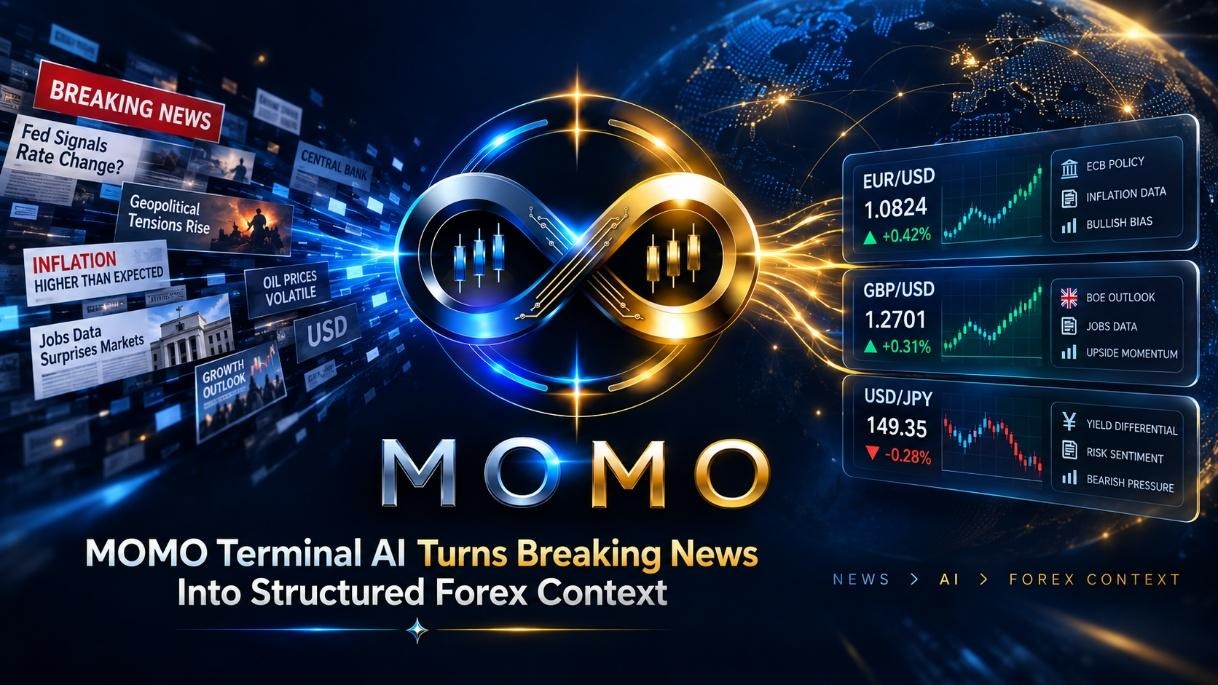
Rather than treating breaking news as an isolated signal, MOMO is designed to connect new information with the wider forex environment through multiple specialized AI agents and a final consolidation layer known as META.
The goal is not simply to deliver more information.
It is to turn information into context.
A Headline Is Only the First Layer
Consider a hypothetical central-bank announcement:
“Interest rates remain unchanged.”
On the surface, the message appears neutral.
But the market may immediately ask several deeper questions.
Was the decision already expected?
Did policymakers become more concerned about inflation?
Was future easing discussed?
Did economic projections change?
How did the currency react?
What happened in related markets?
The headline tells traders what happened.
The wider market response helps explain why it matters.
This distinction is important because forex prices are rarely driven by one factor alone. Currency movements can be influenced by monetary policy, inflation expectations, employment data, risk sentiment, liquidity, positioning and cross-market flows at the same time. MOMO’s broader positioning has consistently focused on organizing these fragmented inputs into a more structured decision framework.
Macroeconomic AI: Understanding the Economic Meaning
MOMO’s Macroeconomic AI focuses on economic forces that may influence currency valuations.
These can include interest-rate expectations, inflation, employment figures, economic growth and central-bank decisions.
The important point is that the system is not designed to view every announcement in isolation.
For example, higher-than-expected inflation may influence expectations for future monetary policy.
But the effect depends on context.
Was the number already anticipated?
Is inflation accelerating or slowing?
What has the central bank recently communicated?
Are markets already expecting a rate increase or rate cut?
By evaluating the wider economic environment, MOMO can place a breaking headline within a broader macroeconomic narrative.
Sentiment AI: How Is the Market Reacting?
Economic significance is only one part of the story.
Markets also react according to expectations and confidence.
This is where MOMO’s Sentiment AI adds another perspective.
A strong economic release does not automatically mean a currency will strengthen.
If traders expected an even stronger result, the market reaction may be muted.
Likewise, broader global risk sentiment can influence how currencies respond to economic developments.
The question therefore moves beyond:
“Is this news positive or negative?”
It becomes:
“How is the market interpreting it?”
This difference can be critical during fast-moving market events.
Technical Analysis AI: Is Price Confirming the Story?
News may provide the catalyst.
Price action shows how participants are responding.
MOMO’s Technical Analysis AI evaluates market structure, trend, momentum, support and resistance, and other chart-based conditions.
Suppose a major announcement sends a currency pair sharply higher.
That initial movement does not necessarily mean the move will continue.
Price may approach an important resistance level and reverse.
Alternatively, it may break through an established structure and maintain momentum.
By examining what price is actually doing, MOMO can compare the market reaction with the original news narrative.
Volatility AI: Direction Is Not Everything
Major economic announcements often create rapid changes in volatility.
Prices can move sharply in one direction before reversing minutes later.
MOMO’s Volatility AI evaluates the speed, intensity and stability of those movements.
This matters because a market can appear to be moving in a clear direction while conditions remain highly unstable.
A potential setup may therefore look attractive from a directional perspective while carrying a very different risk profile because of volatility.
MOMO is designed to evaluate both.
Correlation AI: One Event Can Affect Multiple Markets
Forex markets are interconnected.
A major policy announcement involving the US dollar, euro, yen or pound can influence several currency pairs at once. It may also interact with commodities, equity markets and broader risk sentiment.
MOMO’s Correlation AI examines these relationships.
If several related markets respond consistently, the wider reaction may reinforce the developing interpretation.
If they move in conflicting directions, that divergence may suggest that the market is not fully aligned.
Instead of examining one chart alone, correlation analysis helps MOMO view the event across a broader market landscape.
Order-Flow AI: What Is Happening Beneath the Move?
A sharp price movement does not always mean market conditions are equally strong beneath the surface.
MOMO’s Order-Flow AI focuses on liquidity, market participation and execution-related conditions.
Around major announcements, liquidity can change quickly.
Markets may move aggressively as participants reposition, while execution conditions become less stable.
This gives MOMO another layer of context beyond the direction of price alone.
META Connects the Different Perspectives
The key to MOMO Terminal AI is not simply that it uses multiple AI agents.
It is how their findings are brought together.
Each specialized agent evaluates the market from a different perspective.
Their conclusions are then passed to META, MOMO’s final intelligence layer. META is designed to compare those assessments, identify areas of agreement or conflict and evaluate whether the overall market conditions are sufficiently aligned.
Consider a hypothetical central-bank announcement.
Macroeconomic AI sees the development as supportive.
Sentiment AI detects improving confidence.
Technical Analysis AI sees price confirming the move.
Correlation AI finds related markets moving in the same direction.
But Volatility AI identifies unstable conditions, while Order-Flow AI sees weaker liquidity.
A simple interpretation may say:
Positive news. Currency moving higher.
MOMO’s framework can produce a more complete view:
Supportive macro context and price action, but with elevated volatility and weaker execution conditions.
That is the difference between reading a headline and understanding market context.
MOMO Radar: Filtering What Matters
Modern traders already have access to more information than ever.
Economic calendars, financial websites, news feeds, analyst commentary and social media all operate continuously.
The challenge is not finding information.
It is deciding what deserves attention.
MOMO Radar is designed to help surface relevant market developments while the wider MOMO intelligence framework evaluates their significance.
The process can be understood as:
Headline → Market Relevance → Multi-Layer Analysis → META → Structured Context
Instead of forcing users to interpret every piece of information separately, MOMO aims to bring the most relevant market inputs into one coordinated analytical process.
Less Noise. More Context.
Not every headline matters equally.
Not every market reaction lasts.
And not every apparently positive announcement leads to a positive currency move.
This is why MOMO Terminal AI focuses on more than information delivery.
Macroeconomic AI evaluates the economic meaning.
Sentiment AI considers the market response.
Technical Analysis AI examines price structure.
Correlation AI connects related markets.
Volatility AI evaluates stability.
Order-Flow AI examines liquidity and participation.
META brings those perspectives together.
The result is a framework designed to move traders beyond simply knowing what happened toward understanding what the market may be communicating after it happened.
Because in modern forex markets, the fastest headline does not always provide the clearest intelligence.
Sometimes, the real value begins after the headline.
MOMO Terminal AI — Institutional Intelligence, Retail Accessible.