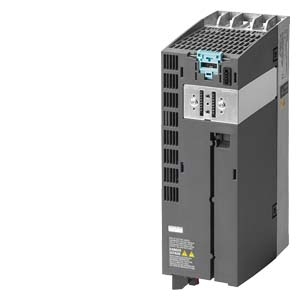
A servo drive receives a command signal from a control system, amplifies the signal, and transmits electric current to a servo motor in order to produce motion proportional to the command signal. Typically, the command signal represents a desired velocity, but can also represent a desired torque or position.
Function
A servo drive receives a command signal from a control system, amplifies the signal, and transmits electric current to a servo motor in order to produce motion proportional to the command signal. Typically, the command signal represents a desired velocity, but can also represent a desired torque or position. A sensor attached to the servo motor reports the motor's actual status back to the servo drive. The servo drive then compares the actual motor status with the commanded motor status. It then alters the voltage, frequency or pulse width to the motor so as to correct for any deviation from the commanded status.
In a properly configured control system, the servo motor rotates at a velocity that very closely approximates the velocity signal being received by the servo drive from the control system. Several parameters, such as stiffness (also known as proportional gain), damping (also known as derivative gain), and feedback gain, can be adjusted to achieve this desired performance. The process of adjusting these parameters is called performance tuning.
Although many servo motors require a drive specific to that particular motor brand or model, many drives are now available that are compatible with a wide variety of motors..
Digital and analog
Servo drives can be digital, analog, or both. Digital drives differ from analog drives by having a microprocessor, or computer, which analyses incoming signals while controlling the mechanism. The microprocessor receives a pulse stream from an encoder, enabling the determination of velocity and position. Varying the pulse, or blip, allows the mechanism to adjust speed essentially creating a speed controller effect.The repetitive tasks performed by a processor allows a digital drive to be quickly self-adjusting. In cases where mechanisms must adapt to many conditions, this can be convenient because a digital drive can adjust quickly with little effort. A drawback to digital drives is the large amount of energy that is consumed. However, many digital drives install capacity batteries to monitor battery life. The overall feedback system for a digital servo drive is like an analog, except that a microprocessor uses algorithms to predict system conditions.
Use in industry
OEM servo drive from INGENIA installed on CNC router machine controlling a Faulhaber motor
Servo systems can be used in CNC machining, factory automation, and robotics, among other uses. Their main advantage over traditional DC or AC motors is the addition of motor feedback. This feedback can be used to detect unwanted motion, or to ensure the accuracy of the commanded motion. The feedback is generally provided by an encoder of some sort. Servos, in constant speed changing use, have a better life cycle than typical AC wound motors. Servo motors can also act as a brake by shunting off generated electricity from the motor itself.
Media Contact
Company Name: SICHUAN HONGJUN SCIENCE AND TECHNOLOGY CO., LTD.
Email: Send Email
Phone: +86 15008220675
Country: China
Website: https://www.hjstmotor.com/