Overview of Transformer Losses
Transformer losses consist of two primary components:
-
No-load loss (Po): Also known as iron loss, caused by hysteresis and eddy currents in the transformer core. It remains nearly constant as long as voltage and frequency are stable.
-
Load loss (Pk or Pc): Mainly copper loss generated by winding resistance when load current flows. It varies with load and is proportional to the square of the current.
The total transformer loss is expressed as:
ΔP = Po + Pc
Transformer Loss Calculation Formula
Transformer losses can be evaluated using the following standard formulas:
Active power loss:
ΔP = Po + KT · β² · Pk
Reactive power loss:
ΔQ = Qo + KT · β² · Qk
Comprehensive power loss:
ΔPz = ΔP + KQ · ΔQ
Where:
-
Po – No-load loss (kW)
-
Pk – Rated load loss (kW)
-
Qo – No-load reactive loss (kvar), Qo ≈ Io% · Sn
-
Qk – Rated load reactive power (kvar), Qk ≈ Uk% · Sn
-
Sn – Rated transformer capacity (kVA)
-
Uk% – Percentage short-circuit voltage
-
Io% – No-load current percentage
-
β – Load factor
-
KT – Load fluctuation loss coefficient
-
KQ – Reactive economic equivalent (kW/kvar)
Recommended Parameter Selection
For practical engineering calculations, the following values are commonly used:
-
KT = 1.05
-
KQ = 0.1 kW/kvar (for 6kV–10kV urban and industrial power grids at minimum load)
-
Load factor (β):
-
Agricultural transformers: 20%
-
Industrial transformers (three-shift operation): 75%
-
-
Annual operating hours: 8760 h
-
Maximum load loss hours: 5500 h
Transformer-specific parameters such as Po, Pk, Io%, and Uk% should be obtained from manufacturer nameplates or factory test reports.
Calculation of Iron Loss and Copper Loss Energy
Iron loss energy consumption:
Iron loss (kWh) = Po (kW) × Operating time (h)
-
Continuous power supply users: 720 h per month
-
Intermittent supply: calculated based on actual energized hours
-
Users with accumulation clocks: based on recorded power supply time
Copper loss energy consumption:
-
When average load rate ≤ 40%: Copper loss = Monthly energy consumption × 2%
-
When average load rate > 40%: Copper loss = Monthly energy consumption × 3%
Load rate formula:
Load rate = Energy consumption / (Sn × T × cosφ)
Where T = 720 h and cosφ ≈ 0.8.
Transformer Efficiency
Transformer efficiency is defined as:
η = Pz / (Pz + ΔP) × 100%
Where Pz is the transformer output power.
Typical transformer loss levels:
-
Copper loss: ~0.5%
-
Iron loss: ~5–7%
-
Dry-type transformers generally exhibit lower total losses than oil-immersed transformers.
No-Load Loss Measurement and Standards
No-load loss is measured by applying rated sinusoidal voltage to the primary winding with the secondary open-circuited. Accurate measurement requires:
-
Near-perfect sinusoidal voltage waveform
-
Difference between average and RMS voltage readings ≤ 3%
-
High-accuracy CTs, PTs, and wattmeters suitable for low power factor measurement
With modern low-loss core materials such as grain-oriented silicon steel and amorphous alloys, no-load power factors are extremely low, placing higher demands on test equipment accuracy.
Professional Transformer Testing Solution
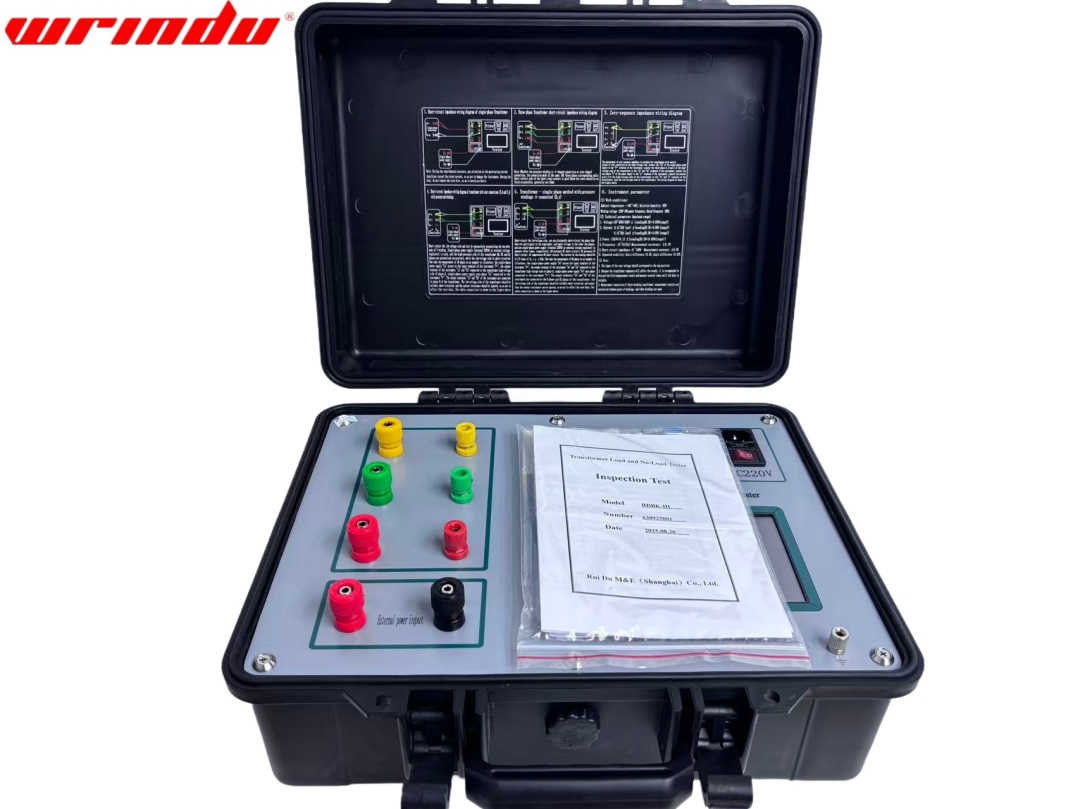
For precise measurement of transformer no-load and load losses, the RDBK-Ⅲ Transformer Load and No-Load Tester is a reliable and efficient solution.
The RDBK-Ⅲ integrates:
-
Advanced single-chip microcomputer technology
-
High-precision A/D synchronous AC sampling
-
Digital signal processing algorithms
This ensures accurate, stable, and repeatable test results, making it ideal for factory testing, site commissioning, and maintenance applications.
About Transformer Testing Solutions
Modern transformer testing plays a critical role in energy efficiency evaluation, condition assessment, and compliance with international standards. Selecting the right testing equipment helps utilities and industries reduce losses, improve system reliability, and achieve long-term cost savings.
For more information on transformer testing equipment or to request the latest quotation, please contact us directly.
For more HV Testing Equipment, visit official website: www.wrindu.com / www.hvtesters.com
Media Contact
Company Name: Rui Du Mechanical and Electrical (Shanghai) Co., Ltd.
Contact Person: Wrindu
Email: Send Email
Phone: 13661908522
Address:No.500 Jianyun Road, Pudong New Area
City: Shanghai
Country: China
Website: https://www.wrindu.com/