US Injection Molding Industry: 2026 Five-Axis Robot Demand Trend Forecast
Against the backdrop of a global shift towards accelerated factory automation (Bernstein 2026 Report), the US injection molding industry is entering a critical technological upgrade cycle. The North American smart injection molding market exceeded $6 billion in 2025. With the implementation of manufacturing reshoring policies and a surge in demand for automotive lightweighting and medical device precision, five-axis servo robots, as core equipment connecting "efficient production" and "flexible manufacturing," are expected to experience a multi-dimensional surge in demand in 2026. This article will analyze the demand logic and trends of US injection molding companies for five-Axis Robots from four dimensions: market drivers, segmented scenarios, technological integration, and policy compliance.
I. Manufacturing Reshoring and Capacity Expansion: The "Basic Demand Explosion Period" for Five-Axis Robots
The primary driver of demand in the US injection molding industry in 2026 will be the accelerated expansion of domestic production capacity. To address global supply chain risks, US federal and local government incentive policies for manufacturing reshoring have spurred an 18% year-on-year increase in new investment in domestic injection molding plants (North American Smart Injection Molding Market Report 2025), with automated equipment being a core component for achieving this increased capacity.
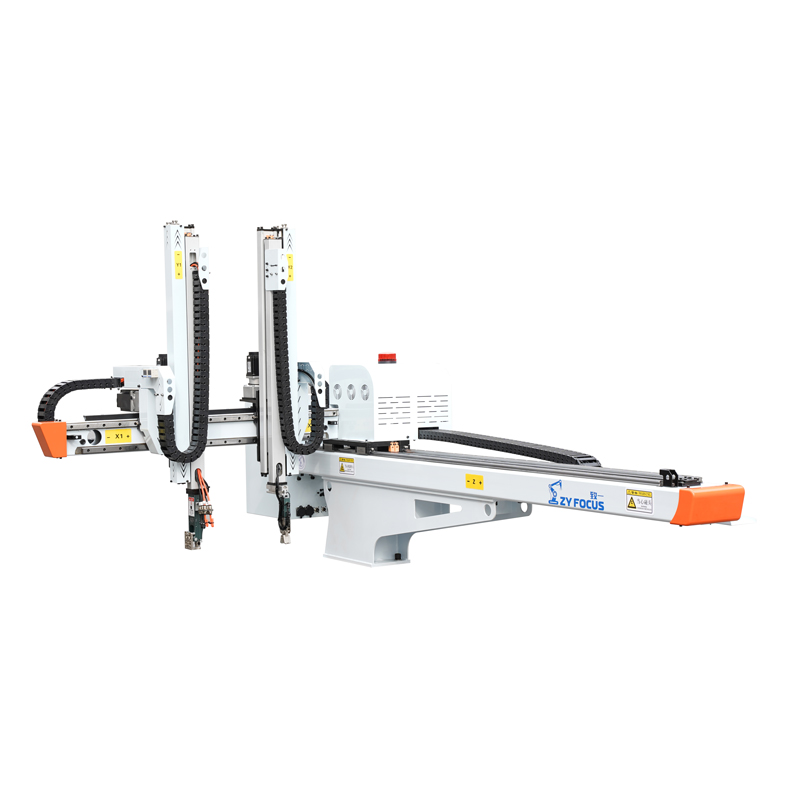
The reason five-axis Robotic Arms have become the "preferred automation solution" for new capacity is their balance between load capacity and spatial flexibility:For large injection molded parts (such as car bumpers and appliance housings), five-axis robotic arms can stably handle loads from 5-500kg (Talo Zobots technical data). Combined with their long-stroke design, they can cover the entire process of "Injection Molding Machine part removal—inspection—palletizing," replacing the multi-machine collaboration mode of traditional three-axis equipment and reducing equipment footprint by 30%.For small- to medium-batch customized production capacity (such as medical consumables and 3C accessories), the multi-axis linkage of five-axis robotic arms allows for rapid switching of work trajectories, reducing mold changeover time to one-third that of traditional equipment, adapting to the US market's trend of "small batches, multiple varieties" orders.
Furthermore, the labor shortage problem facing the US injection molding industry remains unresolved – the manufacturing job vacancy rate has long remained above 7%. Five-axis robots, through "24/7 uninterrupted operation," can improve production line efficiency by 40% and help companies reduce labor costs by 65% (data from five-axis multi-joint robot application cases), becoming a core tool for factories to "reduce costs and increase efficiency."
II. Differentiated Demand in Sub-sectors: Automotive and Medical Become the "Core Growth Drivers" for Five-Axis Robots
In 2026, the demand for five-axis robots in the US injection molding industry will be highly concentrated in two major areas: automotive lightweighting and precision manufacturing of medical devices, exhibiting differentiated technical requirements:
1. Automotive Injection Molding: Heavy-duty, high-precision five-axis robots become "standard equipment"
With the penetration rate of electric vehicles (EVs) in the US exceeding 35%, the demand for injection molding of battery pack components and lightweight interior parts is experiencing explosive growth. These components are generally characterized by their large size, complex structure, and strict tolerance requirements, making it difficult for traditional three-axis robots to meet processing needs: Battery pack covers (PP + fiberglass material) can weigh up to 25kg, requiring a five-axis robot to perform continuous "lifting-flipping-docking to assembly line" movements, with repeatability controlled within ±0.05mm (ABB IRB 1400 technical parameters) to prevent component collision damage; Automotive interior integrated components (such as integrated dashboard frames) require multi-process collaboration. Five-axis robots can achieve 360° angle adjustment via dual wrist rotation axes (J4/J5), working in conjunction with a vision system to complete snap-fit assembly, reducing the process cycle from 120 seconds to 80 seconds.
According to QYResearch, by 2026, the US automotive injection molding sector will account for 42% of total procurement of five-axis robots, with "heavy-duty five-axis servo robots" (load capacity 50-200kg) experiencing the fastest growth, projected to reach an annual growth rate of 15%.
2. Medical Devices: Clean, Traceable 5-Axis Robots Become a "Must-Have"
The US FDA's continuously upgraded requirements for the "sterility and traceability" of medical injection molded parts (such as syringes and artificial joint shells) are driving the development of 5-axis robots towards "high cleanliness + data-driven" solutions: Medical-grade 5-axis robots must meet IP67 protection standards, with stainless steel bodies and food-grade lubricants to prevent dust and oil contamination of parts; Integrated barcode scanning and data acquisition modules can record the processing time of each component and robot operating parameters in real time, achieving full-process traceability and meeting FDA 21 CFR Part 11 compliance requirements.
A case study from a North American medical injection molding company shows that after introducing 5-axis robots with "cleanliness + traceability functions," the product qualification rate increased from 92% to 99.5%, and compliance audit costs decreased by 40%. The demand for 5-axis robots in this field is projected to grow by 18% in 2026, becoming the second largest application scenario after automobiles.
III. Integration of Intelligent and Digital Technologies: Upgrading the Core Competitiveness of Five-Axis Robots
In 2026, when US injection molding companies selected five-axis robots, they no longer focused solely on "handling/processing capabilities," but rather placed greater emphasis on their integration with smart factory systems—AI algorithms, digital twins, and IoT connectivity became key selection criteria. This aligns with the global trend of "software-based" industrial robots (Bernstein 2026 report).
1. AI Process Optimization: Five-Axis Robots Achieve "Adaptive Production"
The new generation of five-axis robots, through the integration of AI algorithms, can learn in real-time fluctuations in injection molding process parameters (such as material temperature and mold temperature changes), automatically adjusting their running trajectory and gripping force:When flash occurs on injection molded parts, the AI system can analyze the correlation between the robot's part-picking speed and the mold opening and closing time, automatically optimizing the action rhythm and reducing the defect rate;
For density differences between different batches of materials, AI can dynamically adjust the clamping force (e.g., fine-tuning from 50N to 45N) to prevent part deformation.
A US injection molding plant's experience shows that AI-powered five-axis robotic arms can reduce process parameter debugging time from 4 hours to 1 hour and decrease material waste by 25%.
2. Digital Twins: A "Virtual Debugging Revolution" for Five-Axis Robotic Arms
Digital twin technology is changing the debugging model of five-axis robotic arms. By constructing a digital mapping of "robotic arm + injection molding machine + mold" in a virtual environment, companies can simulate the operating effects under different working conditions in advance: Before a new production line is put into operation, the motion trajectory of the five-axis robotic arm can be tested in a virtual scenario, avoiding the collision risks during physical debugging; For product iterations, the robotic arm program can be quickly modified in the digital twin system without downtime for adjustments, shortening the production cycle by 50%.
In 2026, leading US injection molding companies (such as Berry Global) listed "support for digital twin integration" as a core criterion for purchasing five-axis robotic arms, and it is expected that products with this function will account for more than 60%.
IV. Policy and Standard Upgrades: The "Compliance Demand-Driven" for Five-Axis Robots
In 2026, the demand for five-axis robots in the US injection molding industry will be driven by both energy efficiency standards and data security regulations, making compliance a "hard threshold" for enterprise selection:
1. Energy Efficiency Standards: Driving the "Energy Saving" of Five-Axis Robots
The US Department of Energy (DOE) plans to implement new energy efficiency standards for industrial equipment in 2027, requiring injection molding automation equipment to reduce energy consumption by 15% compared to current levels. This policy has already impacted procurement demand in 2026—five-axis robots with "energy recovery technology" are becoming mainstream:
During the robot's descent, the servo motor can convert gravitational potential energy into electrical energy (recovery rate up to 20%), reducing overall machine energy consumption;
Using a lightweight arm design (such as carbon fiber material) reduces motion inertia, further reducing power consumption.
Test data shows that energy-efficient five-axis robotic arms can reduce annual power consumption by 3000 kWh compared to traditional products, making them significantly attractive to injection molding companies in high-electricity-price regions of the United States (such as California).
2. Data Security: Five-axis robotic arms must meet "cybersecurity compliance" requirements.
With the popularization of the Industrial Internet, "data security" of five-axis robotic arms has become a new focus for American companies. According to NIST's (National Institute of Standards and Technology) "Guideline for Industrial Control Systems Security," five-axis robotic arms procured by 2026 must have:
encrypted data transmission capabilities (such as using the TLS 1.3 protocol) to prevent the theft of operating parameters and production data;
tiered access control to prevent unauthorized personnel from modifying the robotic arm program and ensure production safety.
For companies undertaking injection molding orders for military and aerospace industries, "data security design compliant with ITAR (International Trade in Arms Regulations)" has become a prerequisite for the procurement of five-axis robotic arms.
Summary of 5-Axis Robot Demand in the US Injection Molding Industry in 2026
2026 will be a pivotal year for the US injection molding industry, marking the shift of 5-axis robots from "optional equipment" to "strategic infrastructure":
In terms of demand scale, the total procurement volume is expected to exceed 12,000 units, with a market size of $980 million and an annual growth rate exceeding 12%;
In terms of product direction, "heavy-duty (automotive)," "cleanroom (medical)," and "intelligent (AI + digital twin)" will become the three mainstream categories;
In terms of selection logic, "compliance (energy efficiency, data security)," "integration (smart factory integration)," and "cost-effectiveness (investment payback period of 1-1.5 years)" will replace single "performance parameters" as the core basis for enterprise decision-making.
Media Contact
Company Name: Zhejiang Zhiyi Intelligent Robot Co., Ltd.
Email: Send Email
Country: China
Website: https://www.zhiyirobotics.com/