Views of the US economy have more to do with political leanings than economic analysis.
I still belong to the camp that The Economy isn't real, but rather something made up by people over time.
Don’t Miss a Day: From crude oil to coffee, sign up free for Barchart’s best-in-class commodity analysis.Additionally, using the US beef market as an economic indicator clouds the picture more than it clears it up.
What do we know about the US economy? Unfortunately, not much. That being said, there are a couple things I’m confident saying:
- One’s view of the economy depends on what side of the political aisle they sit on. Analysis of the economy is about economics, but politics. That means generally everything that is said comes with a side of “boiled sausage”. You get the meaning.
- As I’ve said before, the best definition of the “economy” I’ve heard comes from the long running animated television show South Park. Back in 2009, the third episode of season 13 titled “Margaritaville”, one of the 10-year-old characters (Kyle Broflovski) gives this speech: Listen, this all you need to know. The Economy is just an idea made up by people thousands of years ago. The Economy is not real, and yet it is real…Truly meaningless until we put our faith in it. Faith is what makes an economy exist. Without faith…it is only plastic cards and paper money.
With that out of the way, and with the April meeting of the US Federal Open Market Committee (FOMC) set to get under way Tuesday (April 28), do we have anything that acts as a clear economic indicator? We know Fed Chair Jerome Powell will continue to talk about US employment and inflation as his last meeting as Chairman concludes Wednesday. Based on these factors, it is unlikely the FOMC will make a change to the Fed fund rate this week. (I’ll talk more about what the market is showing us in Wednesday’s piece.)
As a market analyst, and thankfully not an economist, I could make the argument there are markets we can watch as economic indicators. What I mean by this is some markets show the combined effects of the US employment situation and inflation. Let’s start this part of our discussion with a look at Boxed Beef.
A number of years ago, I wrote a piece asking the question if US boxed beef markets can be used as an economic indicator. Theoretically, if demand for US beef remains strong, particularly if boxed beef prices are high, then we can assume US employment remains strong. (All while knowing what Felix Unger taught us about the word “Assume” in The Odd Couple.) There is an equally strong case to be made that we can’t believe what we see with boxed beef prices because they are generated daily by USDA. In my mind, that is more than an asterisk. It’s more like a big warning flag waving wildly in the wind. Particularly these days, when the US Ag Secretary has been tasked with reporting lower prices.
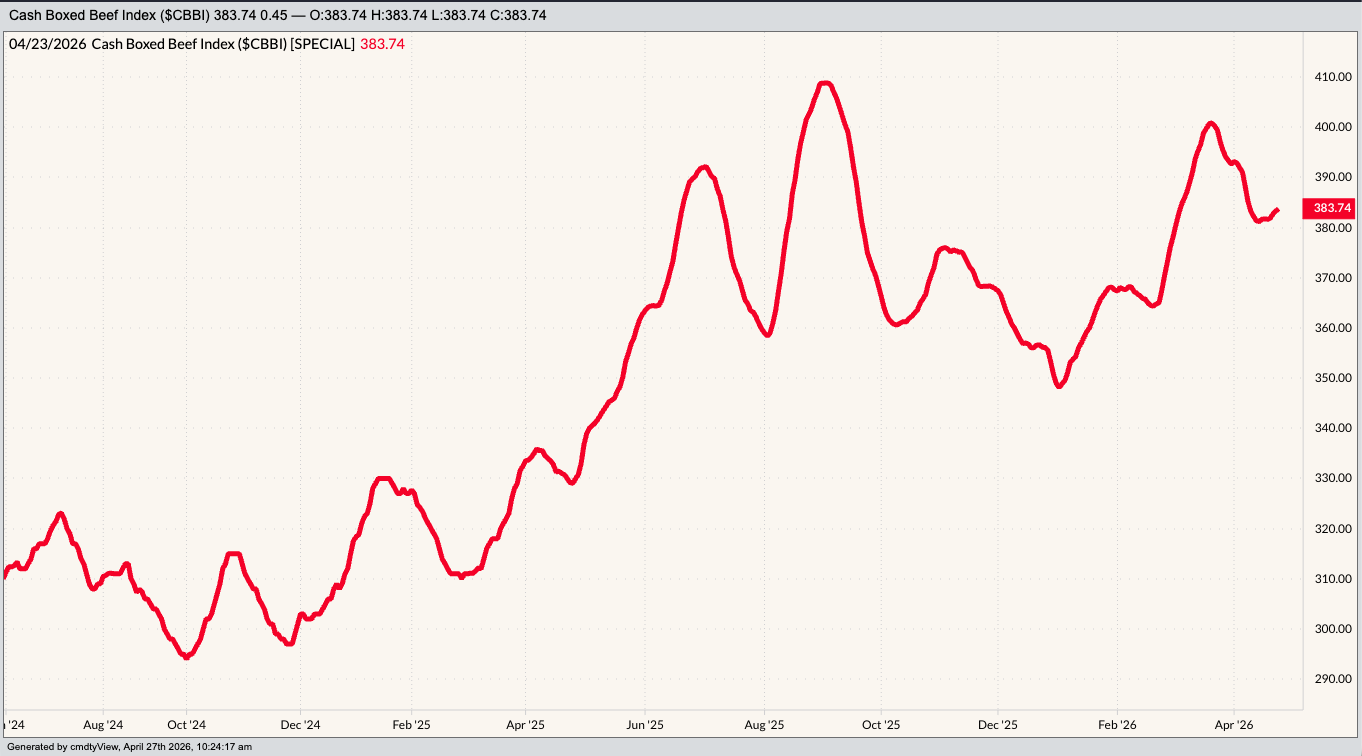
A look at the daily chart for the CME Boxed Beef Index ($CBBI), a combination of both choice and select prices, shows the type of predictable chaos I talked about with Michele Steele on StocktwitsTV last week. There are plenty of waves, indicating chaos, while the general trend (price direction over time) has been up. However, much depends on what happens next. Does the Index take out its previous high of $400.84 from March 20, or recent low of $381.18 from April 14.
Another piece of the puzzle, also as I talked about with Michele, are the numbers from monthly USDA Cold Storage reports. I’ll say it again, I am not a believer in government generated numbers, but I could make the argument the made-up numbers that supposedly show the way things were could be viewed as a bit more reliable than those numbers made-up as estimates for what will be.
Did I see anything in the March 31 Cold Storage report, released Friday, April 24, that indicated US consumer demand was switching from high priced beef to lower priced poultry due to inflation and/or employment concerns? Maybe. (Now I sound like an economist.) Total chicken stocks were down 3% month-to-month and 3% year-to-year. Meanwhile, total beef stocks were down 2% month-to-month and 3% year-to-year. This after USDA reported in its April 1 (Fools’ Day?) Cattle on Feed report that the number of head of cattle marketed during March was up 7% month-to-month. In other words, more cattle were turned into beef during March, as beef prices moved higher, but frozen stocks of beef declined.
Did the US increase its exports during March? At the end of February, total shipments of US beef projected calendar year export demand 5% below 2025. By the end of March, the lag had grown to 7%, raising the age-old question of slow exports due to lack of supply or lack of global demand? As I said at the beginning, we don’t know much about the US economy at this point. And as you can tell, the US beef market didn’t clear things up much.
It’s a good thing The Economy isn’t real.
On the date of publication, Darin Newsom did not have (either directly or indirectly) positions in any of the securities mentioned in this article. All information and data in this article is solely for informational purposes. For more information please view the Barchart Disclosure Policy here.
More news from Barchart
- Cattle, Hog Prices Are Starting to Lose Steam. Gasoline Prices, DOJ Meatpacking Investigation Are Key Catalysts to Watch.
- What Do We Know About the US Economy?
- ‘It’s Not Going to End Well’ for Investors Who ‘Get in Too Late’ to Volatile, Meme-Like Commodities. How to Trade the Chaos Instead.
- Dear Cattle Futures Traders, Mark Your Calendars for June 5