In a call-to-action commentary published in the American Psychologist, behavioral science leaders outline four trial designs to evaluate the effects of the adoption of Open Science practices
The Open Science (OS) movement is an effort by individual researchers, funding agencies, scientific journals, organizations and institutions to improve the quality of science, be more transparent and help the reproducibility of studies. To investigate OS efforts, behavioral scientists at The Feinstein Institutes for Medical Research and the University of Minnesota argue in the journal American Psychologist for experimentally testing the benefits and any unanticipated costs of adoption of OS research practices with randomized controlled trials (RCTs), the gold standard of scientific research.
This press release features multimedia. View the full release here: https://www.businesswire.com/news/home/20220428005226/en/
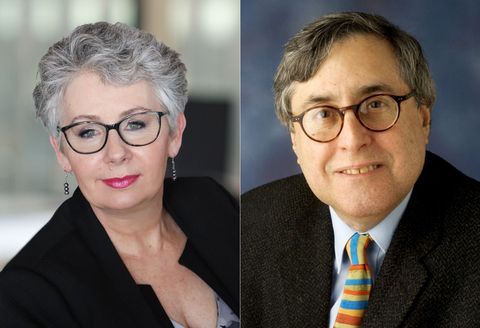
Dr. Karina Davidson (left) and Dr. Jerry Suls co-authored a commentary in American Psychologist. (Credit: The Feinstein Institutes for Medical Research)
OS practices have mostly come into action, especially with the advancement of technology, like registering research through online platforms or gaining access to digital data. However, some apprehension within the research community includes the fear of a “one-size-fits-all” approach to research, an unwillingness to share data and an added burden – particularly for young investigators – when designing research.
In the commentary, written by the Feinstein Institutes’ Karina Davidson, PhD, and Jerry Suls, PhD, and their colleague Alexander J. Rothman, PhD, the case is made for the need to test the effects of OS practices with RCTs. RCTs are a type of research study in which the subjects are randomly assigned to be part of the experimental group or comparison group – those not receiving the proposed treatment. These trials are the most efficient way to maintain statistical control over outside influences.
“Open Science will improve scientific research by encouraging more thorough practices, sharing of information and fostering collaboration,” said Dr. Davidson, director of the Institute of Health System Science at the Feinstein Institutes. “But these methods will only fulfill their promise if they to undergo rigorous scientific tests.”
The authors laid out four RCT trial design strategies to test OS practices. Such practices include data sharing, preregistering study protocols prior to actual data collection, and providing public access to all study materials. RCTs could appropriately test whether researchers should be offered financial incentives for data sharing, are assigned to OS education/assistance (vs. education/assistance unrelated to OS) and “scientific boot camps" to engage early-career scientists with OS practices and to determine some best practices for implementation.
“Our proposals for testing the effects of OS practices should spark conversations in the research community to evaluate methods and practices,” said Dr. Suls, a social psychologist and professor at the Feinstein Institutes’ Institute of Health System Science. “Many factors are at play and some practices may be associated with benefits to scientific discoveries; other practices may have unanticipated costs.”
“Collaboration is crucial to the scientific process,” said Kevin J. Tracey, MD, president and CEO of the Feinstein Institutes. "The practices laid out by Drs. Davidson and Suls will help investigators work collaboratively when designing and conducting research.”
About the Feinstein Institutes
The Feinstein Institutes for Medical Research is the home of the research institutes of Northwell Health, the largest health care provider and private employer in New York State. Encompassing 50 research labs, 3,000 clinical research studies and 5,000 researchers and staff, the Feinstein Institutes raises the standard of medical innovation through its five institutes of behavioral science, bioelectronic medicine, cancer, health system science, and molecular medicine. We make breakthroughs in genetics, oncology, brain research, mental health, autoimmunity, and are the global scientific leader in bioelectronic medicine – a new field of science that has the potential to revolutionize medicine. For more information about how we produce knowledge to cure disease, visit http://feinstein.northwell.edu and follow us on LinkedIn.
View source version on businesswire.com: https://www.businesswire.com/news/home/20220428005226/en/
Contacts
Matthew Libassi
631-793-5325
mlibassi@northwell.edu