One of the main roles of the spleen is to help the body’s immune system fight infections. The spleen does this through producing and regulating antibodies – antibody production is negatively affected in various conditions, including sepsis and autoimmune diseases like lupus. New research published in Science Advances by The Feinstein Institutes for Medical Research scientists shows that activation of the vagus nerve triggers the spleen, thereby regulating the production of antibodies. This research highlights how the nervous system regulates immunity and suggests potential for non-pharmalogical, vagus nerve modulation to treat a variety of diseases, like lupus and sepsis.
This press release features multimedia. View the full release here: https://www.businesswire.com/news/home/20240426059864/en/
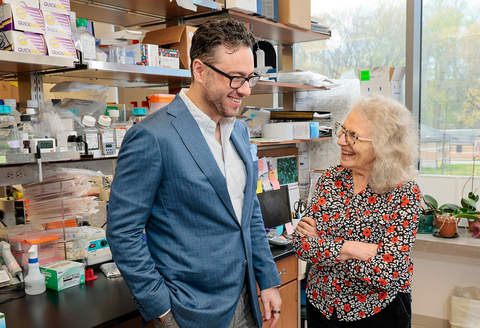
Drs. Stavros Zanos and Betty Diamond’s new research was published in Science Advances. (Credit: Feinstein Institutes)
This research –led by Betty Diamond, MD, director of the Institute of Molecular Medicine, in collaboration with Stavros Zanos, MD, PhD, associate professor in the Institute of Bioelectronic Medicine and Barbara Sherry, PhD, professor at the Feinstein Institutes – found that chronic stimulation of the vagus nerve led to a decrease in the production of specific antibodies by splenic B cells that attack and destroy foreign invaders and are able to prevent disease in the future by remembering what those substances look like. This decrease was associated with changes in the way B cells matured and survived in the body, as well as alterations in the functional organization of other immune cells.
“Although we have a good understanding of the role of the vagus nerve in the regulation of the inflammatory response and the innate immune system, this study provides new insights in how the vagus nerve regulates adaptive immunity and the functions of B cells,” said. Dr. Diamond. “Better understanding these mechanisms will elucidate how altered function of the vagus nerve in conditions like sepsis and autoimmune disease may impact immune function and could lead to new therapeutic approaches for these conditions.”
In the study, the Feinstein Institutes team discovered that acetylcholine released in response to vagus nerve stimulation (VNS) directly affects B cells by interacting with specific receptors on their surface, thereby altering their ability to produce signaling molecules and mature.
"Consistent stimulation of the vagus nerve in mice allows us to explore the therapeutic possibilities of bioelectronic medicine in new diseases,” said Dr. Zanos. “These exciting findings warrant further investigation and eventually studies in humans to explore the extent to which vagus nerve stimulation, and other bioelectronic medicine approaches, could become treatment options for diseases involving adaptive immunity."
For more than four decades, Dr. Diamond has dedicated her career to the study of DNA-reactive B cells, autoantibodies and their origin and effect on the body. In May 2022, in recognition of her breakthrough achievements in molecular medicine and original research, The National Academy of Sciences elected Dr. Diamond as one of its newest members.
Dr. Zanos’s research focus is on understanding the anatomy and physiology of the vagus nerve and the effects vagus nerve stimulation has in inflammation and cardiovascular diseases. This study builds on a 2021 paper by Dr. Zanos’ group in which they described the development and characterization of the first chronic VNS implant in mice. Recently, Dr. Zanos was awarded $6.7 million from the National Institutes of Health to lead a cross-insititonal research team to develop a detailed map of the anatomy of the human vagus nerve and all its more than 100,000 fibers.
“While we understand the spleen is an essential part of the immune system, finding that stimulation of the vagus nerve effects the regulation of adaptive immunity by this critical organ is novel and important," said Kevin J. Tracey, MD, president and CEO of the Feinstein Institutes and Karches Family Distinguished Chair in Medical Research. "The research by Drs. Diamond and Zanos highlights the need to continue producing knowledge about bioelectronic medicine's potential to treat or prevent autoimmune disease.”
The Feinstein Institutes for Medical Research is the global scientific home of bioelectronic medicine, which combines molecular medicine, neuroscience, and biomedical engineering. At the Feinstein Institutes, medical researchers use modern technology to develop new device-based therapies to treat disease and injury.
Building on years of research in molecular disease mechanisms and the link between the nervous and immune systems, our researchers discover neural targets that can be activated or inhibited with neuromodulation devices, like vagus nerve implants, to control the body's immune response and inflammation. If inflammation is successfully controlled, diseases – such as arthritis, pulmonary hypertension, Crohn's disease, inflammatory bowel diseases, diabetes, cancer and autoimmune diseases – can be treated more effectively.
Beyond inflammation, using novel brain-computer interfaces, Feinstein Institutes' researchers developed techniques to bypass injuries of the nervous system so that people living with paralysis can regain sensation and use their limbs. By producing bioelectronic medicine knowledge, disease and injury could one day be treated with our own nerves without costly and potentially harmful pharmaceuticals.
About the Feinstein Institutes
The Feinstein Institutes for Medical Research is the home of the research institutes of Northwell Health, the largest health care provider and private employer in New York State. Encompassing 50 research labs, 3,000 clinical research studies and 5,000 researchers and staff, the Feinstein Institutes raises the standard of medical innovation through its five institutes of behavioral science, bioelectronic medicine, cancer, health system science, and molecular medicine. We make breakthroughs in genetics, oncology, brain research, mental health, autoimmunity, and are the global scientific leader in bioelectronic medicine – a new field of science that has the potential to revolutionize medicine. For more information about how we produce knowledge to cure disease, visit http://feinstein.northwell.edu and follow us on LinkedIn.
View source version on businesswire.com: https://www.businesswire.com/news/home/20240426059864/en/
Contacts
Julianne Mosher Allen
516-880-4824
jmosherallen@northwell.edu