The findings published in the Journal of American Medical Association Neurology suggests the need for nuanced treatment responses for chronic epilepsy
For the millions of people worldwide living with severe forms of epilepsy, some do not respond to medication and it can be difficult to find lasting relief. Patients with a severe epileptic condition called focal treatment-resistant epilepsy (FTRE) could experience seizures that start in a specific part of their brain and continue to occur despite significant and appropriate efforts to control them with medication. A new FTRE study, led by Northwell Health’s Feinstein Institutes for Medical Research researchers and recently published in the Journal of American Medical Association (JAMA) Neurology, offers a hopeful but complex message: Many patients with FTRE often experience a significant drop in their seizure frequency over time, but there are questions about whether these improvements are solely due to specific treatments or to the natural course of the disease itself.
This press release features multimedia. View the full release here: https://www.businesswire.com/news/home/20251105638370/en/
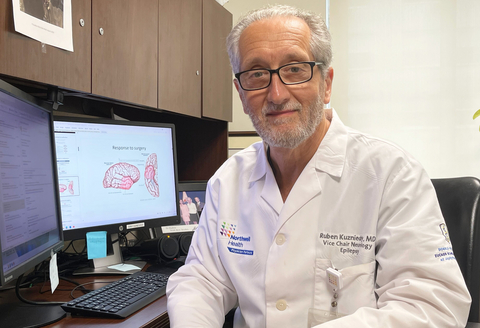
Dr. Ruben Kuzniecky led the study. (Credit: Feinstein Institutes).
Part of the Human Epilepsy Project 2 (HEP2), the longitudinal study, co-led by Ruben Kuzniecky, MD, a neurologist at Northwell’s Lenox Hill Hospital and member of The Feinstein Institutes for Medical Research, followed 146 adults across the United States who had FTRE and had tried at least four different seizure medications, all of which failed to be effective. For one-and-a-half to three years, the researchers carefully tracked their daily seizures, changes in medication and whether they used implanted devices like brain stimulators.
The study’s extensive findings revealed that nearly 70 percent of participants saw a significant decrease in how often they experienced seizures over the study period. While this is a substantial improvement in their daily lives, achieving complete seizure freedom for long stretches was less common – about 13 percent had no seizures for three months, 7.8 percent for six months, and just over 3 percent remained seizure-free for a year or more. The researchers also looked at how different treatments played a role. More than half of the patients had a new anti-seizure medication added, and two-thirds of that group experienced fewer seizures. Newer medications seemed particularly helpful in these improvements.
“This research sheds light on the challenges patients living with chronic, treatment-resistant epilepsy face,” said Dr. Kuzniecky, who is also a professor and vice chair of academic affairs at The Barbara and Donald Zucker School of Medicine at Hofstra/Northwell. “Our findings confirm that seizure frequency can decrease significantly over time, but they also raise important questions about whether these improvements stem from the natural history of the condition or from the active management strategies employed. Discovering this distinction is crucial for developing more precise and effective treatment approaches.”
The research also showed that while neuromodulation devices like deep brain stimulators, responsive neurostimulators and vagal nerve stimulators were found to influence seizure reduction, a key insight was that the seizure frequency in patients using these devices did not significantly differ from those who were not. This finding – combined with the varied treatment adjustments throughout the observational study – showed the complexity in isolating the precise impact of individual interventions. Researchers concluded that it remains unclear whether these long-term reductions reflect the natural evolution of FTRE or are primarily driven by the active, multifaceted management strategies implemented over time.
“This research offers invaluable insights into the dynamic nature of treatment-resistant epilepsy,” said Souhel Najjar, MD, chair of Neurology at Lenox Hill Hospital and Staten Island University Hospital. “By challenging conventional assumptions about intervention-specific ‘disease-modifying effects,’ this study sets the stage for more rigorous research to unravel the true drivers of improvement, ultimately guiding us toward more personalized and effective treatments for patients.”
Dr. Kuzniecky recently published in JAMA research predicting epilepsy drug resistance. He and his colleagues found that patients with frequent seizures at diagnosis and a history of psychiatric disorders are less likely to respond successfully to anti-seizure medications.
About the Feinstein Institutes
The Feinstein Institutes for Medical Research is the home of the research institutes of Northwell Health, the largest health care provider and private employer in New York State. Encompassing 50+ research labs, 3,000 clinical research studies and 5,000 researchers and staff, the Feinstein Institutes raises the standard of medical innovation through its six institutes of behavioral science, bioelectronic medicine, cancer, health system science, molecular medicine, and translational research. We are the global scientific leader in bioelectronic medicine – an innovative field of science that has the potential to revolutionize medicine. The Feinstein Institutes publishes two open-access, international peer-reviewed journals Molecular Medicine and Bioelectronic Medicine. Through the Elmezzi Graduate School of Molecular Medicine, we offer an accelerated PhD program. For more information about how we produce knowledge to cure disease, visit http://feinstein.northwell.edu and follow us on LinkedIn.
View source version on businesswire.com: https://www.businesswire.com/news/home/20251105638370/en/
Contacts
Julianne Mosher Allen
516-880-4824
jmosherallen@northwell.edu