(BPT) - Does location shape how happy we are at work? Or is it something deeper?
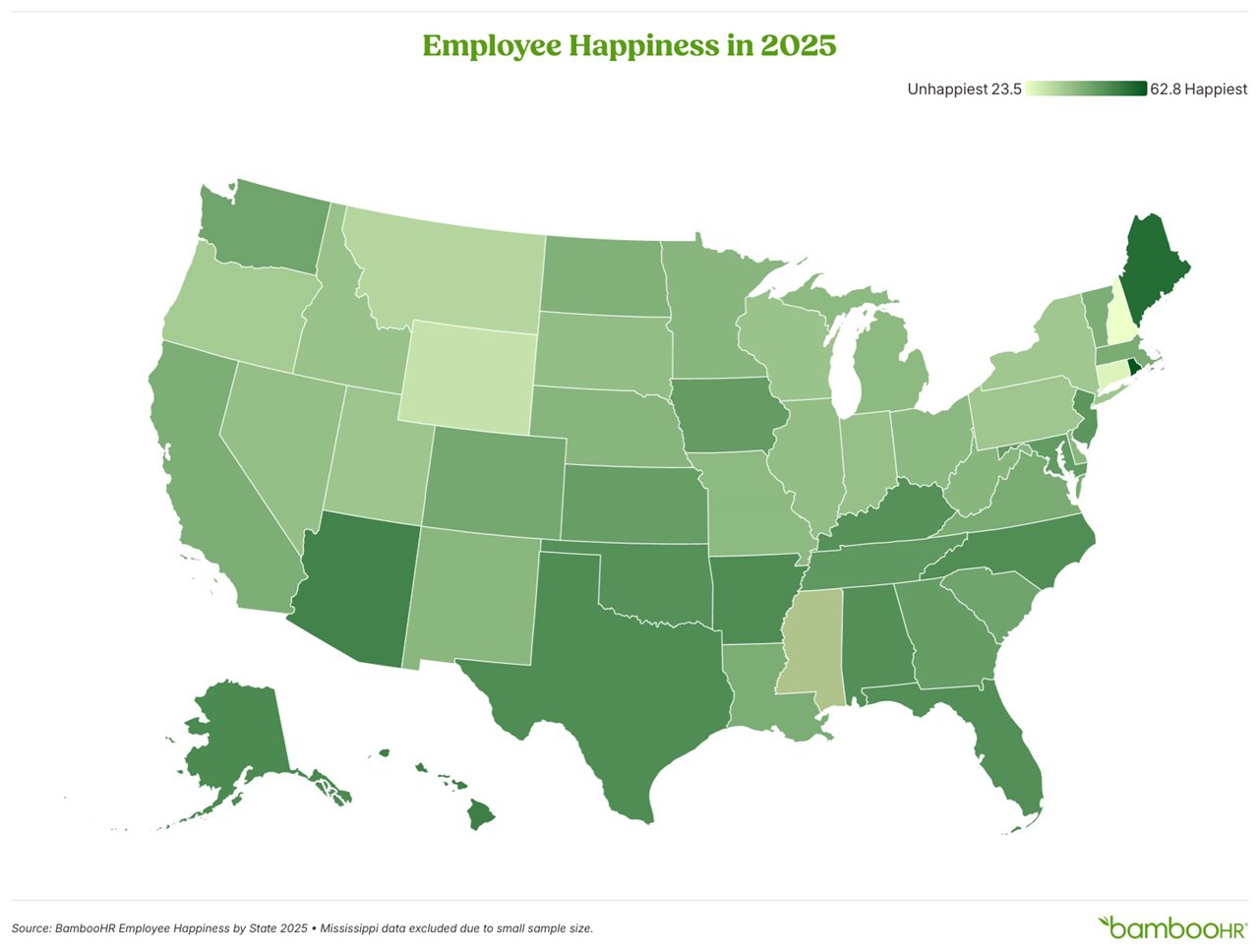
The latest Happiest States report from BambooHR finds that the gap between the states with the happiest and least happy workers stretches nearly 40 points. Surprisingly, those differences don't neatly follow regional lines.
With little to no correlation between happiness and geographical regions, the report shows the state-to-state disparities in worker satisfaction may point to a more hidden tension brewing beneath the surface. The grass isn't always greener on the other side and BambooHR finds that employee happiness is not about where you are, but where you can grow.
How is employee happiness measured?
The rankings are based on aggregated, anonymized employee Net Promoter Score (eNPS) survey data that asks one simple question: How likely are you to recommend your workplace?
Which states have the happiest and unhappiest employees?
Top 5 states in 2025
- Rhode Island (eNPS 62.8)
- Maine (57.2)
- Hawaii (53.1)
- Arizona (52.1)
- Alaska (50.6)
The report further shows that the mix of top-ranking employee satisfaction states shows no correlation with metrics commonly associated with quality of life, such as household income, education level, population density or political partisanship.
Bottom 5 states in 2025
- New Hampshire (eNPS 23.5)
- Connecticut (26.3)
- Wyoming (30.1)
- Montana (32.9)
- Oregon (35.5)
The search for patterns among the states with the unhappiest employees yields a similar mystery.
Money and education don't buy happy workers - New Hampshire and Connecticut rank highly on median income and education attainment, but they're the two unhappiest labor states in the country. Meanwhile, workers in states with lower earnings and education attainment, like those in Wyoming and Montana, echo similar levels of dissatisfaction.
How opportunity, not geography, is shaping employee happiness
In a cooling labor market, leaders who take turnover and retention metrics at face value run the risk of missing early signs of disengagement.
The findings challenge the assumption that location is a primary driver of employee happiness. If regional culture, politics, income levels or cost of living were decisive factors, satisfaction would cluster predictably by state. According to the report, it doesn't.
Instead, the clearest pattern in the data points to labor-market dynamics - specifically, access to opportunity.
While some high eNPS states have low turnover compared to the national median, many others have high turnover, challenging the tried-and-true wisdom that low turnover equals a content workforce.
States with both high employee happiness and high turnover, such as Texas, North Carolina and Florida, indicate that some state labor markets are likely benefiting from dynamic movement. These workforces may be focused on opportunities and growth over stability - workers are moving roles frequently, but they might feel optimistic about it.
Inversely, states with both low eNPS scores and low turnover proportions, like California and Minnesota, suggest that unsatisfied workers may be feeling stuck in their jobs, which can lead to workforce trends like job hugging or quiet quitting.
This data points to a hidden risk: The workforce may seem stable now, but if the winds change, there could be a mass exodus or performance plateau.
How business leaders can take workforce metrics to action
"Low turnover alone isn't a reliable measure of organizational health," says Wende Smith, senior director of people operations at BambooHR. "Real strength comes from purpose - from employees who understand why their work matters. When we dig deeper into employee sentiment, we can transform maintenance mode into sustainable performance."
Here's what leaders should keep in mind:
- Relying on surface metrics breeds complacency. Analyze eNPS and wellness surveys alongside key performance metrics and benchmark data to assess regional and industry performance.
- Stability is good, but apathy isn't. Meaningful work and growth opportunities are necessary to keep workforces engaged, even in stable environments.
- Transparency and support need to be visible. Leaders must offer consistent clarity and effective manager support, not just lip service.
Business leaders can't change the labor market overnight, but understanding how the market is actually impacting their workers could make all the difference for employee happiness and drive performance.