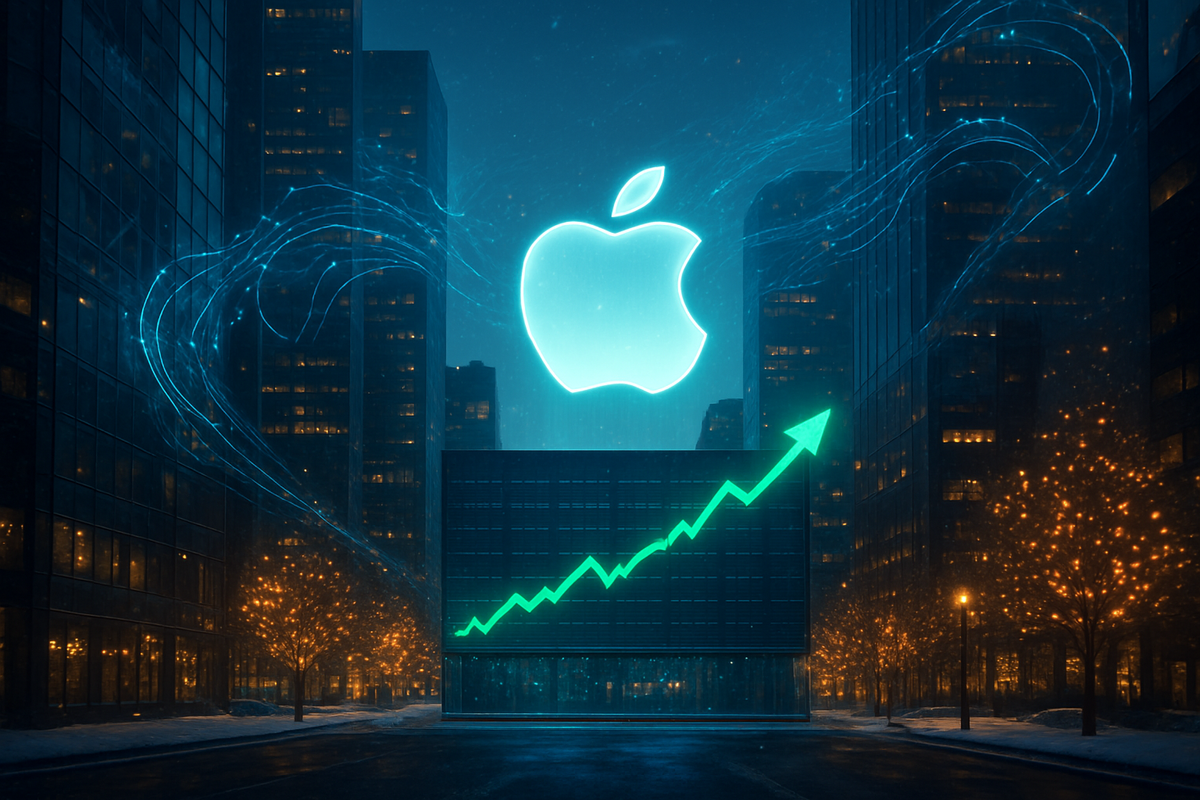
As the final full week of 2025 begins, the financial markets are witnessing a classic display of holiday resilience. Despite a shortened trading calendar and a fresh round of regulatory headwinds in Europe, the broader market indices are pushing toward record territory, anchored by the gravity of the world’s first $4 trillion company. Apple Inc. (NASDAQ: AAPL) remains the focal point of investor sentiment, serving as both a barometer for consumer health and a primary driver of the ongoing "AI Supercycle" that has defined much of this year’s historic bull run.
The market's performance on Monday, December 22, 2025, set a constructive tone for the week. The S&P 500 rose 0.6%, while the Nasdaq Composite gained 0.5%, buoyed by a "cool" Personal Consumption Expenditures (PCE) inflation report that has all but guaranteed a series of interest rate cuts in the coming year. For Apple, the week represents a period of consolidation following a massive 38% year-to-date gain, as the stock trades in a tight range between $271 and $274. While the holiday volume is expected to thin out significantly by the Wednesday early close, the underlying "risk-on" appetite suggests that the traditional Santa Claus Rally is well underway.
The AI Supercycle and the Italian Speed Bump
The narrative surrounding Apple in late 2025 is dominated by the success of the iPhone 17 series. According to recent data from IDC, Apple is on track to ship over 247 million units this year, a 6% year-over-year increase driven almost entirely by the integration of "Apple Intelligence." This on-device AI ecosystem has finally triggered the long-awaited "Supercycle," as users with older models find themselves unable to access the increasingly essential autonomous "Agentic AI" features that have become the hallmark of the 2025 tech landscape. The success in China has been particularly notable, where Apple’s market share surged past 20% in the fourth quarter, defying local competition.
However, the week did not start without friction. On Monday morning, news broke that Italian regulators had fined Apple $115 million (approximately 98.6 million euros) over its app-tracking transparency policies, alleging that the company’s privacy-centric approach unfairly disadvantaged third-party advertisers. While a $115 million fine is a drop in the bucket for a company with Apple's cash reserves, it underscores the persistent regulatory "trade war" between the U.S. and the EU. This fine is part of a broader trend of European enforcement under the Digital Markets Act (DMA), which has led to retaliatory threats from the U.S. Trade Representative against European giants like SAP SE (NYSE: SAP) and Siemens (OTC:SIEGY).
The timeline leading to this week’s market advance was paved by a mid-month tech rout that saw many overextended AI stocks pull back. Investors used that dip as a buying opportunity, fueled by the realization that the "Phase 3" of AI—monetization through software and services—is finally yielding tangible results. Apple has been a key beneficiary of this shift, moving beyond mere hardware sales to a model where AI-enhanced services provide a recurring, high-margin revenue stream that justifies its premium valuation.
Winners and Losers in the Holiday Sprint
In the shadow of Apple’s dominance, a clear bifurcation has emerged among its peers and partners. One of the week’s standout winners is Samsung Electronics (KRX:005930), which saw its shares jump nearly 4% on Monday. The rally was sparked by reports that Samsung’s HBM4 memory chips have successfully passed rigorous testing for Nvidia (NASDAQ: NVDA) systems, positioning the South Korean giant to reclaim lost ground in the high-stakes AI memory market. Furthermore, Samsung’s announcement of its 2nm mobile chip, the Exynos 2600, signals a direct challenge to Apple’s silicon supremacy in 2026.
Conversely, Broadcom (NASDAQ: AVGO) has found itself among the week’s laggards. Despite its role as a critical supplier to both Apple and Nvidia, Broadcom is grappling with margin compression and a slower-than-expected transition for its VMware customers. The stock remains down significantly from its December highs, as investors pivot toward companies with clearer software-driven AI growth. Similarly, Oracle (NYSE: ORCL) faced pressure as a massive $10 billion data center financing deal reportedly stalled, highlighting the growing difficulty of funding the astronomical infrastructure costs required for the next generation of AI.
Alphabet (NASDAQ: GOOGL) and Microsoft (NASDAQ: MSFT) have both trended upward this week, though for different reasons. Alphabet’s "Gemini Deep Research" tool has reinvigorated confidence in its search dominance, while Microsoft continues to reap the rewards of its OpenAI partnership, with Azure revenue commitments reaching a staggering $250 billion. Meanwhile, Nvidia (NASDAQ: NVDA) remains the "kingmaker," gaining 1.5% on Monday as rumors of eased export restrictions on its H200 chips to certain Chinese firms provided a late-year tailwind.
The Transatlantic Regulatory Rift and the Edge AI Shift
The current market advance is occurring against a backdrop of significant shifts in the global tech landscape. The most pressing trend is the escalating regulatory conflict between the U.S. and the European Union. As the EU continues to levy heavy fines on American firms like Apple and Meta Platforms (NASDAQ: META), the U.S. government has begun to signal a more aggressive stance, potentially targeting European industrial and tech firms with retaliatory tariffs. This "Digital Trade War" is a primary concern for multi-national investors heading into 2026, as it threatens to fragment the global digital economy.
Beyond regulation, the industry is witnessing a pivot toward "Edge AI"—the processing of artificial intelligence directly on consumer devices rather than in the cloud. Apple’s "Privacy-First" strategy has forced competitors like Google and Samsung to accelerate their own on-device capabilities. This shift has massive implications for the supply chain, particularly for Taiwan Semiconductor Manufacturing Company (NYSE: TSM). While TSMC remains the sole foundry capable of producing the advanced 2nm and 3nm chips required for this transition, it faces its own set of challenges, including high valuations and the looming "Physical AI" energy crisis, where the power demands of AI data centers begin to outpace global electrical grid capacity.
Historically, this period of the year is marked by low volatility and high optimism, but the 2025 version is unique due to the "India Pivot." Apple now manufactures roughly 20% of all iPhones in India, a strategic move to de-risk its supply chain from Chinese geopolitical tensions. This migration of high-tech manufacturing is creating a new class of industrial winners in South Asia, while simultaneously forcing Chinese manufacturers to innovate faster to maintain their relevance.
Looking Ahead: The 2026 AI Roadmap
As we look toward the new year, the short-term focus remains on the "Santa Claus Rally" and whether the Nasdaq can close at a fresh all-time high. However, the long-term outlook will be defined by how well companies can transition from AI experimentation to AI execution. For Apple, the challenge will be maintaining the momentum of the iPhone 17. While the Pro models have been runaway successes, the underperformance of the slim "iPhone Air" model suggests that consumers are prioritizing power and AI capability over aesthetics.
Investors should also watch for a potential strategic pivot from companies like Salesforce (NYSE: CRM), which are leading the charge toward outcome-based pricing models. If the industry moves away from per-seat licensing toward charging for the "work" performed by AI agents, it could fundamentally reshape the software-as-a-service (SaaS) sector. Furthermore, the "Physical AI" energy bottleneck will likely become a major investment theme in 2026, potentially benefiting utility and energy infrastructure companies that can support the massive power needs of the AI era.
A Season of Resilience and Strategic Realignment
The final trading days of 2025 are a testament to the enduring power of the technology sector to lead the broader market. Apple’s ability to maintain its $4 trillion valuation despite regulatory hurdles and intense competition is a clear signal of its central role in the modern economy. The "Santa Claus Rally" of 2025 is not just a seasonal anomaly; it is a reflection of a market that has found its footing in the "Phase 3" of the AI revolution, where tangible products and services are finally meeting the hype.
Moving forward, investors should keep a close eye on the VIX (volatility index), which currently sits below 15, suggesting a level of market complacency that could be tested by any unexpected geopolitical or regulatory shifts. The key takeaways for the coming months will be the pace of interest rate cuts and the continued evolution of on-device AI. As the holiday-shortened week concludes, the market appears poised for a strong start to 2026, led by a tech sector that has proven its ability to innovate through adversity.
This content is intended for informational purposes only and is not financial advice.