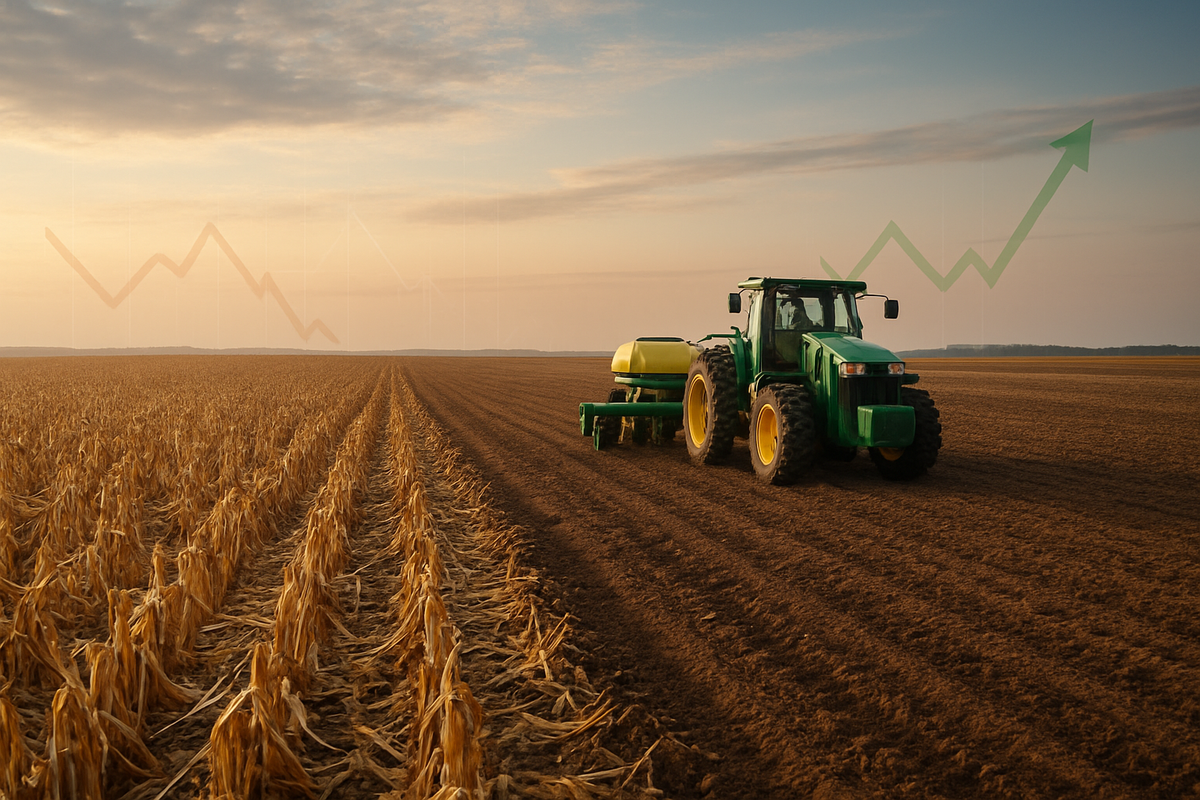
The United States Department of Agriculture (USDA) released its highly anticipated 2026 agricultural planting forecasts this week, signaling a strategic pivot for American farmers as they grapple with a massive global supply glut. During the annual Agricultural Outlook Forum, officials projected that corn plantings will decrease to 94 million acres, down from 98.8 million in 2025, while soybean plantings are expected to climb to 85 million acres. This shift represents a direct response to the "supply avalanche" left in the wake of 2025’s record-breaking harvests, which have pushed grain inventories to multi-year highs.
For the broader financial markets, these projections offer a sobering look at the "bottoming process" of the current agricultural cycle. While the reduction in corn acreage aims to stabilize prices, the persistent overhang of nearly 1.8 billion bushels of carryover stock remains a formidable headwind. Investors and commodity traders are now weighing the impact of these acreage shifts against a backdrop of new federal intervention policies and a cooling market for heavy farm machinery.
A Balanced Retreat: Analyzing the 2026 Projections
The USDA’s 2026 forecast of 94 million acres for corn and 85 million for soybeans comes at a time of extreme economic tension for the American heartland. The 5% drop in corn acreage is a necessary correction following a 2025 season that saw nearly 100 million acres planted, leading to a surplus that decimated farm-gate prices. Despite this reduction, the USDA still projects a corn crop of 15.76 billion bushels, assuming a trendline yield of 183 bushels per acre. This would still rank as the second-largest corn harvest in U.S. history, suggesting that the "oversupply" narrative is far from over.
The migration toward soybeans—up by 3.8 million acres—is driven by lower input costs and a slightly more favorable pricing outlook relative to corn. However, the projected farm-gate price for soybeans sits at a modest $10.30 per bushel, capped by a massive 180 million metric ton crop currently being harvested in Brazil. A critical and controversial factor in this year's forecast is the "Farmer Bridge Assistance" (FBA) program, a component of the recently passed One Big Beautiful Bill Act (OBBBA). The FBA provides subsidies of roughly $44.36 per acre for corn, which analysts argue has artificially incentivized farmers to keep corn acreage at 94 million, when market signals alone might have pushed it closer to 90 million.
Initial market reactions to the report were described by floor traders as "muted to bearish." December 2026 corn futures struggled to hold the $4.60 level, while soybean futures saw a minor technical bounce toward $11.40 on short-covering. The consensus among grain analysts is that while the acreage shift is a step toward rebalancing the market, the sheer volume of existing grain in storage bins across the Midwest will prevent any significant price rally in the first half of the year.
Winners and Losers: Corporate Fallout from the Farm Belt
The ripples of the USDA forecast are being felt acutely across the industrial and agribusiness sectors. Perhaps the most visible casualty of the current cycle is Deere & Company (NYSE: DE). Following the USDA’s report, the machinery giant issued a cautious 2026 outlook, projecting net income between $4 billion and $4.75 billion—well below the $5.3 billion consensus. Management warned that 2026 would likely mark the "bottom of the large ag cycle," with a projected 15-20% decline in sales for high-horsepower equipment as farmers tighten their belts in a low-margin environment.
In contrast, Corteva (NYSE: CTVA) appears more resilient. The seed and crop protection specialist guided for a 7% growth in Operating EBITDA, bolstered by a $610 million resolution with Bayer that has accelerated its corn trait licensing. While grain prices are low, farmers still require high-quality seeds to maximize yield on their reduced acreage, providing a steadier revenue stream for Corteva than for equipment manufacturers.
For the giant grain merchants, Archer-Daniels-Midland (NYSE: ADM) and Bunge Global SA (NYSE: BG), the outlook is a mixed bag. Both companies are handling record volumes of grain, but thin processing margins and uncertainty surrounding the 45Z Clean Fuel Production Credit have dampened profit expectations. Bunge's 2026 earnings guidance missed Wall Street estimates, reflecting the difficulty of maintaining high margins when the market is awash in cheap feedstock. Meanwhile, the Teucrium Corn Fund (NYSE Arca: CORN) and Teucrium Soybean Fund (NYSE Arca: SOYB) continue to see high volatility as they track the fluctuating futures market, while the Invesco DB Agriculture Fund (NYSE Arca: DBA) has become a preferred haven for those looking to hedge grain exposure with "soft" commodities like sugar and cocoa.
Broader Industry Trends and Historical Context
The current shift in the U.S. agricultural landscape is reminiscent of the mid-2010s, where several years of record production led to a long period of depressed prices and consolidation in the sector. However, the 2026 scenario is complicated by the increasing intersection of agriculture and energy policy. The delay in clarifying federal tax credits for sustainable aviation fuel (SAF) has left many soybean processors in a state of limbo, unsure if the "green premium" for soybean oil will materialize in time to offset the increased acreage.
The "Acreage War" between corn and soybeans also highlights a growing divide between market-driven economics and policy-driven production. The FBA subsidies are intended to provide a safety net, but they risk prolonging the surplus by delaying the necessary contraction in planting. This policy-induced floor on production is a significant departure from historical precedents where market crashes led to rapid drops in acreage. Furthermore, the global landscape has changed; with Brazil and Argentina expanding their capacity, the U.S. is no longer the undisputed "price setter," making these USDA forecasts critical indicators of how much global market share American farmers are willing to defend at lower price points.
The Road Ahead: What to Watch in 2026
As we move into the spring planting season, the market's focus will shift from USDA projections to actual "boots on the ground" conditions. The short-term outlook remains tethered to weather patterns across the "I-states" (Illinois, Indiana, Iowa), where any planting delays could spark a much-needed relief rally in grain prices. However, long-term sustainability for the sector will require a significant uptick in export demand or a breakthrough in the domestic biofuels market to clear the existing inventories.
Strategic pivots are already underway. Farmers are increasingly adopting precision agriculture technology to lower their "cost per bushel," a trend that may eventually benefit tech-heavy ag-firms even as traditional machinery sales slump. Additionally, if soybean oil demand for renewable diesel continues to grow, we may see the 85-million-acre mark become the new floor for soybean plantings in future years, marking a permanent structural shift in U.S. crop rotations.
Final Assessment: A Market in Transition
The 2026 USDA planting forecasts paint a picture of an industry in the midst of a painful but necessary transition. The pivot from 98.8 million to 94 million acres of corn is a concession to the reality of oversupply, yet the abundance of grain ensures that prices will remain under pressure for the foreseeable future. For livestock producers, this era of cheap feed provides a golden opportunity for herd expansion and margin improvement, acting as a silver lining in an otherwise cloudy agricultural forecast.
For investors, the key takeaway is the divergence in performance between "input" companies like Corteva and "capital expenditure" companies like Deere & Company. As the agricultural cycle bottoms out, the market will reward those firms that can navigate a low-price environment through technological innovation and diversified revenue streams. In the coming months, the focus will remain on the USDA’s monthly WASDE (World Agricultural Supply and Demand Estimates) reports, which will provide the final word on whether the 2026 shift was enough to finally break the back of the "supply avalanche."
This content is intended for informational purposes only and is not financial advice.