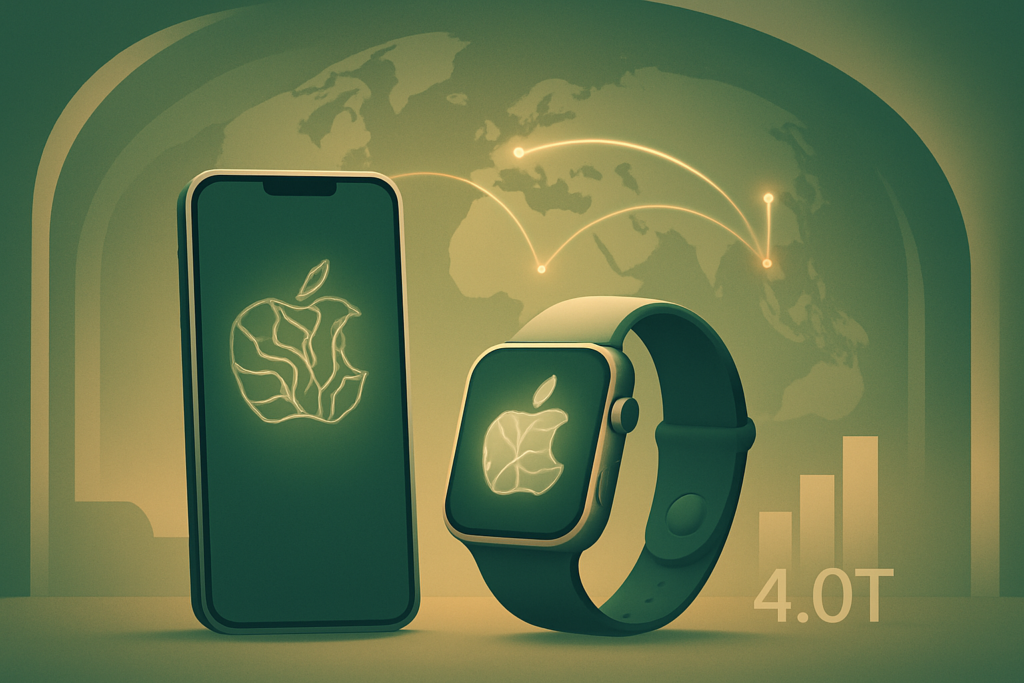
As of December 23, 2025, Apple Inc. (NASDAQ: AAPL) stands as a monument to corporate resilience and iterative brilliance. For years, skeptics argued that the "age of innovation" at Apple had plateaued, yet the closing weeks of 2025 tell a different story. With a market capitalization comfortably sustained above the historic $4 trillion threshold, Apple has defied gravity, propelled by a "supercycle" of hardware upgrades and a fundamental pivot toward generative artificial intelligence (AI).
The company is currently in a state of profound transition. While the iPhone remains its financial bedrock, the integration of "Apple Intelligence" and a burgeoning $100 billion-plus services business have redefined its value proposition. However, this success is shadowed by unprecedented regulatory scrutiny in the European Union and the United States, as well as a generational leadership shift that could see the departure of CEO Tim Cook in the near future. This article explores the mechanics of the world’s most valuable enterprise at the close of 2025.
Historical Background
Apple’s journey is often divided into eras: the iconoclastic founding by Steve Jobs and Steve Wozniak in 1976; the "dark ages" of the 1990s; the renaissance of the 2000s (iPod, iPhone, iPad); and the operational mastery of the Tim Cook era.
Under Cook’s leadership since 2011, Apple transformed from a product-centric hardware company into a massive ecosystem services provider. The last five years, in particular, have been marked by the transition to "Apple Silicon," which gave the company an unrivaled performance-per-watt advantage in its hardware, and the recent 2024-2025 pivot into on-device AI. What began in a garage in Los Altos has become a global sovereign-level economic force, dictates global supply chains, and sets the standard for consumer privacy and design.
Business Model
Apple’s business model is a "walled garden" ecosystem designed for maximum customer lifetime value. It operates through five primary segments:
- iPhone: Still the primary driver, accounting for roughly 50% of total revenue.
- Services: The high-margin crown jewel, including the App Store, iCloud+, Apple Music, Apple Pay, and the newly launched "Apple Intelligence Pro" subscription tier.
- Wearables, Home, and Accessories: Including the market-leading Apple Watch and AirPods.
- Mac: High-end computing powered by proprietary M-series chips.
- iPad: The dominant force in the global tablet market.
The brilliance of the model lies in its "sticky" nature. Once a user enters the ecosystem via an iPhone, the cost of switching—both financial and cognitive—becomes prohibitively high. In 2025, Apple has successfully begun monetizing AI not just as a hardware feature, but as a recurring software service, creating a dual-engine growth model.
Stock Performance Overview
Apple’s stock performance over the last decade has been nothing short of legendary.
- 1-Year Performance (2025): AAPL shares have gained approximately 38% year-to-date, significantly outperforming the S&P 500. This was driven by the successful launch of the iPhone 17 and the realization of the AI supercycle.
- 5-Year Performance: Investors have seen a return of over 200%, as Apple navigated the pandemic, supply chain crises, and the transition to high-margin services.
- 10-Year Performance: Apple has been a cornerstone of the "Magnificent Seven," with a total return exceeding 800% when accounting for dividends and buybacks.
Notable moves in 2025 occurred following the Q3 earnings report, where the company proved that its AI strategy was actually driving hardware upgrades—a point that had been a major source of investor anxiety in 2024.
Financial Performance
For the fiscal year 2025, Apple’s financials are a testament to its pricing power:
- Revenue: Reached an all-time high, crossing the $400 billion mark for the first time.
- Services Growth: The segment generated $109 billion in revenue with a staggering 75% gross margin.
- Net Income: Consistently high, with the company maintaining a net profit margin near 26%.
- Cash Position: Despite aggressive share buybacks (routinely exceeding $20 billion per quarter), Apple maintains a cash pile of over $160 billion, providing a massive "war chest" for R&D and strategic acquisitions.
- Valuation: As of late 2025, Apple trades at a forward P/E ratio of roughly 32x—a premium compared to its historical average but justified by analysts due to the recurring nature of its AI services revenue.
Leadership and Management
The "Cook Era" appears to be approaching its twilight. Tim Cook, 65, is rumored to be preparing for a transition to Executive Chairman by 2026.
- John Ternus: The Senior VP of Hardware Engineering has emerged as the heir apparent. His prominent role in the iPhone 17 and AI launches has signaled to the street that he is the choice for a "product-first" future.
- Management Stability: The recent departures of CFO Luca Maestri and COO Jeff Williams have marked the most significant C-suite turnover in a decade, yet the transition has been handled with Apple’s characteristic discipline, avoiding any "key person risk" sell-offs.
- Strategy: The leadership remains focused on "Privacy as a Human Right," a marketing pillar that has allowed Apple to position its AI as safer and more personal than competitors like Google (NASDAQ: GOOGL) or Meta (NASDAQ: META).
Products, Services, and Innovations
The 2025 product lineup is dominated by the iPhone 17 series. Unlike previous iterative updates, the iPhone 17 features dedicated NPU (Neural Processing Unit) enhancements specifically designed for "Agentic AI"—Siri’s ability to perform complex tasks across multiple apps without user intervention.
- Apple Intelligence: The suite has matured from a 2024 beta into a robust ecosystem. The "Apple Intelligence Pro" tier offers high-end photo editing and complex coding assistants, marking Apple's successful entry into software-as-a-service (SaaS) for consumers.
- Vision Pro & The Pivot: While the $3,499 Vision Pro was a commercial disappointment (selling fewer than 500,000 units by late 2025), Apple has used the technology to develop more affordable "Vision" headsets and AR Smart Glasses, expected to launch in 2026.
- Apple Silicon: The M5 chip family continues to lead the industry in efficiency, keeping the Mac and iPad segments highly competitive against Qualcomm’s (NASDAQ: QCOM) recent incursions.
Competitive Landscape
Apple faces a three-front war:
- High-End Smartphones: Samsung remains the primary global rival, though Apple’s dominance in the "premium" segment ($800+) remains unchallenged in the US and Europe.
- Generative AI: Apple is playing catch-up to Microsoft (NASDAQ: MSFT) and Google in cloud-based LLMs but is winning the race for on-device AI, which offers superior latency and privacy.
- China: Local heroes like Huawei have staged a comeback. However, Apple regained a 20% market share in China by late 2025, proving that the brand’s "aspirational" status is resilient.
Industry and Market Trends
Three macro trends are currently defining Apple’s trajectory:
- The On-Device AI Shift: Processing AI locally rather than in the cloud is the new industry standard, a trend Apple essentially forced upon the market.
- Supply Chain "De-Risking": Apple has aggressively moved production out of China. By December 2025, 20% of global iPhone production is now based in India, and Vietnam has become the primary hub for AirPods and iPads.
- The Subscription Economy: Consumers are increasingly fatigued by hardware prices, leading to the rise of "iPhone as a Service" programs and high-margin software subscriptions.
Risks and Challenges
Despite its $4 trillion valuation, Apple is not without significant risks:
- Regulatory Hostility: The EU’s Digital Markets Act (DMA) has forced Apple to open its ecosystem to third-party app stores, threatening the lucrative "Apple Tax."
- Antitrust Litigation: The US Department of Justice (DOJ) lawsuit, which alleges Apple maintains an illegal monopoly in the smartphone market, is a "black cloud" that could result in structural changes by 2027.
- China Geopolitics: While supply chains are diversifying, Apple still relies on China for 80% of its total volume and a significant portion of its sales growth. Any escalation in US-China trade tensions is a direct threat.
- Vision Pro Failure: If the pivot to cheaper AR/VR hardware fails, Apple will have spent billions on a "category" that may never reach mass adoption.
Opportunities and Catalysts
- The AI Monetization Upside: Most analysts believe the market has yet to fully price in the long-term revenue from Apple Intelligence subscriptions.
- Emerging Markets: India is no longer just a manufacturing hub; it is becoming a top-five market for Apple sales, with a burgeoning middle class eager for the brand.
- Health Tech: Rumors of non-invasive glucose monitoring in the 2026 Apple Watch could revolutionize the company’s "Health" segment, tapping into a multi-billion dollar medical device market.
Investor Sentiment and Analyst Coverage
Wall Street is overwhelmingly bullish. Major firms like Wedbush and Morgan Stanley have set 2026 price targets as high as $350 per share.
- Institutional Support: Apple remains the top holding for the majority of mutual funds and ETFs, providing a steady "floor" for the stock price.
- Hedge Fund Moves: Several notable "Tiger Cub" funds increased their positions in Q3 2025, betting on the AI Pro subscription's ability to drive margin expansion.
- Retail Chatter: On platforms like X and Reddit, sentiment has shifted from "Apple is boring" to "Apple is the only AI play that matters for consumers."
Regulatory, Policy, and Geopolitical Factors
The geopolitical landscape of 2025 is a minefield for Apple. In the EU, the company has faced fines exceeding €2.3 billion for anti-steering violations. In the US, the outcome of the DOJ case will likely define the company's next decade. Furthermore, as a global symbol of American corporate power, Apple is often a target for retaliatory policy in international trade disputes. The company’s "Privacy first" policy is also a double-edged sword, occasionally putting it at odds with law enforcement and intelligence agencies globally.
Conclusion
Apple Inc. enters 2026 as a company that has successfully reinvented itself once again. By tethering its legendary hardware to a proprietary AI ecosystem, it has created a new reason for its 2 billion active device users to upgrade. While the regulatory environment is the most hostile it has ever been, and the Vision Pro remains a work in progress, the company’s financial fortress and $109 billion services business provide an unparalleled cushion.
For investors, the key watch-items for 2026 will be the official announcement of the CEO succession, the conversion rate of free AI users to "Pro" subscribers, and the first major court dates in the DOJ antitrust trial. In the world of $4 trillion valuations, Apple remains the benchmark against which all others are measured.
This content is intended for informational purposes only and is not financial advice.