Date: January 9, 2026
Introduction
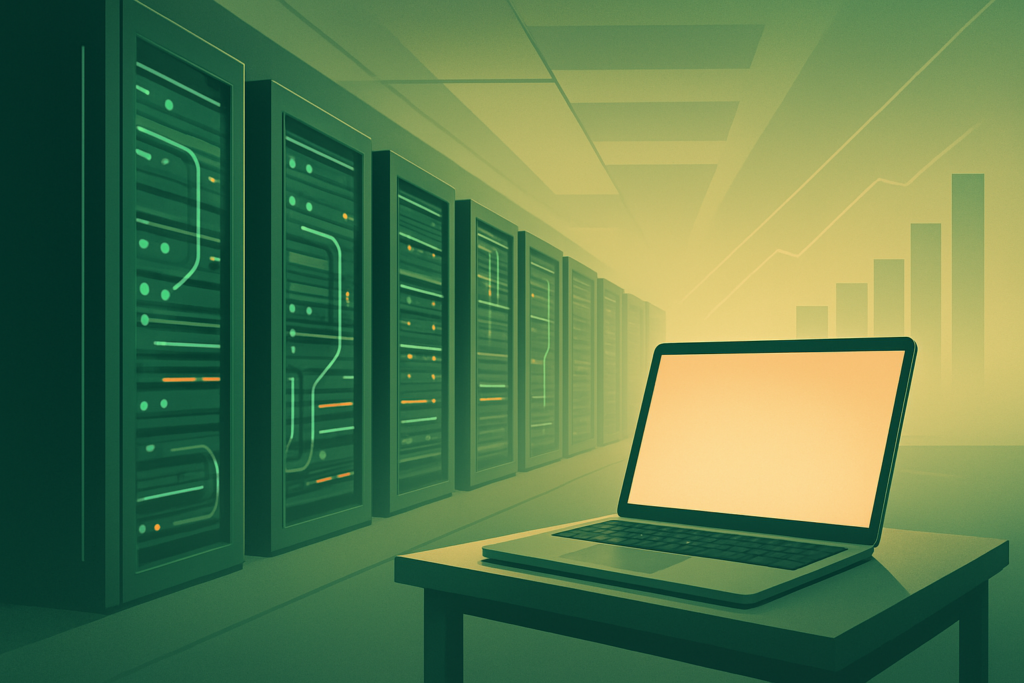
In the rapidly shifting landscape of the technology sector, few companies have successfully navigated as many industry-wide transformations as Dell Technologies Inc. (NYSE: DELL). Once the poster child for the direct-to-consumer PC revolution, Dell has reinvented itself into a cornerstone of the global artificial intelligence (AI) infrastructure. As of early 2026, Dell stands at a critical juncture: it is no longer just a hardware provider but a primary architect of the "AI Factory"—a specialized ecosystem designed to help enterprises build and scale their own generative AI models. With the rise of agentic AI and a massive corporate PC refresh cycle underway, Dell’s strategic positioning has rarely been more vital, though it faces unique challenges ranging from margin compression to complex geopolitical decoupling.
Historical Background
The Dell narrative began in 1984 in a University of Texas dorm room, where 19-year-old Michael Dell founded PC’s Limited with $1,000 and a vision to sell custom-built computers directly to consumers, bypassing the middleman. This disruptive "direct model" allowed Dell to dominate the 1990s and early 2000s, becoming the world’s largest PC seller by 2001.
However, as the PC market matured and mobile computing rose, Michael Dell recognized the need for a radical shift. In 2013, he took the company private in a $24.4 billion deal—one of the largest leveraged buyouts in history—to execute a long-term turnaround away from public market scrutiny. During its private tenure, Dell orchestrated the transformative $60 billion acquisition of EMC Corporation in 2016, a move that integrated world-class storage and virtualization (via VMware) into its portfolio. Dell returned to the public markets in December 2018, repositioned as an enterprise infrastructure powerhouse. Today, the company’s history is defined by this relentless evolution: from mail-order PCs to private restructuring, and finally, to the center of the AI-driven data center.
Business Model
Dell operates a sophisticated dual-engine business model divided primarily into two segments:
- Infrastructure Solutions Group (ISG): This segment is the growth locomotive of the company. It includes high-performance servers, storage solutions, and networking equipment. Within ISG, the "AI Server" sub-category has become the premier revenue driver, focusing on liquid-cooled, high-density GPU racks (utilizing NVIDIA, AMD, and Intel chips) for cloud providers and large enterprises.
- Client Solutions Group (CSG): This remains the high-volume foundation of the business, encompassing commercial and consumer PCs, workstations, and peripherals. Dell’s commercial business (Latitude, Precision) is its crown jewel, benefiting from a "stickier" corporate client base and higher margins than the consumer XPS and Inspiron lines.
Dell leverages a world-class global supply chain and a massive direct sales force, allowing it to provide end-to-end support—a significant competitive advantage over pure-play hardware vendors.
Stock Performance Overview
As of January 2026, Dell’s stock performance reflects its successful pivot to AI:
- 1-Year Performance: Over the past year, DELL has seen an 11.2% total return. While revenue growth has been explosive, the stock has faced headwinds due to fluctuating component costs and the "margin mix" associated with low-margin, high-volume AI server deals.
- 5-Year Performance: Long-term investors have seen a remarkable ~238% total return. This period marks the market’s realization that Dell was perfectly positioned to capture the transition from legacy data centers to AI-optimized infrastructure.
- 10-Year Performance: Since the 2016 merger and 2018 re-listing, Dell has delivered a staggering ~945% total return. This performance has consistently outperformed the S&P 500 and the broader technology hardware sector, rewarding Michael Dell’s long-term conviction during the privatization era.
Financial Performance
Dell’s financial profile in early 2026 is characterized by massive top-line expansion and strategic capital management. For Fiscal Year 2025, Dell reported revenue of $95.6 billion. Looking ahead to the end of FY2026, the company has raised guidance significantly, projecting revenue of approximately $111.7 billion—a 17% year-over-year increase.
Non-GAAP EPS is projected to reach $9.92, driven by the record $18.4 billion backlog in AI servers. However, profitability metrics have seen pressure; gross margins dipped below 20% in late 2025 as the costs of high-bandwidth memory (HBM) and DDR5 DRAM surged. To counter this, Dell has maintained a disciplined share repurchase program, authorizing an additional $10 billion in buybacks, and increased its dividend by 18%, signaling confidence in its long-term free cash flow generation.
Leadership and Management
The leadership team is anchored by Founder and CEO Michael Dell, who remains the company’s largest shareholder and strategic visionary. His leadership style is characterized by a "long-view" approach, often prioritizing market share and architectural shifts over quarterly earnings smoothing.
Supporting him is Vice Chairman and COO Jeff Clarke, widely regarded as the operational architect behind Dell’s supply chain dominance. Under Clarke’s tenure, Dell has pioneered "the speed of Dell" initiative, reducing the time from GPU allocation to fully operational liquid-cooled rack deployment. In late 2025, David Kennedy took over as permanent CFO, bringing a focus on rigorous balance sheet management to navigate the volatile "memory super-cycle" currently impacting the industry.
Products, Services, and Innovations
Innovation at Dell is currently concentrated on the "AI Factory" framework.
- PowerEdge XE9712: This flagship server, developed in collaboration with NVIDIA (NASDAQ: NVDA), utilizes the Blackwell architecture and is the first to offer liquid-cooled NVL72 racks at scale.
- AI PCs: At the 2026 Consumer Electronics Show (CES), Dell unveiled a revitalized XPS lineup featuring built-in Neural Processing Units (NPUs) capable of running local 7B-parameter models.
- Apex: Dell’s consumption-based "as-a-service" model has expanded into AI, allowing companies to lease AI compute power rather than committing to massive upfront capital expenditures. This "cloud-like" experience for on-premise hardware has become a key differentiator.
Competitive Landscape
Dell competes in a "clash of titans" across its business segments:
- Super Micro Computer (NASDAQ: SMCI): While SMCI is often faster to market with new chip architectures, Dell’s advantage lies in its global services and support network. Enterprises often choose Dell for the security of its 24/7 onsite support and integrated storage solutions.
- Hewlett Packard Enterprise (NYSE: HPE): HPE has pivoted toward networking with its Juniper acquisition, while Dell has doubled down on Blackwell-class GPU density. Currently, Dell holds a lead in AI server revenue share (~8.3% vs. HPE’s ~3.0%).
- Lenovo (HKG: 0992): Lenovo remains the volume leader in global PCs. Dell ceded some consumer market share in 2025 to focus on the higher-margin commercial "AI PC" segment.
Industry and Market Trends
The "Windows 11 Refresh" is currently the dominant trend in the Client Solutions segment. With Microsoft (NASDAQ: MSFT) ending support for Windows 10, an estimated 500 million enterprise PCs reached end-of-life in 2025, triggering a replacement cycle that Dell is uniquely positioned to capture.
Simultaneously, the industry is moving from "Training AI" to "Inference AI." This shift favors Dell, as inference—the running of AI models—increasingly happens on-premise or at the "edge" (local servers) rather than in centralized hyperscaler clouds, driving demand for Dell's PowerEdge servers.
Risks and Challenges
Despite the growth, Dell faces three significant risks:
- Component Costs: A "memory super-cycle" has pushed DRAM and NAND prices up 260% since mid-2024. Dell’s ability to pass these costs to customers is limited by the competitive pricing of massive AI server contracts.
- Margin Dilution: High-volume AI server deals often carry lower margins than traditional enterprise storage. If Dell cannot upsell its higher-margin software and services alongside the hardware, its overall profitability could stagnate even as revenue soars.
- The "China Decoupling": Dell has set an aggressive target to eliminate all Chinese-made chips from its products by the end of 2026. This transition is capital-intensive and risks supply chain disruptions if alternative manufacturing hubs in Vietnam and India cannot meet demand.
Opportunities and Catalysts
- Sovereign AI: Governments are increasingly seeking to build their own AI infrastructure to ensure data sovereignty. Dell has already secured major contracts for national AI labs across Europe and the Middle East.
- Agentic AI: As AI moves from chatbots to "agents" that execute tasks, the demand for "always-on" enterprise compute will rise, potentially extending the AI server boom for another 3-5 years.
- Capital Returns: With a robust buyback program and a growing dividend, Dell is increasingly attractive to "Total Return" investors who want exposure to AI without the extreme volatility of pure-play chipmakers.
Investor Sentiment and Analyst Coverage
Wall Street maintains a "Moderate Buy" consensus on Dell. Analysts highlight the company’s massive AI server backlog as a primary bullish indicator. The average price target of $162.84 implies a 35% upside from current levels.
Institutional sentiment is largely positive, with major hedge funds increasing positions in late 2025 as the "AI PC" narrative gained steam. However, retail sentiment remains cautious, with some investors concerned that the "AI hype" has already been priced into the stock’s five-year run-up.
Regulatory, Policy, and Geopolitical Factors
Dell’s "Zero-China" chip policy is a direct response to escalating US-China trade tensions. While this aligns with US government incentives for supply chain resilience, it puts Dell at a disadvantage in the Chinese domestic market, where Lenovo maintains a "home-court" advantage.
Additionally, new AI safety regulations in the EU and US are forcing Dell to build more robust security and "transparency features" into its hardware at the silicon level. Compliance with these evolving laws is a significant R&D expense but also serves as a barrier to entry for smaller, less-resourced competitors.
Conclusion
As of January 2026, Dell Technologies represents a fascinating hybrid of legacy stability and frontier-tech growth. By successfully tethering its fortunes to the NVIDIA-led AI revolution while maintaining its dominance in the commercial PC market, the company has transformed into a diversified infrastructure giant.
Investors must weigh the explosive revenue potential of the "AI Factory" against the thinning margins caused by component inflation and the logistical hurdles of its China-exit strategy. For those looking for an "at-scale" play on the industrialization of AI, Dell offers a compelling, albeit complex, narrative. The coming twelve months will be defined by one question: Can Dell turn its record-breaking backlog into sustainable, high-margin profit?
Disclaimer: This content is intended for informational purposes only and is not financial advice. PredictStreet specializes in AI-generated research; always consult with a certified financial advisor before making investment decisions.