ETFOptimize | High-performance ETF-based Investment Strategies

Quantitative strategies, Wall Street-caliber research, and insightful market analysis since 1998.


ETFOptimize | HOME
Close Window

Updated Medicare Rules Lower Barriers for RPM Adoption

By: PRLog
ZHONGSHAN, China - Jan. 14, 2026 - PRLog -- Recent updates to U.S. Medicare reimbursement policy are set to accelerate the adoption of Remote Patient Monitoring (RPM) by reducing long-standing financial and operational barriers. Under the 2026 Medicare Physician Fee Schedule Final Rule, the Centers for Medicare & Medicaid Services (CMS) introduced two new reimbursement codes that significantly expand how RPM services can be billed, marking an important shift in the economics of remote care.

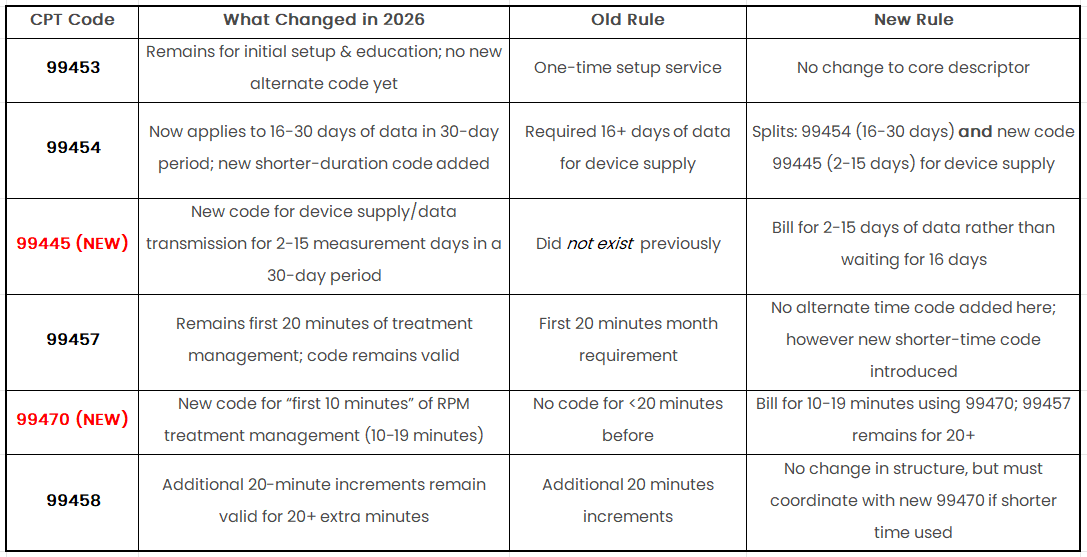
Historically, RPM reimbursement was constrained by rigid thresholds. Providers could bill for device setup and patient education under CPT 99453, and for device supply and data transmission under CPT 99454 only when at least 16 days of data were collected within a 30-day period. Clinical management services under CPT 99457 and 99458 required a minimum of 20 minutes of documented staff time. While clinically reasonable, these requirements often left portions of legitimate care activity unreimbursed, creating financial uncertainty and limiting program scalability.

Effective January 1, 2026, CMS introduced CPT 99445, allowing reimbursement for device supply and data transmission when data are collected on 2–15 days within a 30-day cycle, and CPT 99470, covering the first 10 minutes of clinical management per month with at least one real-time patient interaction. CMS stated that these changes are intended to provide "greater flexibility for providers managing patient conditions remotely," better reflecting real-world care delivery.

This shift is particularly important for chronic disease management, where patient engagement naturally fluctuates. Conditions such as hypertension, diabetes, and chronic respiratory disease require continuous monitoring, yet adherence is rarely consistent month to month. The updated reimbursement framework allows healthcare organizations to sustain long-term monitoring programs without being penalized for short-term variations in patient behavior.

As reimbursement barriers decline, operational execution becomes a defining factor in RPM success. With data continuity and documentation now directly linked to financial performance, technologies that simplify deployment and ensure reliable data transmission are gaining importance.

Transtek's 4G-connected devices align closely with this evolving environment. By eliminating dependence on home Wi-Fi and smartphone pairing, these cellular-enabled solutions streamline patient onboarding, reduce technical failure points, and improve data consistency—allowing providers to more effectively realize the reimbursement opportunities created by the new Medicare framework.

As reimbursement models continue to evolve, the RPM market is entering a new phase focused on scalability, sustainability, and operational efficiency—foundations that will shape the next generation of remote care.

Contact
Guangdong Transtek Medical Electronics Co.,Ltd.
***@transtekcorp.com

Photos: (Click photo to enlarge)

Guangdong Transtek Medical Electronics Co.,Ltd. Logo CPT Code RPM devices


Source: Guangdong Transtek Medical Electronics Co.,Ltd.

Read Full Story - Updated Medicare Rules Lower Barriers for RPM Adoption | More news from this source

Press release distribution by PRLog

Recent Quotes

View More
Symbol Price Change (%)
AMZN  210.11
+5.25 (2.56%)
AAPL  264.58
+4.00 (1.54%)
AMD  200.15
-3.22 (-1.58%)
BAC  53.06
+0.29 (0.55%)
GOOG  314.90
+11.34 (3.74%)
META  655.66
+10.88 (1.69%)
MSFT  397.23
-1.23 (-0.31%)
NVDA  189.82
+1.92 (1.02%)
ORCL  148.08
-8.46 (-5.40%)
TSLA  411.82
+0.11 (0.03%)
Stock Quote API & Stock News API supplied by www.cloudquote.io
Quotes delayed at least 20 minutes.
By accessing this page, you agree to the Privacy Policy and Terms Of Service.


IntelligentValue Home
Close Window

DISCLAIMER

All content herein is issued solely for informational purposes and is not to be construed as an offer to sell or the solicitation of an offer to buy, nor should it be interpreted as a recommendation to buy, hold or sell (short or otherwise) any security.  All opinions, analyses, and information included herein are based on sources believed to be reliable, but no representation or warranty of any kind, expressed or implied, is made including but not limited to any representation or warranty concerning accuracy, completeness, correctness, timeliness or appropriateness. We undertake no obligation to update such opinions, analysis or information. You should independently verify all information contained on this website. Some information is based on analysis of past performance or hypothetical performance results, which have inherent limitations. We make no representation that any particular equity or strategy will or is likely to achieve profits or losses similar to those shown. Shareholders, employees, writers, contractors, and affiliates associated with ETFOptimize.com may have ownership positions in the securities that are mentioned. If you are not sure if ETFs, algorithmic investing, or a particular investment is right for you, you are urged to consult with a Registered Investment Advisor (RIA). Neither this website nor anyone associated with producing its content are Registered Investment Advisors, and no attempt is made herein to substitute for personalized, professional investment advice. Neither ETFOptimize.com, Global Alpha Investments, Inc., nor its employees, service providers, associates, or affiliates are responsible for any investment losses you may incur as a result of using the information provided herein. Remember that past investment returns may not be indicative of future returns.

Copyright © 1998-2017 ETFOptimize.com, a publication of Optimized Investments, Inc. All rights reserved.