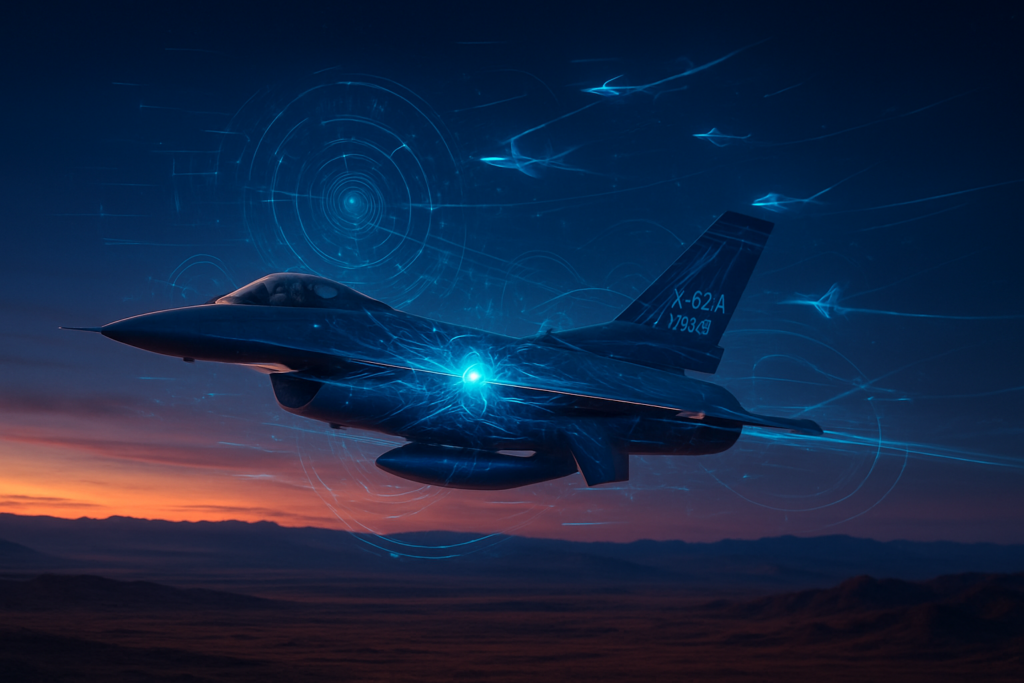
The skies over Edwards Air Force Base have long been the testing ground for the future of aviation, but in late 2025, the roar of engines is being matched by the silent, rapid-fire processing of artificial intelligence. The U.S. Air Force’s X-62A Variable Stability In-flight Simulator Test Aircraft (VISTA) has officially entered a transformative new upgrade phase, expanding its mission from basic autonomous maneuvers to complex, multi-agent combat operations. This development marks a pivotal shift in military strategy, moving away from human-centric cockpits toward a future defined by "loyal wingmen" and algorithmic dogfighting.
As of December 18, 2025, the X-62A has transitioned from proving that AI can fly a fighter jet to proving that AI can lead a fleet. Following a series of historic milestones over the past 24 months—including the first-ever successful autonomous dogfight against a human pilot—the current upgrade program focuses on the "autonomy engine." These enhancements are designed to handle Beyond-Visual-Range (BVR) multi-target engagements and the coordination of multiple autonomous platforms, effectively turning the X-62A into the primary "flying laboratory" for the next generation of American air superiority.
The Architecture of Autonomy: Inside the X-62A’s "Einstein Box"
The technical prowess of the X-62A VISTA lies not in its airframe—a modified F-16—but in its unique, open-systems architecture developed by Lockheed Martin (NYSE: LMT). At the core of the aircraft’s recent upgrades is the Enterprise Mission Computer version 2 (EMC2), colloquially known as the "Einstein Box." This high-performance processor acts as the brain of the operation, running sophisticated machine learning agents while remaining physically and logically isolated from the aircraft's primary flight control laws. This separation is a critical safety feature, ensuring that even if an AI agent makes an unpredictable decision, the underlying flight system can override it to maintain structural integrity.
The integration of these AI agents is facilitated by the System for Autonomous Control of the Simulation (SACS), a layer developed by Calspan, a subsidiary of TransDigm Group Inc. (NYSE: TDG). SACS provides a "safety sandbox" that allows non-deterministic, self-learning algorithms to operate in a real-world environment without risking the loss of the aircraft. Complementing this is Lockheed Martin’s Model Following Algorithm (MFA), which allows the X-62A to mimic the flight characteristics of other aircraft. This means the VISTA can effectively "pretend" to be a next-generation drone or a stealth fighter, allowing the AI to learn how to handle different aerodynamic profiles in real-time.
What sets the X-62A apart from previous autonomous efforts is its reliance on reinforcement learning (RL). Unlike traditional "if-then" programming, RL allows the AI to develop its own tactics through millions of simulated trials. During the DARPA Air Combat Evolution (ACE) program tests, this resulted in AI pilots that were more aggressive and precise than their human counterparts, maintaining tactical advantages in high-G maneuvers that would push a human pilot to their physical limits. The late 2025 upgrades further enhance this by increasing the onboard computing power, allowing for more complex "multi-agent" scenarios where the X-62A must coordinate with other autonomous jets to overwhelm an adversary.
A Competitive Shift: Defense Tech Giants and AI Startups
The success of the VISTA program is reshaping the competitive landscape of the defense industry. While legacy contractors like Lockheed Martin (NYSE: LMT) continue to provide the hardware and foundational architecture, the "software-defined" nature of modern warfare has opened the door for specialized AI firms. Companies like Shield AI, which provides the Hivemind autonomy engine, have become central to the Air Force’s strategy. Shield AI’s ability to iterate on flight software in weeks rather than years represents a fundamental disruption to the traditional defense procurement cycle.
Other players, such as EpiSci and PhysicsAI, are also benefiting from the X-62A’s open-architecture approach. By creating an "algorithmic league" where different companies can upload their AI agents to the VISTA for head-to-head testing, the Air Force has fostered a competitive ecosystem that rewards performance over pedigree. This shift is forcing major aerospace firms to pivot toward software-centric models, as the value of a platform is increasingly determined by the intelligence of its autonomy engine rather than the speed of its airframe.
Market analysts suggest that the X-62A program is a harbinger of massive spending shifts in the Pentagon’s budget. The move toward the Collaborative Combat Aircraft (CCA) program—which aims to build thousands of low-cost, autonomous "loyal wingmen"—is expected to divert billions from traditional manned fighter programs. For tech giants and AI startups alike, the X-62A serves as the ultimate validation of their technology, proving that AI can handle the most "non-deterministic" and high-stakes environment imaginable: the cockpit of a fighter jet.
The Global Implications of Algorithmic Warfare
The broader significance of the X-62A VISTA upgrades cannot be overstated. We are witnessing the dawn of the "Third Posture" in military aviation, where mass and machine learning replace the reliance on a small number of highly expensive, manned platforms. This transition mirrors the move from propeller planes to jets, or from visual-range combat to radar-guided missiles. By proving that AI can safely and effectively navigate the complexities of aerial combat, the U.S. Air Force is signaling a future where human pilots act more as "mission commanders," overseeing a swarm of autonomous agents from a safe distance.
However, this advancement brings significant ethical and strategic concerns. The use of "non-deterministic" AI—systems that can learn and change their behavior—in lethal environments raises questions about accountability and the potential for unintended escalation. The Air Force has addressed these concerns by emphasizing that a human is always "on the loop" for lethal decisions, but the sheer speed of AI-driven combat may eventually make human intervention a bottleneck. Furthermore, the X-62A’s success has accelerated a global AI arms race, with peer competitors like China and Russia reportedly fast-tracking their own autonomous flight programs to keep pace with American breakthroughs.
Comparatively, the X-62A milestones of 2024 and 2025 are being viewed by historians as the "Kitty Hawk moment" for autonomous systems. Just as the first flight changed the nature of geography and warfare, the first AI dogfight at Edwards AFB has changed the nature of tactical decision-making. The ability to process vast amounts of sensor data and execute maneuvers in milliseconds gives autonomous systems a "cognitive advantage" that will likely define the outcome of future conflicts.
The Horizon: From VISTA to Project VENOM
Looking ahead, the data gathered from the X-62A VISTA is already being funneled into Project VENOM (Viper Experimentation and Next-gen Operations Model). While the X-62A remains a single, highly specialized testbed, Project VENOM has seen the conversion of six standard F-16s into autonomous testbeds at Eglin Air Force Base. This move toward a larger fleet of autonomous Vipers indicates that the Air Force is ready to scale its AI capabilities from experimental labs to operational squadrons.
The ultimate goal is the full deployment of the Collaborative Combat Aircraft (CCA) program by the late 2020s. Experts predict that the lessons learned from the late 2025 X-62A upgrades—specifically regarding multi-agent coordination and BVR combat—will be the foundation for the CCA's initial operating capability. Challenges remain, particularly in the realm of secure data links and the "trust" between human pilots and their AI wingmen, but the trajectory is clear. The next decade of military aviation will be defined by the seamless integration of human intuition and machine precision.
A New Chapter in Aviation History
The X-62A VISTA upgrade program is more than just a technical refinement; it is a declaration of intent. By successfully moving from 1-on-1 dogfighting to complex multi-agent simulations, the U.S. Air Force has proven that artificial intelligence is no longer a peripheral tool, but the central nervous system of modern air power. The milestones achieved at Edwards Air Force Base over the last two years have dismantled the long-held belief that the "human touch" was irreplaceable in the cockpit.
As we move into 2026, the industry should watch for the first results of the multi-agent BVR tests and the continued expansion of Project VENOM. The X-62A has fulfilled its role as the pioneer, carving a path through the unknown and establishing the safety and performance standards that will govern the autonomous fleets of tomorrow. The sky is no longer a limit for AI; it is its new home.
This content is intended for informational purposes only and represents analysis of current AI developments.
TokenRing AI delivers enterprise-grade solutions for multi-agent AI workflow orchestration, AI-powered development tools, and seamless remote collaboration platforms.
For more information, visit https://www.tokenring.ai/.