As the calendar turns to 2026, the artificial intelligence landscape has reached a pivotal milestone that many are calling the "Kubernetes moment" for the agentic era. The Model Context Protocol (MCP), an open-source standard originally introduced by Anthropic in late 2024, has officially transitioned from a promising corporate initiative to the bedrock of the global AI ecosystem. Following the formal donation of the protocol to the Agentic AI Foundation (AAIF) under the Linux Foundation in December 2025, the industry has seen a tidal wave of adoption that effectively ends the era of proprietary, siloed AI integrations.
This development marks the resolution of the fragmented "N×M" integration problem that plagued early AI development. Previously, every AI application had to build custom connectors for every data source or tool it intended to use. Today, with MCP serving as a universal interface, a single MCP server can provide data and functionality to any AI model—be it from OpenAI, Google (NASDAQ: GOOGL), or Microsoft (NASDAQ: MSFT)—instantly and securely. This shift has dramatically reduced developer friction, enabling a new generation of interoperable AI agents that can traverse diverse enterprise environments with unprecedented ease.
Standardizing the Agentic Interface
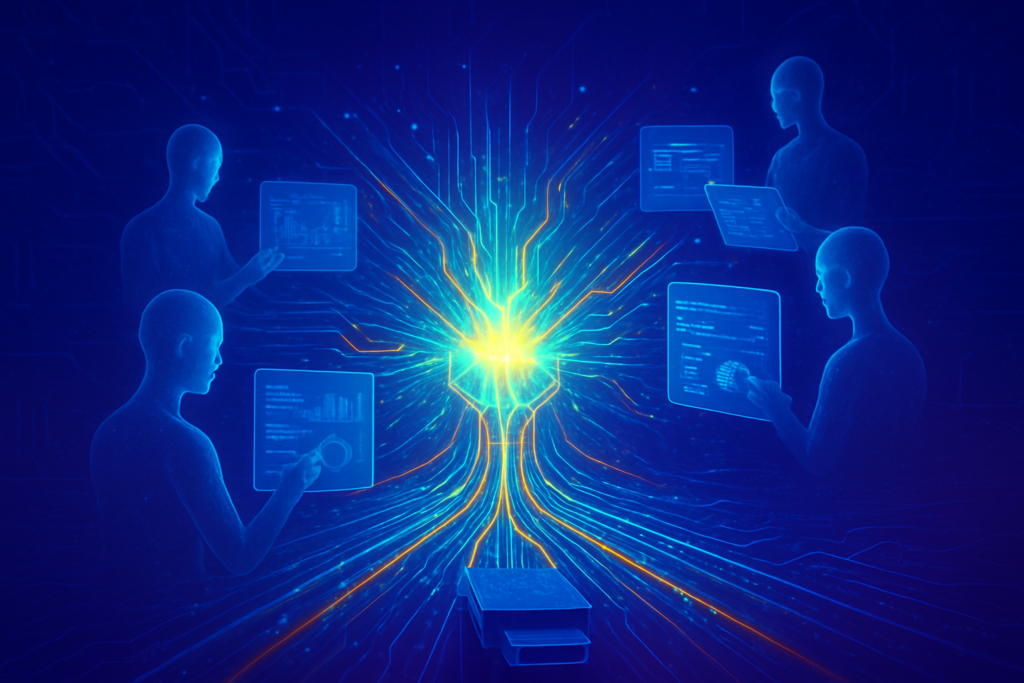
Technically, the Model Context Protocol is built on a client-server architecture utilizing JSON-RPC 2.0 for lightweight, standardized messaging. It provides a structured way for AI models (the "hosts") to interact with external systems through three core primitives: Resources, Tools, and Prompts. Resources allow models to pull in read-only data like database records or live documentation; Tools enable models to perform actions such as executing code or sending messages; and Prompts provide the templates that guide how a model should interact with these capabilities. This standardized approach replaces the thousands of bespoke API wrappers that developers previously had to maintain.
One of the most significant technical advancements integrated into the protocol in late 2025 was the "Elicitation" feature. This allows MCP servers to "ask back"—enabling a tool to pause execution and request missing information or user clarification directly through the AI agent. Furthermore, the introduction of asynchronous task-based workflows has allowed agents to trigger long-running processes, such as complex data migrations, and check back on their status later. This evolution has moved AI from simple chat interfaces to sophisticated, multi-step operational entities.
The reaction from the research community has been overwhelmingly positive. Experts note that by decoupling the model from the data source, MCP allows for "Context Engineering" at scale. Instead of stuffing massive amounts of irrelevant data into a model's context window, agents can now surgically retrieve exactly what they need at the moment of execution. This has not only improved the accuracy of AI outputs but has also significantly reduced the latency and costs associated with long-context processing.
A New Competitive Landscape for Tech Giants
The widespread adoption of MCP has forced a strategic realignment among the world’s largest technology firms. Microsoft (NASDAQ: MSFT) has been among the most aggressive, integrating MCP as a first-class standard across Windows 11, GitHub, and its Azure AI Foundry. By positioning itself as "open-by-design," Microsoft is attempting to capture the developer market by making its ecosystem the easiest place to build and deploy interoperable agents. Similarly, Google (NASDAQ: GOOGL) has integrated native MCP support into its Gemini models and SDKs, ensuring that its powerful multimodal capabilities can seamlessly plug into existing enterprise data.
For major software providers like Salesforce (NYSE: CRM), SAP (NYSE: SAP), and ServiceNow (NYSE: NOW), the move to MCP represents a massive strategic advantage. These companies have released official MCP servers for their respective platforms, effectively turning their vast repositories of enterprise data into "plug-and-play" context for any AI agent. This eliminates the need for these companies to build their own proprietary LLM ecosystems to compete with the likes of OpenAI; instead, they can focus on being the premium data and tool providers for the entire AI industry.
However, the shift also presents challenges for some. Startups that previously built their value proposition solely on "connectors" for AI are finding their moats evaporated by the universal standard. The competitive focus has shifted from how a model connects to data to what it does with that data. Market positioning is now defined by the quality of the MCP servers provided and the intelligence of the agents consuming them, rather than the plumbing that connects the two.
The Global Significance of Interoperability
The rise of MCP is more than just a technical convenience; it represents a fundamental shift in the AI landscape away from walled gardens and toward a collaborative, modular future. By standardizing how agents communicate, the industry is avoiding the fragmentation that often hinders early-stage technologies. This interoperability is essential for the vision of "Agentic AI"—autonomous systems that can work across different platforms to complete complex goals without human intervention at every step.
Comparisons to previous milestones, such as the adoption of HTTP for the web or SQL for databases, are becoming common. Just as those standards allowed for the explosion of the internet and modern data management, MCP is providing the "universal plumbing" for the intelligence age. This has significant implications for data privacy and security as well. Because MCP provides a standardized way to handle permissions and data access, enterprises can implement more robust governance frameworks that apply to all AI models interacting with their data, rather than managing security on a model-by-model basis.
There are, of course, concerns. As AI agents become more autonomous and capable of interacting with a wider array of tools, the potential for unintended consequences increases. The industry is currently grappling with how to ensure that a standardized protocol doesn't also become a standardized vector for prompt injection or other security vulnerabilities. The transition to foundation-led governance under the Linux Foundation is seen as a critical step in addressing these safety and security challenges through community-driven best practices.
Looking Ahead: The W3C and the Future of Identity
The near-term roadmap for MCP is focused on even deeper integration and more robust standards. In April 2026, the World Wide Web Consortium (W3C) is scheduled to begin formal discussions regarding "MCP-Identity." This initiative aims to standardize how AI agents authenticate themselves across the web, essentially giving agents their own digital passports. This would allow an agent to prove its identity, its owner's permissions, and its safety certifications as it moves between different MCP-compliant servers.
Experts predict that the next phase of development will involve "Server-to-Server" MCP communication, where different data sources can negotiate with each other on behalf of an agent to optimize data retrieval. We are also likely to see the emergence of specialized MCP "marketplaces" where developers can share and monetize sophisticated tools and data connectors. The challenge remains in ensuring that the protocol remains lightweight enough for edge devices while powerful enough for massive enterprise clusters.
Conclusion: A Foundation for the Agentic Era
The adoption of the Model Context Protocol as a global industry standard is a watershed moment for artificial intelligence. By solving the interoperability crisis, the industry has cleared the path for AI agents to become truly useful, ubiquitous tools in both personal and professional settings. The transition from a proprietary Anthropic tool to a community-governed standard has ensured that the future of AI will be built on a foundation of openness and collaboration.
As we move further into 2026, the success of MCP will be measured by its invisibility. Like the protocols that power the internet, the most successful version of MCP is one that developers and users take for granted. For now, the tech world should watch for the upcoming W3C identity standards and the continued growth of the MCP server registry, which has already surpassed 10,000 public integrations. The era of the siloed AI is over; the era of the interconnected agent has begun.
This content is intended for informational purposes only and represents analysis of current AI developments.
TokenRing AI delivers enterprise-grade solutions for multi-agent AI workflow orchestration, AI-powered development tools, and seamless remote collaboration platforms.
For more information, visit https://www.tokenring.ai/.