As the artificial intelligence "supercycle" enters its most intensive phase, the semiconductor industry has reached a historic milestone. High Bandwidth Memory (HBM), once a niche technology for high-end graphics, has officially exploded to represent 23% of the total DRAM market revenue as of early 2026. This meteoric rise, confirmed by recent industry reports from Gartner and TrendForce, underscores a fundamental shift in computing: the bottleneck is no longer just the speed of the processor, but the speed at which data can be fed to it.
The significance of this development cannot be overstated. While HBM accounts for less than 8% of total DRAM wafer volume, its high value and technical complexity have turned it into the primary profit engine for memory manufacturers. At the Consumer Electronics Show (CES) 2026, held just last week, the world caught its first glimpse of the next frontier—HBM4. This new generation of memory is designed specifically to dismantle the "memory wall," the performance gap that threatens to stall the progress of Large Language Models (LLMs) and generative AI.
The Leap to HBM4: Doubling Down on Bandwidth
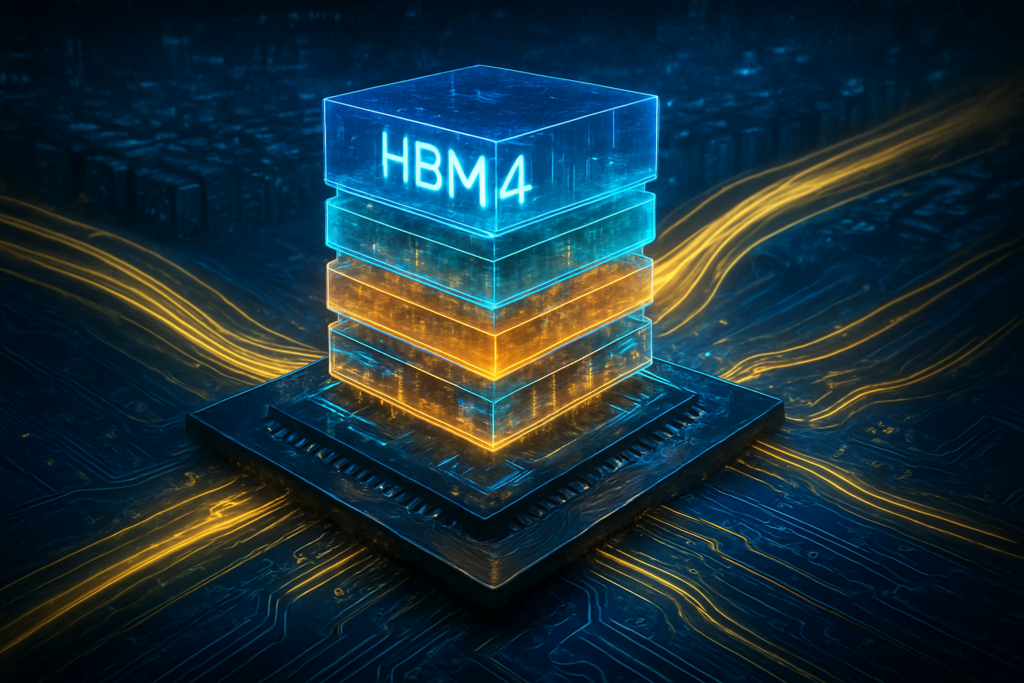
The transition to HBM4 represents the most significant architectural overhaul in the history of stacked memory. Unlike its predecessors, HBM4 doubles the interface width from a 1,024-bit bus to a massive 2,048-bit bus. This allows a single HBM4 stack to deliver bandwidth exceeding 2.6 TB/s, nearly triple the throughput of early HBM3e systems. At CES 2026, industry leaders showcased 16-layer (16-Hi) HBM4 stacks, providing up to 48GB of capacity per cube. This density is critical for the next generation of AI accelerators, which are expected to house over 400GB of memory on a single package.
Perhaps the most revolutionary technical change in HBM4 is the integration of a "logic base die." Historically, the bottom layer of a memory stack was manufactured using standard DRAM processes. However, HBM4 utilizes advanced 5nm and 3nm logic processes for this base layer. This allows for "Custom HBM," where memory controllers and even specific AI acceleration logic can be moved directly into the memory stack. By reducing the physical distance data must travel and utilizing Through-Silicon Vias (TSVs), HBM4 is projected to offer a 40% improvement in power efficiency—a vital metric for data centers where a single GPU can now consume over 1,000 watts.
The New Triumvirate: SK Hynix, Samsung, and Micron
The explosion of HBM has ignited a fierce three-way battle among the world’s top memory makers. SK Hynix (KRX: 000660) currently maintains a dominant 55-60% market share, bolstered by its "One-Team" alliance with Taiwan Semiconductor Manufacturing Company (NYSE: TSM). This partnership allows SK Hynix to leverage TSMC’s leading-edge foundry nodes for HBM4 base dies, ensuring seamless integration with the upcoming NVIDIA (NASDAQ: NVDA) Rubin platform.
Samsung Electronics (KRX: 005930), however, is positioning itself as the only "one-stop shop" in the industry. By combining its memory expertise with its internal foundry and advanced packaging capabilities, Samsung aims to capture the burgeoning "Custom HBM" market. Meanwhile, Micron Technology (NASDAQ: MU) has rapidly expanded its capacity in Taiwan and Japan, showcasing its own 12-layer HBM4 solutions at CES 2026. Micron is targeting a production capacity of 15,000 wafers per month by the end of the year, specifically aiming to challenge SK Hynix’s stronghold on the NVIDIA supply chain.
Beyond the Silicon: Why 23% is Just the Beginning
The fact that HBM now commands nearly a quarter of the DRAM market revenue signals a permanent change in the data center landscape. The "memory wall" has long been the Achilles' heel of high-performance computing, where processors sit idle while waiting for data to arrive from relatively slow memory modules. As AI models grow to trillions of parameters, the demand for bandwidth has become insatiable. Data center operators are no longer just buying "servers"; they are building "AI factories" where memory performance is the primary determinant of return on investment.
This shift has profound implications for the wider tech industry. The high average selling price (ASP) of HBM—often 5 to 10 times that of standard DDR5—is driving a reallocation of capital within the semiconductor world. Standard PC and smartphone memory production is being sidelined as manufacturers prioritize HBM lines. While this has led to supply crunches and price hikes in the consumer market, it has provided the necessary capital for the semiconductor industry to fund the multi-billion dollar research required for sub-3nm manufacturing.
The Road to 2027: Custom Memory and the Rubin Ultra
Looking ahead, the roadmap for HBM4 extends far into 2027 and beyond. NVIDIA’s CEO Jensen Huang recently confirmed that the Rubin R100/R200 architecture, which will utilize between 8 and 12 stacks of HBM4 per chip, is moving toward mass production. The "Rubin Ultra" variant, expected in late 2026 or early 2027, will push pin speeds to a staggering 13 Gbps. This will require even more advanced cooling solutions, as the thermal density of these stacked chips begins to approach the limits of traditional air cooling.
The next major hurdle will be the full realization of "Custom HBM." Experts predict that within the next two years, major hyperscalers like Amazon (NASDAQ: AMZN) and Google (NASDAQ: GOOGL) will begin designing their own custom logic dies for HBM4. This would allow them to optimize memory specifically for their proprietary AI chips, such as Trainium or TPU, further decoupling themselves from off-the-shelf hardware and creating a more vertically integrated AI stack.
A New Era of Computing
The rise of HBM from a specialized component to a dominant market force is a defining moment in the AI era. It represents the transition from a compute-centric world to a data-centric one, where the ability to move information is just as valuable as the ability to process it. With HBM4 on the horizon, the "memory wall" is being pushed back, enabling the next generation of AI models to be larger, faster, and more efficient than ever before.
In the coming weeks and months, the industry will be watching closely as HBM4 enters its final qualification phases. The success of these first mass-produced units will determine the pace of AI development for the remainder of the decade. As 23% of the market today, HBM is no longer just an "extra"—it is the very backbone of the intelligence age.
This content is intended for informational purposes only and represents analysis of current AI developments.
TokenRing AI delivers enterprise-grade solutions for multi-agent AI workflow orchestration, AI-powered development tools, and seamless remote collaboration platforms.
For more information, visit https://www.tokenring.ai/.