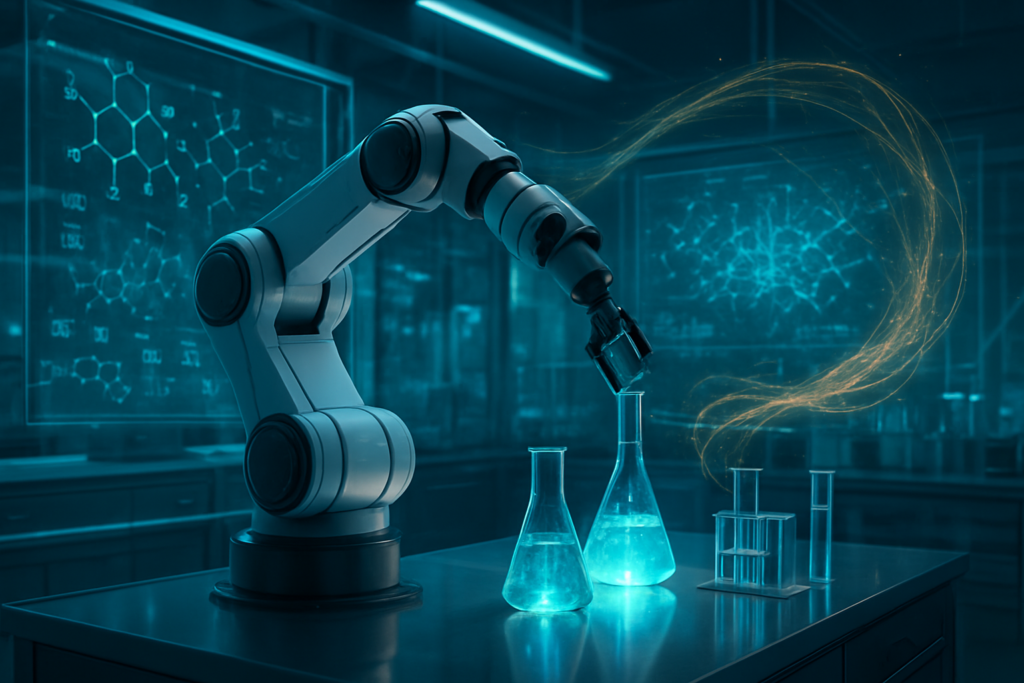
The traditional image of a scientist hunched over a microscope or mixing chemicals in a flask is being rapidly superseded by a new reality: the "Self-Driving Lab." Over the past several months, a revolutionary class of "Discovery AI" platforms has moved from theoretical pilots to active lab partners. These systems are no longer just processing data; they are generating complex hypotheses, designing experimental protocols, and directly controlling robotic hardware to accelerate breakthroughs in physics and chemistry.
The immediate significance of this shift cannot be overstated. By closing the loop between digital prediction and physical experimentation, Discovery AI is slashing research timelines from years to days. In late 2025 and the first weeks of 2026, we have seen these AI "postdocs" solve physics problems that have stumped humans for decades and discover new materials with industrial applications in a fraction of the time required by traditional methods. This transition marks the end of the "trial and error" era and the beginning of the era of "AI-directed synthesis."
Technical Breakthroughs: The Rise of the Agentic Lab Partner
At the heart of this revolution is the transition from static Large Language Models (LLMs) to agentic systems. The Microsoft (NASDAQ: MSFT) Discovery platform, which saw widespread deployment in late 2025, utilizes a sophisticated Graph-Based Knowledge Engine. Unlike previous iterations of AI that provided simple text answers, this system maps billions of relationships across scientific literature and internal lab data, identifying "gaps" in human knowledge. These gaps are then handed off to "AI Postdoc Agents"—specialized sub-units capable of generating testable hypotheses and translating them into robotic code.
In a parallel advancement, Alphabet Inc. (NASDAQ: GOOGL), through its Google DeepMind division, recently unveiled its "AI Co-Scientist" framework. Launched in early 2026, this system employs a multi-agent architecture powered by Gemini 2.0. In this environment, different AI agents take on roles such as "Supervisor," "Generator," and "Ranker," debating the merits of various experimental paths. This approach bore fruit in January 2026 when a collaboration with the Department of Energy saw the AI solve the "Potts Maze"—a notoriously complex problem in frustrated magnetic systems—completing a month’s worth of advanced mathematics in less than 24 hours.
This technical shift differs fundamentally from previous AI-assisted research. Whereas earlier tools like AlphaFold focused on predicting 3D structures from 1D sequences, Discovery AI acts as an orchestrator. It controls hardware, such as the modular robotic clusters from startups like Multiply Labs, to physically synthesize and test its own predictions. The initial reaction from the research community has been one of "cautious awe," as the barrier between digital intelligence and physical chemistry effectively vanishes.
Industry Disruption: Tech Giants vs. Agile Startups
The commercial landscape for laboratory research is undergoing a seismic shift. Major tech players are moving quickly to provide the infrastructure for this new era. NVIDIA (NASDAQ: NVDA) recently announced a landmark partnership with Thermo Fisher Scientific (NYSE: TMO) to integrate "lab-in-the-loop" capabilities directly into lab instruments. Their new NVIDIA DGX Spark, a desktop-sized supercomputer designed for local laboratory use, allows facilities to run massive simulations and control instruments like flow cytometers without sending sensitive proprietary data to the cloud.
This development poses a significant challenge to traditional lab equipment manufacturers who have not yet pivoted to AI-native hardware. Meanwhile, a new breed of "TechBio" and "TechChem" startups is emerging to fill specialized niches. Companies like Lila Sciences and Radical AI are building fully autonomous, closed-loop labs that focus on specific domains like inorganic compounds and clean energy materials. These startups are often more agile than established giants, positioning themselves as "discovery-as-a-service" providers that can out-innovate large R&D departments.
The competitive advantage in 2026 has shifted from who has the most experienced scientists to who has the most efficient "discovery engine." Major AI labs are now engaged in an arms race to develop the most reasoning-capable agents, as the ability to autonomously troubleshoot a failed experiment or interpret a noisy spectroscopy reading becomes a primary differentiator in the market.
Wider Significance: Science at the Speed of Compute
The broader implications of Discovery AI represent a fundamental change in how humanity approaches scientific discovery. We are moving toward a model of "Science at Scale," where the limiting factor is no longer human cognition or manual labor, but the availability of compute and raw chemical materials. The discovery of a non-PFAS data center coolant in just 200 hours by Microsoft’s platform in late 2025 serves as a harbinger for future breakthroughs in climate tech, medicine, and semiconductors.
However, this rapid advancement brings legitimate concerns. The scientific community has raised alarms regarding "algorithmic bias," where AI agents might favor well-documented chemical spaces, potentially ignoring unconventional but revolutionary paths. Furthermore, the 2026 Lab Manager Safety Digital Summit highlighted the psychological impact on the workforce. As bench technicians are increasingly replaced by "AI-Integrated Project Managers" and "Spatial Architects," the industry must grapple with a massive shift in required skill sets and the potential for job displacement in traditional laboratory roles.
Ethical considerations also extend to safety. While new "Chemist Eye" vision-language AI can monitor PPE compliance and hazard detection with 97% accuracy, the prospect of autonomous systems synthesizing potentially hazardous materials without human oversight necessitates a new framework for "AI Safety in the Physical World."
Future Outlook: The Era of Dark Labs and AI Postdocs
Looking ahead, experts predict the rise of "Dark Labs"—fully autonomous, lights-out facilities where AI agents manage the entire lifecycle of an experiment from hypothesis to final data analysis. In the near term, we expect to see these systems expanded to include more complex biological systems and even pharmaceutical clinical trial design. The challenge will be integrating these disparate AI-led discoveries into a cohesive body of human knowledge.
The next two years will likely see the refinement of "Multi-Modal Discovery," where AI agents can watch videos of past experiments to learn manual techniques or interpret physical nuances that were previously un-codified. Developers are already working on "Self-Improving Chemists"—AI that can analyze its own failures to refine its underlying physics engines. As these systems become more autonomous, the primary challenge for humans will be defining the goals and ethical boundaries of the research, rather than performing the experiments themselves.
A New Chapter in Human Inquiry
The emergence of Discovery AI as a true lab partner marks one of the most significant milestones in the history of artificial intelligence. By bridging the gap between digital reasoning and physical action, these systems are effectively automating the scientific method itself. From solving decades-old physics riddles to inventing the sustainable materials of the future, the impact of these agentic partners is already being felt across every scientific discipline.
As we move further into 2026, the key metric for success in the tech and science sectors will be the seamless integration of human intent with machine execution. While the role of the human scientist is changing, the potential for discovery has never been greater. The coming months will likely bring a flurry of new announcements as more industries adopt these "self-driving" research methodologies, forever changing the pace of human progress.
This content is intended for informational purposes only and represents analysis of current AI developments.
TokenRing AI delivers enterprise-grade solutions for multi-agent AI workflow orchestration, AI-powered development tools, and seamless remote collaboration platforms.
For more information, visit https://www.tokenring.ai/.