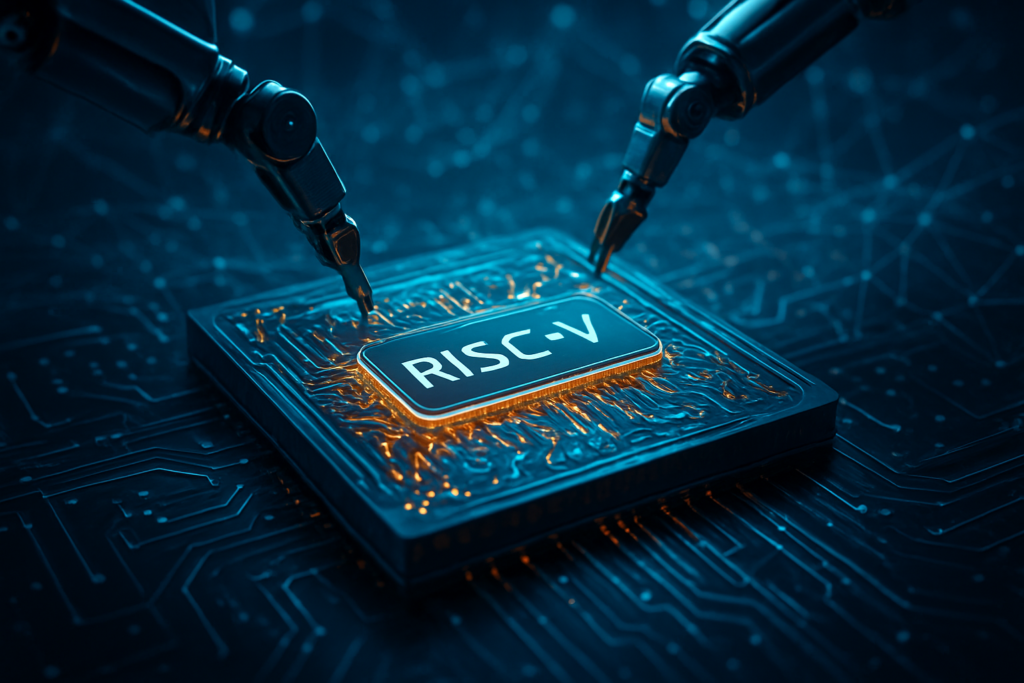
The high-performance computing landscape has reached a historic inflection point in early 2026, as the open-source RISC-V architecture officially shatters the long-standing duopoly of ARM and x86. What began a decade ago as an academic project at UC Berkeley has matured into a formidable industrial force, driven by a global surge in demand for "architectural sovereignty." The catalyst for this shift is the arrival of server-class RISC-V processors that finally match the performance of industry leaders, coupled with a massive migration by tech giants seeking to escape the escalating licensing costs of traditional silicon.
The move marks a fundamental shift in the power dynamics of the semiconductor industry. For the first time, companies like Qualcomm (NASDAQ: QCOM) and Meta (NASDAQ: META) are not merely consumers of chip designs but are becoming the architects of their own bespoke silicon ecosystems. By leveraging the modularity of RISC-V, these firms are bypassing the restrictive "ARM Tax" and building specialized processors tailored specifically for generative AI, high-density cloud computing, and low-power wearable devices.
The Dawn of the Server-Class RISC-V Era
The technical barrier that previously kept RISC-V confined to simple microcontrollers has been decisively breached. Leading the charge is SpacemiT, which recently debuted its VitalStone V100 server processor. The V100 is a 64-core powerhouse built on a 12nm process, featuring the proprietary X100 "AI Fusion" core. This architecture utilizes a 12-stage out-of-order pipeline that is fully compliant with the RVA23 profile, the new 2026 standard that ensures enterprise-grade features like virtualization and high-speed I/O management.
Performance benchmarks reveal that the X100 core achieves parity with the ARM (NASDAQ: ARM) Neoverse V1 and Advanced Micro Devices (NASDAQ: AMD) Zen 2 architectures in integer performance, while significantly outperforming them in specialized AI workloads. SpacemiT’s "AI Fusion" technology allows for a 20x performance increase in INT8 matrix multiplications compared to standard SIMD implementations. This allows the V100 to handle Large Language Model (LLM) inference directly on the CPU, reducing the need for expensive, power-hungry external accelerators in edge-server environments.
This leap in capability is supported by the ratification of the RISC-V Server Platform Specification, which has finally solved the "software gap." As of 2026, major enterprise operating systems including Red Hat and Ubuntu run natively on RISC-V with UEFI and ACPI support. This means that data center operators can now swap x86 or ARM instances for RISC-V servers without rewriting their entire software stack, a breakthrough that industry experts are calling the "Linux moment" for hardware.
Strategic Sovereignty: Qualcomm and Meta Lead the Exodus
The business case for RISC-V has become undeniable for the world's largest tech companies. Qualcomm has fundamentally restructured its roadmap to prioritize RISC-V, largely as a hedge against its volatile legal relationship with ARM. By early 2026, Qualcomm’s Snapdragon Wear platform has fully transitioned to RISC-V cores. In a landmark collaboration with Google (NASDAQ: GOOGL), the latest generation of Wear OS devices now runs on custom RISC-V silicon, allowing Qualcomm to optimize power efficiency for "always-on" AI features without paying per-core royalties to ARM.
Furthermore, Qualcomm’s $2.4 billion acquisition of Ventana Micro Systems in late 2025 has provided it with high-performance RISC-V chiplets capable of competing in the data center. This move allows Qualcomm to offer a full-stack solution—from the wearable device to the private AI cloud—all running on a unified, royalty-free architecture. This vertical integration provides a massive strategic advantage, as it enables the addition of custom instructions that ARM’s standard licensing models would typically prohibit.
Meta has followed a similar path, driven by the astronomical costs of running Llama-based AI models at scale. The company’s MTIA (Meta Training and Inference Accelerator) chips now utilize RISC-V cores for complex control logic. Meta’s acquisition of the RISC-V startup Rivos has allowed it to build a custom CPU that acts as a "traffic cop" for its AI clusters. By designing its own RISC-V silicon, Meta estimates it will save over $500 million annually in licensing fees and power efficiencies, while simultaneously optimizing its hardware for the specific mathematical requirements of its proprietary AI models.
A Geopolitical and Economic Paradigm Shift
The rise of RISC-V is more than just a technical or corporate trend; it is a geopolitical necessity in the 2026 landscape. Because the RISC-V International organization is based in Switzerland, the architecture is largely insulated from the trade wars and export restrictions that have plagued US and UK-based technologies. This has made RISC-V the default choice for emerging markets and Chinese firms like Alibaba (NYSE: BABA), which has integrated RISC-V into its XuanTie series of cloud processors.
The formation of the Quintauris alliance—founded by Qualcomm, Infineon (OTC: IFNNY), and other automotive giants—has further stabilized the ecosystem. Quintauris acts as a clearinghouse for reference architectures, ensuring that RISC-V implementations remain compatible and secure. This collective approach prevents the "fragmentation" that many feared would kill the open-source hardware movement. Instead, it has created a "Lego-like" environment where companies can mix and match chiplets from different vendors, significantly lowering the barrier to entry for silicon startups.
However, the rapid growth of RISC-V has not been without controversy. Traditional incumbents like Intel (NASDAQ: INTC) have been forced to pivot, with Intel Foundry now aggressively marketing its ability to manufacture RISC-V chips for third parties. This creates a strange paradox where the older giants are now facilitating the growth of the very architecture that seeks to replace their proprietary instruction sets.
The Road Ahead: From Servers to the Desktop
As we look toward the remainder of 2026 and into 2027, the focus is shifting toward the consumer PC and high-end mobile markets. While RISC-V has conquered the server and the wearable, the "Final Boss" remains the high-end smartphone and the laptop. Expert analysts predict that the first high-performance RISC-V "AI PC" will debut by late 2026, likely powered by a collaboration between NVIDIA (NASDAQ: NVDA) and a RISC-V core provider, aimed at the burgeoning creative professional market.
The primary challenge remaining is the "Long Tail" of legacy software. While cloud-native applications and AI models port easily to RISC-V, decades of Windows-based software still require x86 compatibility. However, with the maturation of high-speed binary translation layers—similar to Apple's (NASDAQ: AAPL) Rosetta 2—the performance penalty for running legacy apps on RISC-V is shrinking. The industry is watching closely to see if Microsoft will release a "Windows on RISC-V" edition to rival its ARM-based offerings.
A New Era of Silicon Innovation
The RISC-V revolution of 2026 represents the ultimate democratization of hardware. By removing the gatekeepers of the instruction set, the industry has unleashed a wave of innovation that was previously stifled by licensing costs and rigid design templates. The success of SpacemiT’s server chips and the strategic pivots by Qualcomm and Meta prove that the world is ready for a modular, open-source future.
The takeaway for the industry is clear: the monopoly of the proprietary ISA is over. In its place is a vibrant, competitive landscape where performance is dictated by architectural ingenuity rather than licensing clout. In the coming months, keep a close eye on the mobile sector; as soon as a flagship RISC-V smartphone hits the market, the transition will be complete, and the ARM era will officially pass into the history books.
This content is intended for informational purposes only and represents analysis of current AI developments.
TokenRing AI delivers enterprise-grade solutions for multi-agent AI workflow orchestration, AI-powered development tools, and seamless remote collaboration platforms.
For more information, visit https://www.tokenring.ai/.