The MIT-licensed editor runs in the browser, deploys inside the same network as a team's databases, and works with 42 database engines from one tab.
Istanbul, Turkiye--(Newsfile Corp. - October 1, 2026) - LibreDB Studio, an open-source database editor that runs in the browser, is now listed in the official documentation or ecosystem pages of ten database projects: PostgreSQL, Redis, ClickHouse, MariaDB, Trino, Apache Cloudberry (Incubating), YugabyteDB, DragonflyDB, OpenSearch and DuckDB. Each listing was added through the project's own review process.
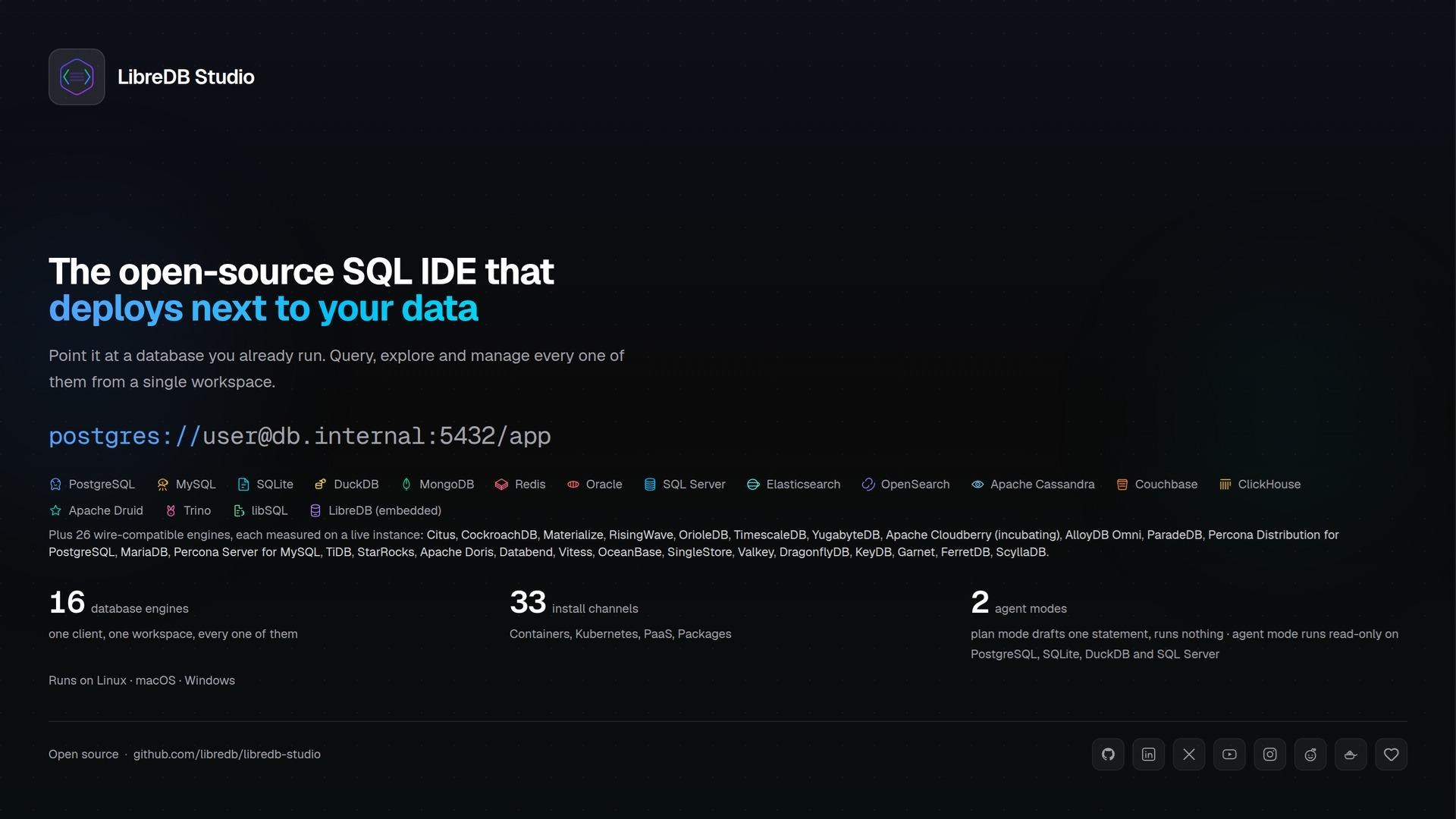
LibreDB Studio, v0.16.2. The sixteen built-in drivers and the 26 wire-compatible engines were tested against live instances.
To view an enhanced version of this graphic, please visit:
https://images.newsfilecorp.com/files/8552/316310_d0d725f2a496bae5_001full.jpg
Databases have moved to Kubernetes clusters, application platforms and private cloud networks, while the tools used to work with them are still mostly desktop applications. Reaching a cloud database from a laptop usually means opening a port to the internet, setting up an SSH tunnel, or installing a separate client for each engine on every machine that needs access. LibreDB Studio takes the opposite approach: the editor is deployed next to the data, inside the same network, and the team reaches it through a browser.
"A database on a cloud platform is ready in under a minute, and then it can take an afternoon just to look inside it," said Abdullah Kaya, a member of the LibreDB Studio core team. "We think the editor should be installed beside the database, the same way everything else around it is. That only works if the editor can go everywhere, so all of it is released under the MIT license."
Sixteen drivers, 42 engines
LibreDB Studio ships sixteen database drivers: PostgreSQL, MySQL, Oracle, SQL Server, SQLite, libSQL, DuckDB, MongoDB, Redis, Couchbase, ClickHouse, Apache Druid, Elasticsearch, OpenSearch, Trino and Apache Cassandra. Twenty-six more engines, including MariaDB, TiDB, CockroachDB, TimescaleDB, YugabyteDB, Valkey and ScyllaDB, speak one of those wire protocols and connect through an existing driver, for 42 engines in total. Each of the 26 was tested against a live instance, and a public compatibility table records how much of the product works on each one.
Teams that run several kinds of databases can work with all of them from the same tab. Where an engine supports it, the editor adds ER diagrams, schema comparison and monitoring panels.
Deployed like infrastructure
LibreDB Studio ships as a container image, a Helm chart listed in Rancher Partner Charts and the SUSE Solutions Catalog, and a Kubernetes operator listed on OperatorHub.io and in the OpenShift community catalogue. It is available on the AWS, Microsoft Azure and DigitalOcean marketplaces, and as one-click templates on Railway, Dokploy, CapRover and Sealos. It is also published as an npm package, so platforms that provision databases can embed the editor in their own product.
Access control in the open-source release
Single sign-on through an OpenID Connect provider of the team's choice, role-based access that separates administrators from users, an audit log of sign-ins, denied access and administrative actions, and a confirmation step before destructive statements such as DELETE, DROP or TRUNCATE run are all part of the open source release. No feature is reserved for a paid edition.
The built-in AI assistant reads the connected schema and works with Gemini, OpenAI, Ollama or any OpenAI-compatible endpoint. It does not write to the database: by default, the SQL it drafts waits in the editor for the user to review, and when it explores data on its own, it runs in read-only sessions.
LibreDB Studio is open source under the MIT license. The source code is at github.com/libredb/libredb-studio, a live demo runs at app.libredb.org, and an installation guide covering 22 install routes in 13 languages is at libredb.org/helper.
About LibreDB Studio
LibreDB Studio is an open-source, browser-based database editor for teams whose databases run in the cloud. It is developed by a three-person core team of engineers with backgrounds in data engineering, backend architecture, and frontend and mobile development, and is released under the MIT license. More information is available at libredb.org.
Media contact: Abdullah Kaya | info@libredb.org
To view the source version of this press release, please visit https://www.newsfilecorp.com/release/316310