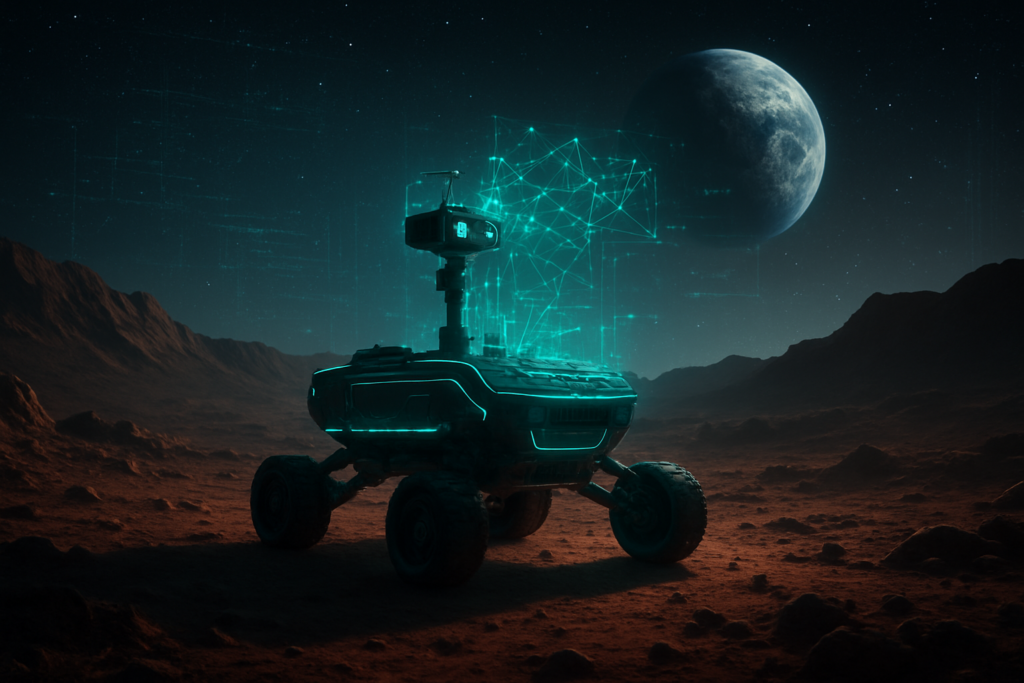
PASADENA, CA – December 11, 2025 – The NASA Jet Propulsion Laboratory (JPL) has officially launched its new Rover Operations Center (ROC), marking a pivotal moment in the quest for advanced autonomous space exploration. This state-of-the-art facility is poised to revolutionize how future lunar and Mars missions are conducted, with an aggressive focus on accelerating AI-enabled autonomy. The ROC aims to integrate decades of JPL's unparalleled experience in rover operations with cutting-edge artificial intelligence capabilities, setting a new standard for mission efficiency and scientific discovery.
The immediate significance of the ROC lies in its ambition to be a central hub for developing and deploying AI solutions that empower rovers to operate with unprecedented independence. By applying AI to critical operational workflows, such as route planning and scientific target selection, the center is designed to enhance mission productivity and enable more complex exploratory endeavors. This initiative is not merely an incremental upgrade but a strategic leap towards a future where robotic explorers can make real-time, intelligent decisions on distant celestial bodies, drastically reducing the need for constant human oversight and unlocking new frontiers in space science.
AI Takes the Helm: Technical Advancements in Rover Autonomy
The Rover Operations Center (ROC) represents a significant technical evolution in space robotics, building upon JPL's storied history of developing autonomous systems. At its core, the ROC is focused on integrating and advancing several key AI capabilities to enhance rover autonomy. One immediate application is the use of generative AI for sophisticated route planning, a capability already being leveraged by the Perseverance rover team on Mars. This moves beyond traditional pre-programmed paths, allowing rovers to dynamically assess terrain, identify hazards, and plot optimal routes in real-time, significantly boosting efficiency and safety.
Technically, the ROC is developing a suite of advanced solutions, including engineering foundation models that can learn from vast datasets of mission telemetry and environmental data, digital twins for high-fidelity simulation and testing, and AI models specifically adapted for the unique challenges of space environments. A major focus is on edge AI-augmented autonomy stack solutions, enabling rovers to process data and make decisions onboard without constant communication with Earth, which is crucial given the communication delays over interplanetary distances. This differs fundamentally from previous approaches where autonomy was more rule-based and reactive; the new AI-driven systems are designed to be proactive, adaptive, and capable of learning from their experiences. Initial reactions from the AI research community and industry experts have been overwhelmingly positive, highlighting the ROC's potential to bridge the gap between theoretical AI advancements and practical, mission-critical applications in extreme environments. Experts laud the integration of multi-robot autonomy, as demonstrated by the Cooperative Autonomous Distributed Robotic Exploration (CADRE) technology demonstration, which involves teams of small, collaborative rovers. This represents a paradigm shift from single-robot operations to coordinated, intelligent swarms, dramatically expanding exploration capabilities.
The center also provides comprehensive support for missions, encompassing systems engineering, integration, and testing (SEIT), dedicated teams for onboard autonomy/AI development, advanced planning and scheduling tools for orbital and interplanetary communications, and robust capabilities for critical anomaly response. This holistic approach ensures that AI advancements are not just theoretical but are rigorously tested and seamlessly integrated into all facets of mission operations. The emphasis on AI-assisted operations automation aims to reduce human workload and error, allowing mission controllers to focus on higher-level strategic decisions rather than granular operational details.
Reshaping the Landscape: Impact on AI Companies and Tech Giants
The establishment of NASA JPL's (NASDAQ: LMT) (NYSE: BA) (NYSE: RTX) new Rover Operations Center and its aggressive push for AI-enabled autonomy will undoubtedly send ripples across the AI industry, benefiting a diverse range of companies from established tech giants to agile startups. Companies specializing in machine learning frameworks, computer vision, robotics, and advanced simulation technologies stand to gain significantly. Firms like NVIDIA (NASDAQ: NVDA), known for its powerful GPUs and AI platforms, could see increased demand for hardware and software solutions capable of handling the intensive computational requirements of onboard AI for space applications. Similarly, companies developing robust AI safety and reliability tools will become critical partners in ensuring the flawless operation of autonomous systems in high-stakes space missions.
The competitive implications for major AI labs and tech companies are substantial. Those with a strong focus on reinforcement learning, generative AI, and multi-agent systems will find themselves in a prime position to collaborate with JPL or develop parallel technologies for commercial space ventures. The expertise gained from developing AI for the extreme conditions of space—where data is scarce, computational resources are limited, and failure is not an option—could lead to breakthroughs applicable across various terrestrial industries, from autonomous vehicles to industrial automation. This could disrupt existing products or services by setting new benchmarks for AI robustness and adaptability.
Market positioning and strategic advantages will favor companies that can demonstrate proven capabilities in developing resilient, low-power AI solutions suitable for edge computing in harsh environments. Startups specializing in novel sensor fusion techniques, advanced path planning algorithms, or innovative human-AI collaboration interfaces for mission control could find lucrative niches. Furthermore, the ROC's emphasis on technology transfer and strategic partnerships with industry and academia signals a collaborative ecosystem where smaller, specialized AI firms can contribute their unique expertise and potentially scale their innovations through NASA's rigorous validation process, gaining invaluable credibility and market traction. The demand for AI solutions that can handle partial observability, long-term planning, and dynamic adaptation in unknown environments will drive innovation and investment across the AI sector.
A New Frontier: Wider Significance in the AI Landscape
The launch of NASA JPL's Rover Operations Center and its dedication to accelerating AI-enabled autonomy for space exploration represents a monumental stride within the broader AI landscape, signaling a maturation of AI capabilities beyond traditional enterprise applications. This initiative fits perfectly into the growing trend of deploying AI in extreme and unstructured environments, pushing the boundaries of what autonomous systems can achieve. It underscores a significant shift from AI primarily as a data analysis or prediction tool to AI as an active, intelligent agent capable of complex decision-making and problem-solving in real-world (or rather, "space-world") scenarios.
The impacts are profound, extending beyond the immediate realm of space exploration. By proving AI's reliability and effectiveness in the unforgiving vacuum of space, JPL is effectively validating AI for a host of other critical applications on Earth, such as disaster response, deep-sea exploration, and autonomous infrastructure maintenance. This development accelerates the trust in AI systems for high-stakes operations, potentially influencing regulatory frameworks and public acceptance of advanced autonomy. However, potential concerns also arise, primarily around the ethical implications of increasingly autonomous systems, the challenges of debugging and verifying complex AI behaviors in remote environments, and the need for robust cybersecurity measures to protect these invaluable assets from interference.
Comparing this to previous AI milestones, the ROC's focus on comprehensive, mission-critical autonomy for space exploration stands alongside breakthroughs like DeepMind's AlphaGo defeating human champions or the rapid advancements in large language models. While those milestones demonstrated AI's cognitive prowess in specific domains, JPL's work showcases AI's ability to perform complex physical tasks, adapt to unforeseen circumstances, and collaborate with human operators in a truly operational setting. It's a testament to AI's evolution from a computational marvel to a practical, indispensable tool for pushing the boundaries of human endeavor. This initiative highlights the critical role of AI in enabling humanity to venture further and more efficiently into the cosmos.
Charting the Course: Future Developments and Horizons
The establishment of NASA JPL's Rover Operations Center sets the stage for a cascade of exciting future developments in AI-enabled space exploration. In the near term, we can expect to see an accelerated deployment of advanced AI algorithms on upcoming lunar and Mars missions, particularly for enhanced navigation, scientific data analysis, and intelligent resource management. The CADRE (Cooperative Autonomous Distributed Robotic Exploration) mission, involving a team of small, autonomous rovers, is a prime example of a near-term application, demonstrating multi-robot collaboration and mapping on the lunar surface. This will pave the way for more complex swarms of robots working in concert.
Long-term developments will likely involve increasingly sophisticated AI systems that can independently plan entire mission segments, adapt to unexpected environmental changes, and even perform on-the-fly repairs or reconfigurations of robotic hardware. Experts predict the emergence of AI-powered "digital twins" of entire planetary surfaces, allowing for highly accurate simulations and predictive modeling of rover movements and scientific outcomes. Potential applications and use cases on the horizon include AI-driven construction of lunar bases, autonomous mining operations on asteroids, and self-replicating robotic explorers capable of sustained, multi-decade missions without direct human intervention. The ROC's efforts to develop engineering foundation models and edge AI-augmented autonomy stack solutions are foundational to these ambitious future endeavors.
However, significant challenges need to be addressed. These include developing more robust and fault-tolerant AI architectures, ensuring ethical guidelines for autonomous decision-making, and creating intuitive human-AI interfaces that allow astronauts and mission controllers to effectively collaborate with highly intelligent machines. Furthermore, the computational and power constraints inherent in space missions will continue to drive research into highly efficient and miniaturized AI hardware. Experts predict that the next decade will witness AI transitioning from an assistive technology to a truly co-equal partner in space exploration, with systems capable of making critical decisions independently while maintaining transparency and explainability for human oversight. The focus will shift towards creating truly symbiotic relationships between human explorers and their AI counterparts.
A New Era Dawns: The Enduring Significance of AI in Space
The unveiling of NASA JPL's Rover Operations Center marks a profound and irreversible shift in the trajectory of space exploration, solidifying AI's role as an indispensable co-pilot for humanity's cosmic ambitions. The key takeaway from this development is the commitment to pushing AI beyond terrestrial applications into the most demanding and unforgiving environments imaginable, proving its mettle in scenarios where failure carries catastrophic consequences. This initiative is not just about building smarter rovers; it's about fundamentally rethinking how we explore, reducing human risk, accelerating discovery, and expanding our reach across the solar system.
In the annals of AI history, this development will be assessed as a critical turning point, analogous to the first successful deployment of AI in medical diagnostics or autonomous driving. It signifies the transition of advanced AI from theoretical research and controlled environments to real-world, high-stakes operational settings. The long-term impact will be transformative, enabling missions that are currently unimaginable due to constraints in communication, human endurance, or operational complexity. We are witnessing the dawn of an era where robotic explorers, imbued with sophisticated artificial intelligence, will venture further, discover more, and provide insights that will reshape our understanding of the universe.
In the coming weeks and months, watch for announcements regarding the initial AI-enhanced capabilities deployed on existing or upcoming missions, particularly those involving lunar exploration. Pay close attention to the progress of collaborative robotics projects like CADRE, which will serve as crucial testbeds for multi-agent autonomy. The strategic partnerships JPL forges with industry and academia will also be key indicators of how rapidly these AI advancements will propagate. This is not merely an incremental improvement; it is a foundational shift that will redefine the very nature of space exploration, making it more efficient, more ambitious, and ultimately, more successful.
This content is intended for informational purposes only and represents analysis of current AI developments.
TokenRing AI delivers enterprise-grade solutions for multi-agent AI workflow orchestration, AI-powered development tools, and seamless remote collaboration platforms.
For more information, visit https://www.tokenring.ai/.