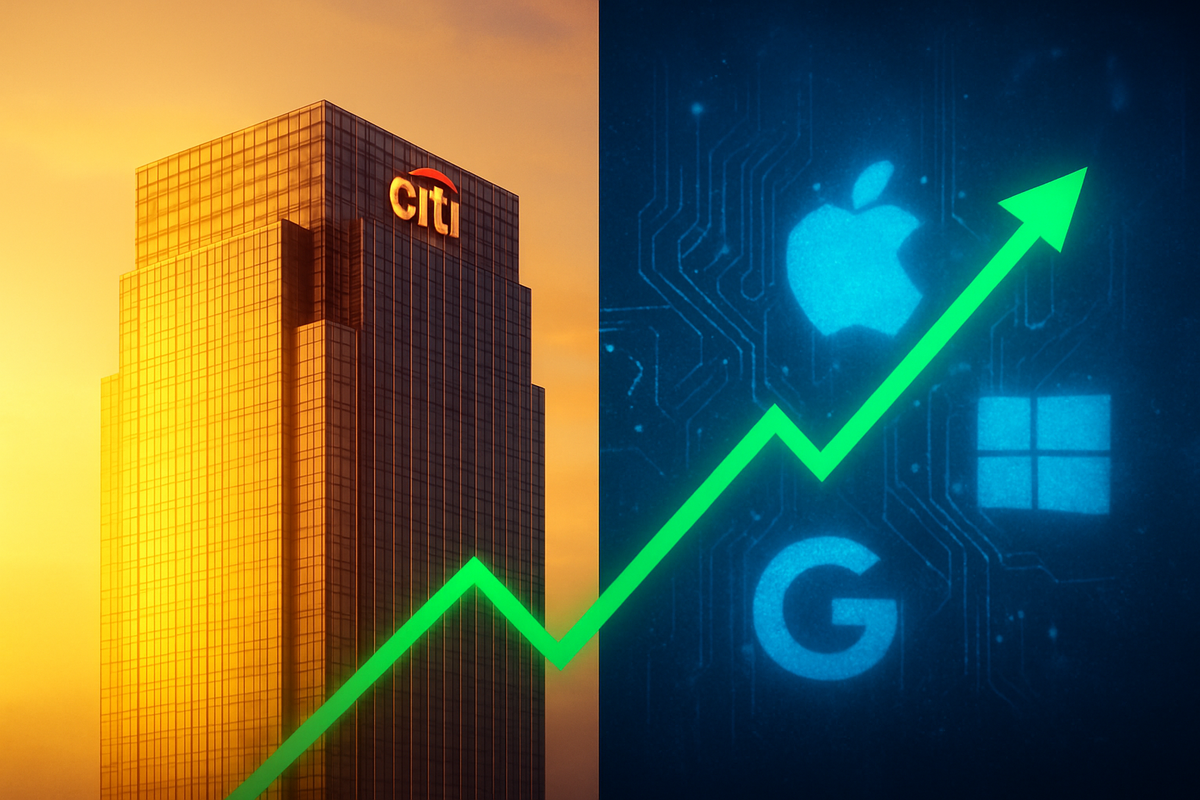
As the curtain closes on 2025, the financial markets have delivered a plot twist that few analysts predicted at the start of the decade. Citigroup Inc. (NYSE: C), a bank long dismissed as a "perpetual turnaround story," has emerged as the surprise champion of the year. While the high-flying tech giants that dominate the "Magnificent Seven" faced a reality check of slowing growth and valuation scrutiny, Citigroup’s stock has surged by a staggering 53% year-to-date, comfortably outperforming six of the seven most valuable tech companies in the world.
This dramatic shift marks a fundamental rotation in investor sentiment. The era of blind faith in artificial intelligence (AI) premiums has transitioned into a "show me the money" phase, where tangible earnings growth and operational efficiency are once again the gold standard. For Citigroup, 2025 was the year the "Boring Bank" thesis finally paid off, proving that a lean, simplified financial institution could provide better returns than the most sophisticated Silicon Valley innovators.
The Architect of the Turnaround: Jane Fraser’s "Bora Bora" Vision Realized
The catalyst for Citigroup’s meteoric rise can be traced back to the aggressive restructuring efforts led by CEO Jane Fraser. Dubbed "Project Bora Bora," the initiative sought to dismantle the bank's labyrinthine corporate structure. By the end of 2025, Citigroup successfully collapsed its management layers from thirteen down to eight, a move that eliminated 20,000 roles and significantly reduced the bureaucracy that had plagued the firm for decades. This simplification allowed the bank to report a 5% year-over-year decline in expenses by early 2025, hitting a guidance target of $53.4 billion that many skeptics thought was unattainable.
Beyond headcount reductions, the bank’s strategic pivot to five core business units—Services, Markets, Banking, Wealth, and U.S. Personal Banking—has begun to fire on all cylinders. A pivotal moment in the 2025 timeline was the successful separation and preparation for the initial public offering (IPO) of Banamex, Citigroup’s Mexican consumer unit. This move not only freed up billions in capital but also signaled to the market that Citigroup was finally serious about shedding its non-core assets to focus on high-margin institutional services.
The market reaction has been swift and decisive. While tech stocks grappled with the "idiosyncratic" nature of their growth, Citigroup became the primary beneficiary of a massive rotation into undervalued cyclical sectors. Trading well below its tangible book value at the start of the year, the stock underwent a massive rerating as institutional investors sought refuge in "value" plays. The bank’s ability to grow its Net Interest Income (NII) by 4% despite a shifting interest rate environment further cemented its status as a resilient powerhouse in a volatile market.
Winners and Losers: The Shifting Tides of Market Leadership
The 2025 performance leaderboard reveals a stark contrast between the banking giant and the tech elite. While Alphabet Inc. (NASDAQ: GOOGL) managed to lead the pack with a 64% gain, Citigroup’s 53% surge left most of the Magnificent Seven in the dust. NVIDIA Corporation (NASDAQ: NVDA), the darling of the AI boom, saw its growth moderate to 38% as the market moved from valuing AI "enablers" to demanding proof of productivity from AI "adopters."
Other tech titans struggled even more to keep pace. Microsoft Corporation (NASDAQ: MSFT) and Meta Platforms, Inc. (NASDAQ: META) posted respectable but trailing gains of 16% and 14%, respectively. Meanwhile, the consumer-facing giants Apple Inc. (NASDAQ: AAPL), Tesla, Inc. (NASDAQ: TSLA), and Amazon.com, Inc. (NASDAQ: AMZN) lagged significantly, with Amazon barely scratching out a 3% return for the year. The primary "losers" in this scenario were investors who remained over-concentrated in growth at any price, missing the 50%+ rally in a banking sector that had been overlooked for a decade.
For Citigroup, the win is not just in the stock price but in the restoration of its reputation. Analysts from firms like Wells Fargo & Company (NYSE: WFC), led by the historically critical Mike Mayo, have raised their price targets to the $115–$125 range. Conversely, the tech sector now faces the "immense pressure" of justifying high price-to-earnings multiples in an environment where the "easy money" from AI hype has already been made.
A Broader Shift: Value Over Growth and the Return of the Banking Supercycle
Citigroup’s outperformance is a symptom of a much larger trend: the return of the value trade. After years of technology stocks driving the S&P 500 to record highs, 2025 has seen a normalization where fundamentals like Return on Tangible Common Equity (RoTCE) are prioritized over "moonshot" projects. This event fits into a historical precedent where long periods of tech dominance are followed by a resurgence in financial and industrial sectors as the broader economy stabilizes and interest rate paths become more predictable.
The ripple effects are being felt across the industry. Competitors like JPMorgan Chase & Co. and Bank of America have also seen gains, but none as dramatic as Citigroup, which had the most "ground to make up" in terms of valuation. Regulators and policymakers are also taking note; a healthier, more streamlined Citigroup reduces the "too big to fail" systemic risk that has been a concern since 2008. The bank's successful restructuring serves as a blueprint for other global systemically important banks (G-SIBs) looking to shed legacy costs and improve capital efficiency.
Furthermore, the banking sector is entering what some are calling a "supercycle" in investment banking. As capital costs lowered throughout 2025, a massive backlog of M&A and IPO activity began to clear. Citigroup’s revamped banking division is perfectly positioned to capture this fee-based income, which is less dependent on interest rate spreads and more on corporate activity—a trend that is expected to accelerate as we head into 2026.
Looking Ahead: The 2026 Outlook and Potential Challenges
As we look toward 2026, the momentum for Citigroup appears sustainable, though not without hurdles. Consensus estimates suggest the bank’s earnings per share (EPS) could rise by an additional 25% to 30% next year. The primary strategic pivot for 2026 will be the final execution of the Banamex IPO and the continued scaling of its Wealth management division, which has lagged behind its peers but offers significant upside if Fraser can replicate her success in the Services division.
However, the technology sector will not remain dormant. While the Magnificent Seven may no longer move as a monolithic block, 2026 is expected to be the year of the "AI Adopter." Companies that can successfully integrate AI to drive massive productivity gains will likely see a second wind. Additionally, as 2026 is a midterm election year in the United States, policy uncertainty regarding trade and regulation could introduce volatility that may affect global banks like Citigroup more than domestic-focused tech firms.
The short-term possibility of a "soft landing" for the U.S. economy remains the base case, which would be a "goldilocks" scenario for Citigroup—keeping loan losses low while maintaining healthy demand for credit. The challenge for management will be maintaining expense discipline once the initial "low-hanging fruit" of the restructuring has been harvested.
Conclusion: A New Era for the Financial Sector
The story of Citigroup in 2025 is one of redemption and rigorous execution. By outperforming the majority of the Magnificent Seven, the bank has proved that old-school financial discipline can still win in a high-tech world. The key takeaway for investors is that the market's appetite has shifted; the "growth at any cost" mantra has been replaced by a preference for operational efficiency and clear paths to capital return.
Moving forward, the market appears more balanced than it has been in years. While the tech giants will continue to be essential components of any portfolio, the dominance of the Magnificent Seven is no longer absolute. Investors should watch closely for Citigroup’s quarterly RoTCE updates in 2026, as hitting the 11% target will be the final hurdle in its journey from a laggard to a leader. As we enter the new year, the banking sector is no longer just a defensive play—it is a growth engine in its own right.
This content is intended for informational purposes only and is not financial advice.