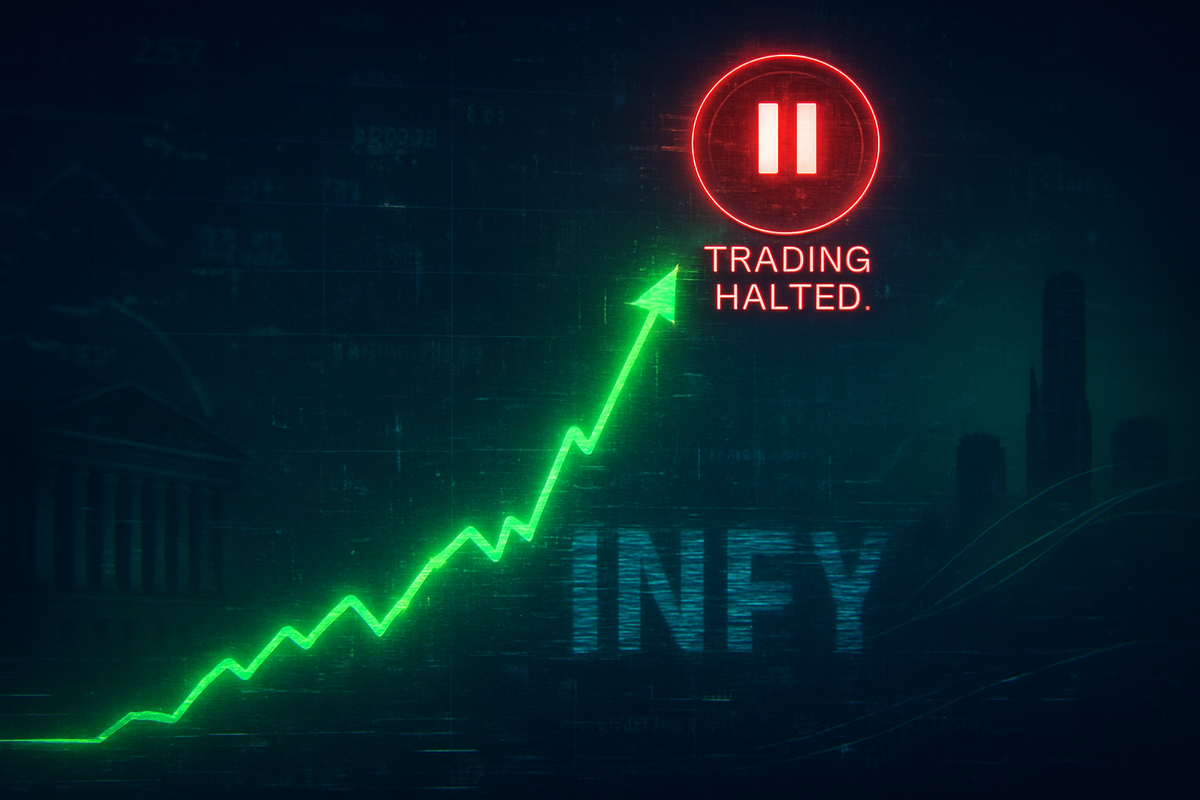
Wall Street was left in a state of bewilderment on Friday, December 19, 2025, as the American Depository Receipts (ADRs) of Indian IT titan Infosys Ltd. (NYSE: INFY) experienced a staggering, unexplained surge of nearly 50% within minutes of the opening bell. The sudden vertical move, which added tens of billions of dollars in paper wealth to the company’s market capitalization, triggered multiple "Limit Up-Limit Down" (LULD) volatility halts on the New York Stock Exchange, leaving traders and analysts scrambling to find a fundamental catalyst that simply did not exist.
The anomaly created a massive disconnect between the U.S.-listed ADRs and the company’s primary shares on the National Stock Exchange (NSE) in India, which remained largely stable. While the spike was short-lived and prices eventually retreated toward their previous close, the event has raised urgent questions about the integrity of financial data feeds and the growing risks of algorithmic trading in a market increasingly dominated by automated "black box" systems.
A "Glitch in the Matrix": The Anatomy of a Mystery Surge
The chaos began early in the trading session when INFY ADRs, which had closed the previous day at approximately $19.18, suddenly rocketed to as high as $27.00. The move occurred on heavy volume but was not accompanied by any press releases, regulatory filings, or earnings beats from the Bengaluru-based company. As the price breached the 40% gain threshold, the NYSE invoked circuit breakers to pause trading, a standard procedure for "extraordinary" volatility. When trading resumed, the price remained erratic before a wave of selling pressure brought the ADRs back down to earth, confirming that the move was a technical outlier rather than a fundamental revaluation.
The "mystery" behind the move appears to be rooted in a bizarre technical glitch involving ticker mapping. In the days leading up to the surge, several prominent financial data providers—including Zacks Investment Research and MarketBeat—began erroneously identifying the "INFY" ticker as "American Noble Gas Inc." in their automated reports. While the financial metrics and news headlines attached to the ticker still referenced Infosys’s massive AI investments and $75 billion market cap, the name mismatch is believed to have confused automated trading algorithms. These systems, designed to hunt for "mispriced" assets or sudden momentum shifts, likely interpreted the data discrepancy as a signal to buy, creating a feedback loop that amplified the price action in the thin liquidity of a year-end Friday.
Furthermore, market participants noted that the surge coincided with a period of low seasonal liquidity. With many institutional traders already closing their books for the holiday season, the absence of large-scale market makers allowed a relatively small number of algorithmic trades to push the price to extreme levels. The "fat finger" theory—a human error in trade entry—was also floated, though the widespread nature of the ticker mapping error suggests a more systemic data integrity failure across the financial ecosystem.
Winners, Losers, and the Ripple Effect Across Indian Tech
While the surge was a "phantom" move, it had real-world consequences for peers in the Indian IT services sector. Wipro (NYSE: WIT) saw its ADRs rise in sympathy, as high-frequency trading (HFT) algorithms often treat the major Indian tech firms as a correlated basket. Traders who were long on Wipro or the broader sector saw a brief, albeit artificial, boost in their portfolio values. Conversely, short-sellers who had positions against Infosys or its peers faced a terrifying "short squeeze" scenario, potentially triggering forced liquidations at the height of the spike before the trading halt provided a reprieve.
In the domestic Indian market, the reaction was more measured but still notable. Shares of Tata Consultancy Services (NSE: TCS) and HCLTech (NSE: HCLTECH) saw modest upticks of 1% to 3% as the ADR drama in New York filtered back to Mumbai. However, the biggest "losers" in this scenario may be the retail investors who chased the momentum during the brief windows when trading was active. Those who bought at the $25-$27 peak were left holding significant losses as the ADRs reverted to their fundamental value near $19. Additionally, the data providers involved in the ticker mapping error now face a significant reputational crisis, as the event highlights the dangers of relying on automated data aggregation without human oversight.
The Fragility of the ADR Bridge and Algorithmic Dominance
This event serves as a stark reminder of the unique risks associated with ADRs, which act as a bridge between domestic and foreign markets. Because ADRs trade during U.S. hours while the underlying Indian markets are closed, they are susceptible to "price discovery" vacuums. When a technical glitch or a rumor hits during these hours, there is no "anchor" from the home market to steady the ship. The disconnect between the 50% surge in New York and the 0.7% move in Mumbai highlights how easily these two markets can become unmoored from one another.
The Infosys incident also fits into a broader trend of "flash" events driven by algorithmic trading. As more capital is managed by machines that react to headlines and data feeds in milliseconds, the potential for a single incorrect data point to trigger a market-wide spasm increases. This is not the first time a ticker confusion has caused market chaos—historical precedents include investors mistakenly buying "ZOOM" (a small telecom company) instead of Zoom Video Communications (NASDAQ: ZM)—but the scale of the Infosys move, affecting a blue-chip giant, is unprecedented in the Indian tech space. It signals a need for regulators to look closer at how "alternative data" and automated feeds are integrated into trading platforms.
What Comes Next: Scrutiny, Regulation, and Technical Audits
In the short term, the NYSE and the Securities and Exchange Commission (SEC) are expected to conduct a formal review of the trading activity on December 19. This will likely involve an audit of the LULD triggers and an investigation into whether any "bad actors" intentionally exploited the ticker mapping error to manufacture a pump-and-dump scenario. For Infosys, the company may be forced to issue a formal clarification to reassure investors that its internal systems and fundamentals remain sound, despite the external market turbulence.
Looking further ahead, this event may lead to a strategic pivot in how financial data is verified. We may see a push for "dual-verification" systems where automated feeds must be cross-referenced against official exchange data before being pushed to retail and institutional trading terminals. For investors, the takeaway is one of caution: the "mystery" move of Infosys ADRs proves that even the most stable, multi-billion-dollar companies are not immune to the "ghosts in the machine." Expect increased volatility in Indian ADRs in the coming months as traders remain on high alert for similar technical anomalies.
Final Thoughts: A Warning Shot for the Digital Age
The 50% surge and subsequent halt of Infosys ADRs will likely be remembered as one of the most bizarre trading days of 2025. It underscores the reality that in the modern financial market, "data" is as much a commodity as the stocks themselves, and when that data is corrupted, the results can be explosive. The key takeaway for the market is that the "speed" of trading has far outpaced the "accuracy" of the information driving it.
Moving forward, investors should watch for any regulatory changes regarding how ADRs are traded during domestic market closures and whether exchanges will implement stricter "sanity checks" for price moves that deviate so wildly from the underlying asset. While the "mystery" of the move has been largely solved by the discovery of the ticker mapping glitch, the lasting impact will be a renewed sense of skepticism toward automated market moves. For now, the Indian tech giants remain a cornerstone of the global economy, but their journey on Wall Street just got a lot more complicated.
This content is intended for informational purposes only and is not financial advice.