
Custom-engineered solutions manufacturer Methode Electronics (NYSE: MEI) reported revenue ahead of Wall Streets expectations in Q3 CY2025, but sales fell by 15.6% year on year to $246.9 million. The company expects the full year’s revenue to be around $950 million, close to analysts’ estimates. Its non-GAAP loss of $0.19 per share was in line with analysts’ consensus estimates.
Is now the time to buy Methode Electronics? Find out by accessing our full research report, it’s free for active Edge members.
Methode Electronics (MEI) Q3 CY2025 Highlights:
- Revenue: $246.9 million vs analyst estimates of $237.7 million (15.6% year-on-year decline, 3.9% beat)
- Adjusted EPS: -$0.19 vs analyst estimates of -$0.20 (in line)
- Adjusted EBITDA: $17.6 million vs analyst estimates of $15.27 million (7.1% margin, 15.2% beat)
- The company reconfirmed its revenue guidance for the full year of $950 million at the midpoint
- EBITDA guidance for the full year is $75 million at the midpoint, above analyst estimates of $73.53 million
- Operating Margin: 1.2%, down from 3.2% in the same quarter last year
- Free Cash Flow was -$11.6 million compared to -$58.4 million in the same quarter last year
- Market Capitalization: $292.3 million
President and Chief Executive Officer Jon DeGaynor said, “Methode's transformation journey made further progress in the quarter and is on track. I am proud of the unwavering commitment and hard work that the Methode team has put into our transformation. The tangible improvements we have made are creating real value for our customers and shareholders. We are laser focused on improving execution and making Methode a more reliable and resilient company."
Company Overview
Founded in 1946, Methode Electronics (NYSE: MEI) is a global supplier of custom-engineered solutions for Original Equipment Manufacturers (OEMs).
Revenue Growth
Reviewing a company’s long-term sales performance reveals insights into its quality. Any business can put up a good quarter or two, but many enduring ones grow for years. Unfortunately, Methode Electronics struggled to consistently increase demand as its $984.4 million of sales for the trailing 12 months was close to its revenue five years ago. This was below our standards and suggests it’s a low quality business.
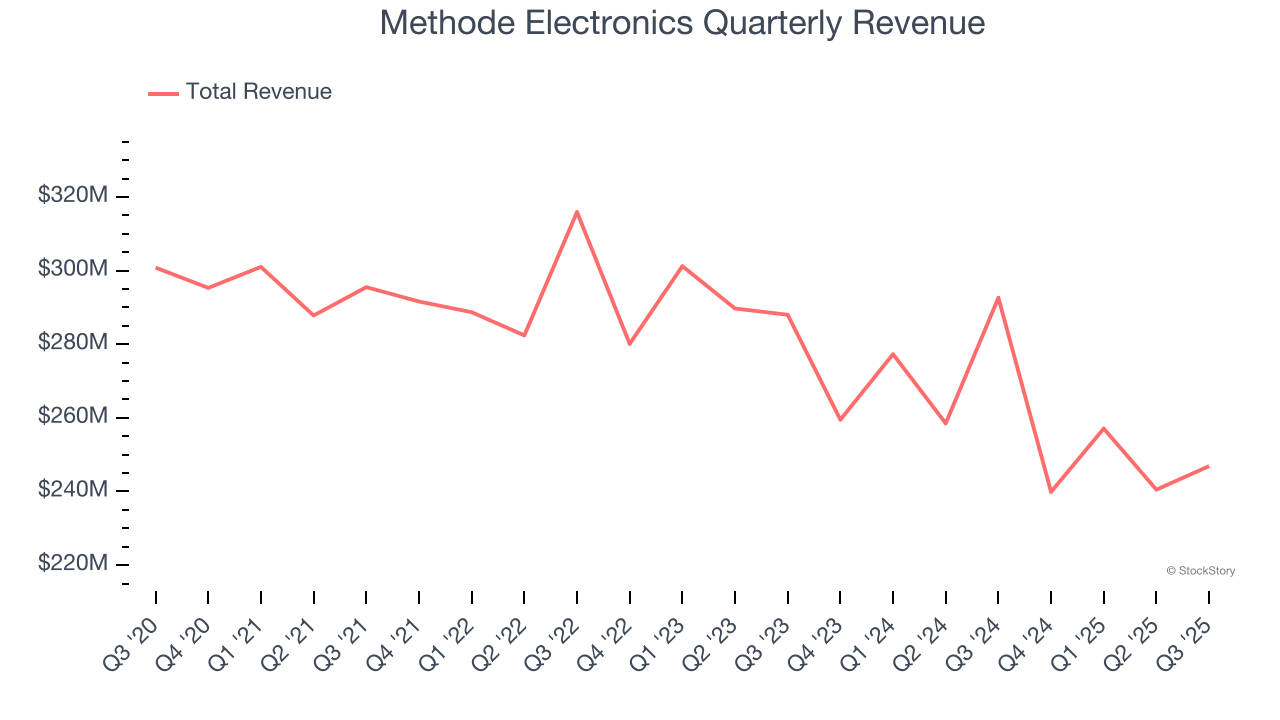
Long-term growth is the most important, but within industrials, a half-decade historical view may miss new industry trends or demand cycles. Methode Electronics’s recent performance shows its demand remained suppressed as its revenue has declined by 7.8% annually over the last two years. 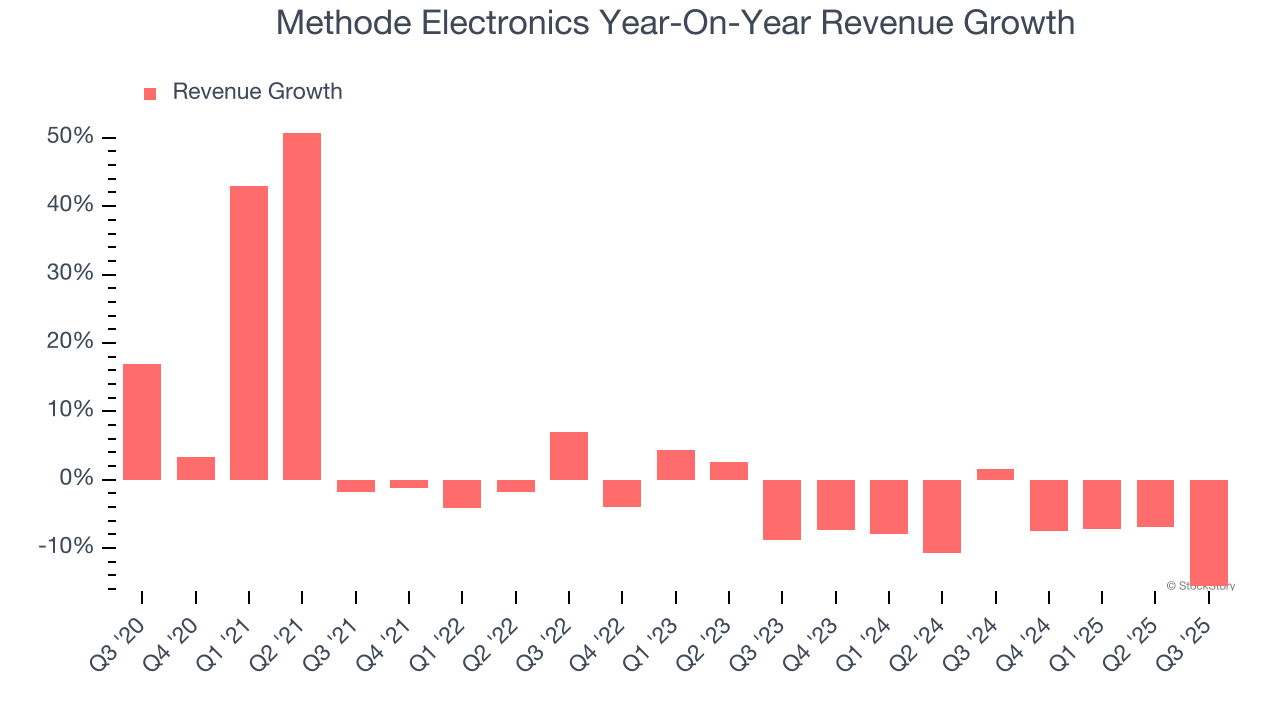
This quarter, Methode Electronics’s revenue fell by 15.6% year on year to $246.9 million but beat Wall Street’s estimates by 3.9%.
Looking ahead, sell-side analysts expect revenue to decline by 1.3% over the next 12 months. While this projection is better than its two-year trend, it’s hard to get excited about a company that is struggling with demand.
Microsoft, Alphabet, Coca-Cola, Monster Beverage—all began as under-the-radar growth stories riding a massive trend. We’ve identified the next one: a profitable AI semiconductor play Wall Street is still overlooking. Go here for access to our full report.
Operating Margin
Methode Electronics was profitable over the last five years but held back by its large cost base. Its average operating margin of 4.9% was weak for an industrials business. This result isn’t too surprising given its low gross margin as a starting point.
Analyzing the trend in its profitability, Methode Electronics’s operating margin decreased by 13.8 percentage points over the last five years. Methode Electronics’s performance was poor no matter how you look at it - it shows that costs were rising and it couldn’t pass them onto its customers.
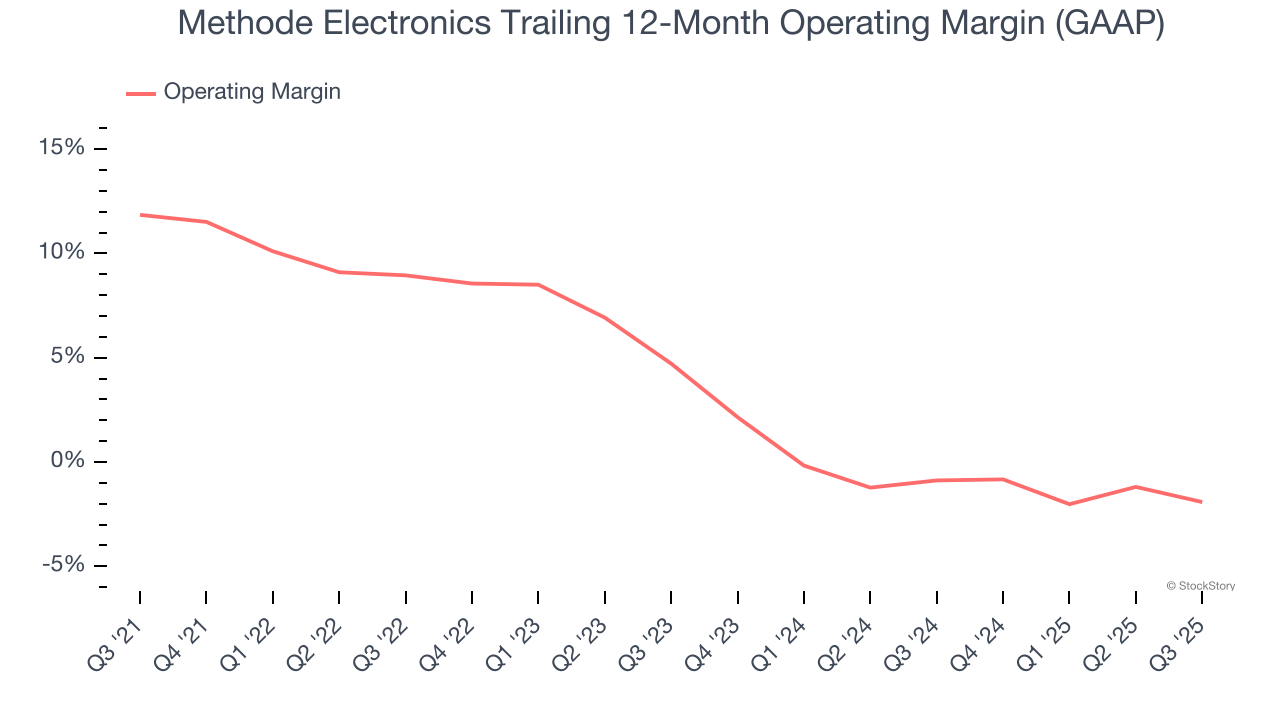
This quarter, Methode Electronics generated an operating margin profit margin of 1.2%, down 2.1 percentage points year on year. Since Methode Electronics’s operating margin decreased more than its gross margin, we can assume it was less efficient because expenses such as marketing, R&D, and administrative overhead increased.
Earnings Per Share
We track the long-term change in earnings per share (EPS) for the same reason as long-term revenue growth. Compared to revenue, however, EPS highlights whether a company’s growth is profitable.
Sadly for Methode Electronics, its EPS declined by 19.5% annually over the last five years while its revenue was flat. This tells us the company struggled because its fixed cost base made it difficult to adjust to choppy demand.
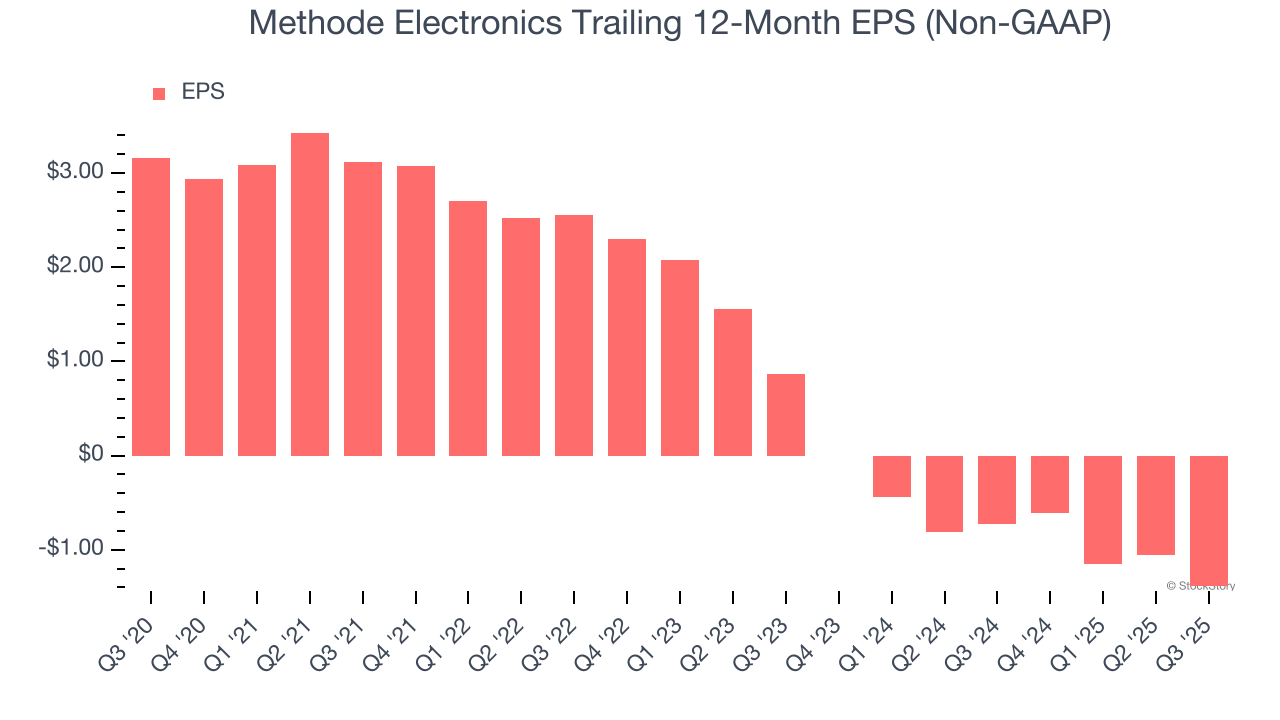
Diving into the nuances of Methode Electronics’s earnings can give us a better understanding of its performance. As we mentioned earlier, Methode Electronics’s operating margin declined by 13.8 percentage points over the last five years. This was the most relevant factor (aside from the revenue impact) behind its lower earnings; interest expenses and taxes can also affect EPS but don’t tell us as much about a company’s fundamentals.
Like with revenue, we analyze EPS over a shorter period to see if we are missing a change in the business.
For Methode Electronics, its two-year annual EPS declines of 89.7% show it’s continued to underperform. These results were bad no matter how you slice the data.
In Q3, Methode Electronics reported adjusted EPS of negative $0.19, down from $0.14 in the same quarter last year. Despite falling year on year, this print beat analysts’ estimates by 2.6%. Over the next 12 months, Wall Street is optimistic. Analysts forecast Methode Electronics’s full-year EPS of negative $1.39 will flip to positive $0.41.
Key Takeaways from Methode Electronics’s Q3 Results
We were impressed by how significantly Methode Electronics blew past analysts’ EBITDA expectations this quarter. We were also excited its revenue outperformed Wall Street’s estimates by a wide margin. Zooming out, we think this was a good print with some key areas of upside. The market seemed to be hoping for more, and the stock traded down 6.2% to $8.15 immediately after reporting.
So do we think Methode Electronics is an attractive buy at the current price? The latest quarter does matter, but not nearly as much as longer-term fundamentals and valuation, when deciding if the stock is a buy. We cover that in our actionable full research report which you can read here, it’s free for active Edge members.