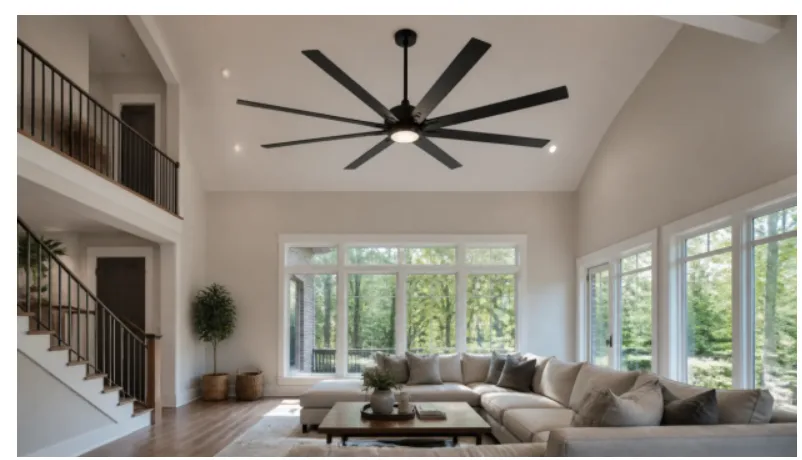
A component-by-component guide to motor life, LED performance, maintenance, and replacement decisions
Quick answer. A commonly cited planning range for a ceiling fan assembly is about 10 to 15 years, but there is no universal expiration date. The motor, LED module, driver, remote receiver, blades, and mounting hardware can age at different rates, and correct installation and maintenance strongly influence useful service life.
A large ceiling fan with lights does not have one fixed expiration date. A well-built model that is correctly installed and maintained may remain useful beyond a general planning range, while a poorly mounted or heavily exposed fan can develop problems much sooner. Daily run time, speed, vibration, dust, heat, moisture, electrical conditions, and replacement-part availability all affect the outcome.
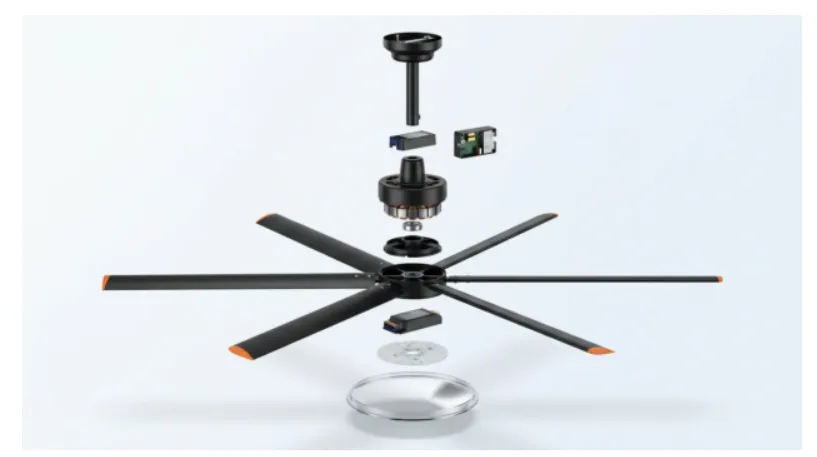
The word lifespan can also hide an important detail: a ceiling fan is a system. The motor may still be healthy when a light driver fails, a replaceable bulb may burn out while the fan body is fine, and a remote receiver may stop responding years before the blades or housing wear out. Anyone comparing large ceiling fans with lights should look beyond blade span and appearance and check how the motor, lighting, controls, mounting system, and intended location are documented.
The Short Answer: Expect a Range, Not an Expiration Date
Consumer guidance often gives different lifespan figures, including ranges from roughly 5 to 10 years, 10 to 15 years, or even 10 to 20 years. That variation is a reason to be careful, not a reason to choose whichever number sounds best. A practical editorial summary is that around 10 to 15 years can be used as a broad planning benchmark for the fan assembly, while some well-made and well-maintained units remain serviceable longer.
Useful life is better judged by condition than by age alone. A fan should remain securely mounted, reasonably quiet, stable at its operating speeds, electrically sound, and supported by serviceable parts. A 12-year-old fan that runs steadily and only needs a new bulb is in a very different position from a much newer fan with an overheating motor, damaged wiring, or persistent structural wobble.
One Fan, Several Different Lifespans
The most accurate way to discuss longevity is to separate the fan into major systems. A failure in one system does not automatically end the life of every other system.
Component lifespan checklist
| Component | What May Wear Out | What to Verify |
| Motor and fan body | Bearings, windings, heat-sensitive electronics, or internal connections may deteriorate. | Motor specifications, intended use, installation requirements, warranty coverage, and service guidance. |
| Integrated LED module | Light output may gradually decline, shift in color, flicker, or fail. | Rated operating hours, module identification, warranty, and whether the light module is replaceable. |
| LED driver | Flickering, delayed startup, intermittent light, or complete light failure may appear. | Whether the driver is separate from the LED board and whether a compatible replacement is available. |
| Replaceable bulbs or light kit | Bulbs follow their own replacement cycle; sockets and wiring can develop separate faults. | Approved bulb type, base, maximum wattage, access method, and compatible light-kit parts. |
| Remote and receiver | Speed or light commands may become delayed, intermittent, or unavailable. | Battery type, pairing instructions, receiver part number, and compatible replacement controls. |
| Blades and mounting hardware | Warping, corrosion, looseness, imbalance, or finish damage may affect safe operation. | Blade material, fan-rated mounting support, downrod compatibility, location rating, and replacement hardware. |
LED ratings also illustrate why calendar-year claims can be misleading. For example, a hypothetical 25,000-hour light rating would represent about 22.8 years at three hours of use per day, but only about 8.6 years at eight hours per day. The example is not a promise; it simply shows why rated hours, daily usage, heat, and driver quality matter more than a headline expressed only in years. The fan motor and the light may also run for different numbers of hours because most models allow them to be controlled separately.
Does a Larger Ceiling Fan Last Longer?
Blade span does not determine longevity by itself. A properly engineered large fan uses a motor, hub, blades, and mounting system designed to work together. When those parts are matched and the installation is stable, a large diameter is not automatically a durability disadvantage. Conversely, a large appearance cannot compensate for inadequate support, poor balance, unsuitable controls, or weak documentation.
Blade count is not a shortcut to durability either. Four blades are not automatically stronger than five, and a many-blade design is not automatically longer lasting. Blade mass, pitch, material, motor loading, balance, and the manufacturer’s complete design are more meaningful than the count alone. The same caution applies to motor labels: a DC motor may offer efficient, flexible control, but the label does not guarantee a specific lifespan. Electronics, heat management, installation quality, and replacement-part support still matter.
What Shortens the Service Life of a Large Ceiling Fan?
Long Run Time and Continuous High-Speed Use
Running a ceiling fan around the clock does not create an automatic failure date, but it accumulates operating hours much faster than occasional or seasonal use. Continuous high-speed operation can also make existing heat, noise, balance, or bearing problems easier to notice. Follow the product instructions, use the fan only when airflow is needed, and do not ignore a change in sound, speed, smell, or housing temperature.
Poor Installation and Persistent Wobble
A large fan places significant importance on the ceiling support, mounting bracket, downrod, fasteners, blade alignment, and electrical connections. A ceiling box intended only for a light fixture may not be appropriate for a fan. Loose or mismatched components can create repeated movement that stresses bearings, hardware, and wiring. If a fan develops new or severe wobble, the cause should be investigated rather than hidden by simply lowering the speed.
Dust, Heat, and Blocked Ventilation
Dust is more than a cosmetic problem. Uneven buildup on wide blades can contribute to imbalance, while grime around the motor housing may interfere with normal heat dissipation. Dust on a lens also reduces useful light output and can make an owner assume the LED is failing. Cleaning frequency should reflect the room and usage rather than a rigid calendar, and the fan should be switched off before cleaning. Avoid bending blades or using moisture where the manual does not allow it.
Moisture, Salt Air, and the Wrong Location Rating
Humidity, wind-driven moisture, coastal salt, and temperature changes can accelerate corrosion and electrical deterioration. For covered patios and other exposed spaces, large outdoor ceiling fans with lights should be selected according to the required location rating rather than appearance alone. A roof does not always prevent moisture from reaching the motor, blades, light, or controls, so dry-, damp-, and wet-location suitability should be verified for the actual installation.
Electrical and Control Conditions
Voltage irregularities, loose wiring, nonapproved wall controls, incompatible dimmers, and damaged receivers can create symptoms that look like motor or LED failure. Before condemning the entire fan, check simple items such as remote batteries and pairing instructions. Electrical diagnosis, rewiring, heat damage, or repeated breaker problems should be handled by a qualified professional.
How Long Does the LED Light in a Ceiling Fan Last?
An LED ceiling-fan light should be evaluated in rated operating hours, not calendar years alone. The number of hours used each day changes the calendar result, and heat around the light housing can affect both the LED board and its driver. LEDs may also fade gradually rather than fail all at once, so reduced brightness or a color shift can be an early sign of aging. Flicker, delayed startup, or intermittent operation may point to the driver, receiver, wiring, or control system instead of the LED chips themselves.
When comparing large ceiling fan lighting options, buyers should check whether a model uses replaceable bulbs, a replaceable LED module, a separate driver, or a fully integrated lighting assembly. Integrated lighting does not always mean the entire fan must be discarded after a light failure, but repairability depends on the specific design and continued availability of compatible parts.
Before buying, ask these practical questions:
- Is the LED module replaceable, and is a part number documented?
- Is the LED driver a separate serviceable component?
- Does the warranty distinguish the motor, lighting system, and electronic controls?
- Are compatible replacement modules, receivers, and remotes available?
- Does the model require a specific wall control or dimmer?
Maintenance That Supports Long-Term Use
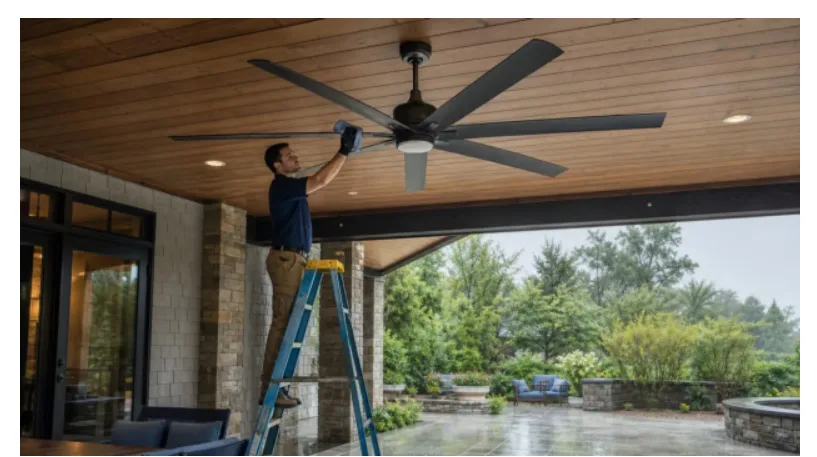
Maintenance cannot guarantee a particular number of years, but it can reduce avoidable stress and reveal problems before they become larger. The product manual should always take priority over generic advice.
- Power down before cleaning or inspection. Switch the fan off and follow the manual’s safety instructions before touching blades, lights, or accessible hardware.
- Remove dust without changing blade alignment. Support wide blades gently and avoid cleaners or moisture that the manufacturer does not approve.
- Investigate new wobble or noise. A new click, scrape, grind, hum, or speed fluctuation deserves attention, particularly on a large fan.
- Use specified lamps and controls. Stay within the approved bulb type and wattage, and do not assume any dimmer or wall speed control is compatible.
- Watch exposed installations. Check outdoor-rated fans for corrosion, moisture entry, blade damage, and deteriorating finishes.
- Keep the documentation. Store the model number, manual, wiring information, warranty terms, and part numbers where they can be found later.
Safety note. Stop using the fan if there is a burning odor, visible arcing, damaged wiring, serious structural cracking, repeated overheating, or severe instability. These are not routine cleaning issues and should be assessed by a qualified professional.
Repair the Problem or Replace the Entire Fan?
Age is only one part of the decision. First identify which system has failed and whether the repair can be performed safely with documented, compatible parts.
Repair-versus-replacement guide
| Decision | Typical Conditions |
| A repair may be reasonable | A replaceable bulb, LED module, driver, remote, receiver, or approved hardware is the only failed part; compatible parts are documented; and the fan remains secure, quiet, and stable. |
| Replacement may be safer or more practical | The motor repeatedly overheats, grinds, or fails to start; wiring or structural parts are damaged; corrosion is severe; wobble persists after proper correction; multiple systems are failing; or compatible safety-critical parts are no longer available. |
A failed light is not automatically a failed fan, and a working light does not prove that the fan is mechanically sound. Repair costs, product age, accessibility on a high ceiling, parts availability, and electrical safety should be considered together. Permanent wiring, mounting changes, unknown ceiling boxes, and symptoms involving heat or damaged insulation are good reasons to use a qualified electrician.
What to Check Before Buying for Long-Term Use
No label can guarantee decades of trouble-free operation, but better documentation makes it easier to choose, install, maintain, and repair a fan responsibly. Look for the following before purchase:
- A motor, hub, blades, and mounting system designed for the stated blade span.
- Clear installation requirements for ceiling support, fan-rated boxes, downrods, and sloped or high ceilings.
- A location rating that matches the real exposure to moisture and weather.
- Documented LED, driver, receiver, remote, and blade part information where applicable.
- Warranty terms that distinguish the motor, lighting components, electronics, and other parts.
- Accessible manuals, wiring diagrams, control compatibility details, and service contacts.
- Blade materials and finishes appropriate for the room or outdoor environment.
- A realistic match between the fan’s airflow, mounting height, controls, and intended operating pattern.
Airflow, speed range, blade count, and motor type are useful performance specifications, but none should be treated as a standalone lifespan score. Long-term value comes from the complete system, its installation, and the owner’s ability to obtain accurate information and compatible parts.
Final Takeaway
The most useful question is not simply how many years a large ceiling fan with lights will last, but which component is aging and whether it can be safely serviced. A broad 10-to-15-year benchmark can help with planning, yet actual useful life depends on stable installation, operating hours, heat, dust, moisture, electrical conditions, maintenance, and access to replacement lighting and control components. Treat lifespan as a condition-based range, not a guaranteed countdown.
Frequently Asked Questions
What is the average lifespan of a large ceiling fan with lights?
A practical planning range often cited for a ceiling fan assembly is about 10 to 15 years, but it is not a guarantee. Installation, run time, heat, vibration, dust, moisture, electrical conditions, and maintenance can shorten or extend useful service. The light, driver, and remote receiver may have different service lives from the motor.
How long does an LED light last in a ceiling fan?
LED lifespan should be evaluated in rated operating hours rather than calendar years alone. Daily use changes how those hours translate into years, and the LED driver or controls may fail before the LED chips. Check the product documentation for the rated hours and whether the module and driver can be replaced separately.
Can a ceiling fan run 24 hours a day?
A correctly installed fan may be capable of extended operation when used according to its instructions, but running continuously accumulates operating hours faster. Do not ignore new heat, noise, smell, speed changes, or instability. Turn the fan off and arrange an inspection if it overheats, smells burnt, or begins to wobble severely.
Does a large ceiling fan last longer than a smaller fan?
Not automatically. Blade span does not determine lifespan by itself. The motor, hub, blades, mounting system, balance, heat management, installation quality, operating pattern, and replacement-part support are more useful indicators than size alone.
When should you replace a ceiling fan?
Replacement may be appropriate when the motor repeatedly overheats or fails to start, severe wobble continues after proper correction, structural parts are cracked or badly corroded, wiring is damaged, electrical faults recur, or compatible safety-critical parts are unavailable. A failed bulb, driver, or remote receiver may only require a component repair.
What happens if you never clean your ceiling fan?
Dust can build up unevenly on the blades, contribute to imbalance, reduce light output, and collect around the motor housing. Cleaning with the power off, without bending the blades or introducing unapproved moisture, helps maintain stable operation and makes developing problems easier to see.
What are the most common problems with ceiling fans?
Common symptoms include wobble, clicking or grinding noise, slow startup, speed variation, light flicker, remote-control failure, loose hardware, blade warping, and corrosion. The symptom should be traced to the affected component before deciding whether the entire fan needs replacement.
Do you need an electrician to replace a ceiling fan?
Ceiling-fan replacement usually involves permanent wiring and secure overhead mounting, and local requirements vary. A qualified electrician is especially appropriate for new wiring, unknown ceiling boxes, high or sloped ceilings, damaged insulation, repeated breaker problems, or signs of heat. Only perform user-serviceable tasks specifically allowed by the product instructions.