-
As remote work scales globally, Dee Agarwal explains why clarity, asynchronous workflows, and outcome-driven leadership matter more than constant availability when building high-performance teams across time zones.
ATLANTA, GA, 28th January 2026, ZEX PR WIRE, A 2023 study by Buffer.com found that 62% of remote workers interfaced directly with a teammate in a different time zone. As companies continue to scale beyond borders, the challenge is no longer whether teams can work across time zones, but whether they can do so at a high level. Distributed work has become normal in the post-pandemic era, yet many organizations still struggle with misalignment, slow decision-making, and burnout when teams rarely share the same working hours.
According to business strategist and entrepreneur Deepak “Dee” Agarwal, building high-performance teams across time zones is less about tools and more about intentional design. “Time zone differences don’t break teams,” Dee Agarwal says. “Unclear expectations do.”
Rather than attempting to replicate in-office dynamics remotely, Dee Agarwal advocates for rethinking how performance, communication, and accountability are defined when teams operate asynchronously.
Start With Clarity, Not Coverage
One of the most common mistakes leaders make is trying to ensure constant availability across regions. Dee Agarwal believes this approach quietly erodes trust and productivity.
“High-performing global teams are not online all the time,” Dee Agarwal explains. “They are clear all the time. Everyone knows what success looks like before the workday even starts.”
This begins with clearly documented goals, ownership, and decision rights. When team members understand what they are responsible for and how their work connects to the broader objective, progress continues regardless of who is awake.
Dee Agarwal emphasizes that clarity should be written, visible, and easy to reference. “If something only lives in a meeting, it doesn’t exist for a distributed team,” he says.
Design for Asynchronous Excellence
While real-time collaboration has its place, Dee Agarwal encourages leaders to treat asynchronous work as the default, not a backup.
“Async is not a compromise,” he notes. “It is a competitive advantage when done well.”
This means structuring work so it can move forward without immediate responses. Clear briefs, thoughtful handoffs, and shared documentation allow teams in different regions to build on each other’s progress rather than waiting for approvals.
Dee Agarwal also highlights the importance of decision frameworks. “If every decision requires a live conversation, you create bottlenecks across time zones,” he says. “High-performance teams agree in advance on what can be decided independently.”
Rethink Meetings and Overlap Time
Time zone overlap is often treated as sacred, but Dee Agarwal suggests using it more strategically.
“Overlap time should be used for discussion, alignment, and problem-solving, not status updates,” he says.
Instead of filling limited shared hours with routine check-ins, Dee Agarwal recommends reserving them for conversations that benefit from real-time energy. Everything else can be documented and shared asynchronously.
He also encourages leaders to rotate meeting times when possible. “If the same region always absorbs the inconvenience, resentment builds quietly,” Dee Agarwal notes. “Equity in scheduling sends a powerful message about respect.”
Build Trust Through Outcomes, Not Presence
In distributed teams, trust cannot be built solely on visibility. Dee Agarwal argues that performance should be measured by outcomes rather than activity.
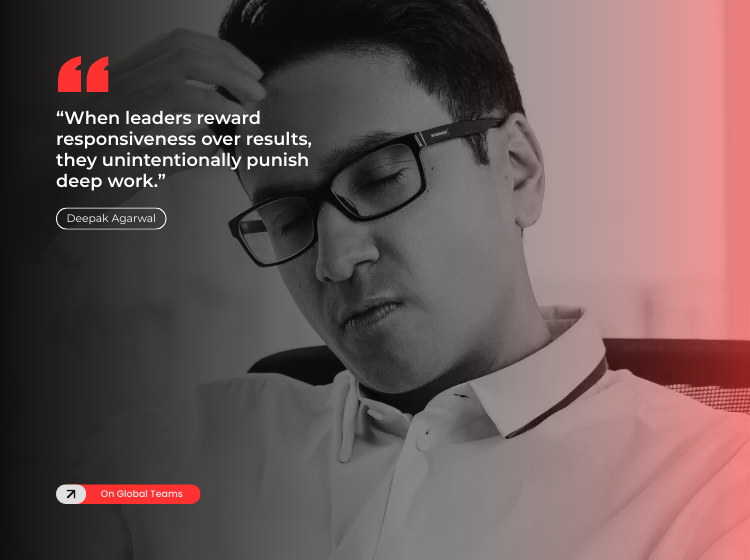
“When leaders reward responsiveness over results, they unintentionally punish deep work,” he says.
High-performing global teams establish clear metrics and timelines, then give individuals autonomy in managing their schedules. This flexibility allows team members to work when they are most effective, rather than conforming to another region’s clock.
Dee Agarwal adds that leaders must model this behavior themselves. “If leadership sends messages at all hours and expects immediate replies, no policy will fix that,” he explains.
Invest in Human Connection Intentionally
While efficiency matters, Dee Agarwal is quick to point out that performance suffers when teams feel disconnected.
“People don’t collaborate well with people they don’t feel connected to,” he says.
He recommends creating structured moments for relationship-building that do not rely on constant social interaction. Simple practices, such as shared onboarding experiences, periodic virtual offsites, or rotating team spotlights, can help reinforce a sense of belonging.
“These moments don’t need to be frequent,” Dee Agarwal notes. “They just need to be intentional.”
Leadership Sets the Tempo
Ultimately, Dee Agarwal believes that building high-performance teams across time zones is a leadership responsibility, not a logistical challenge.
“Teams take their cues from how leaders communicate, prioritize, and make decisions,” he says. “If leadership is thoughtful and disciplined, the team will follow.”
Rather than chasing perfect alignment throughout the day, Dee Agarwal encourages leaders to focus on trust, clarity, and execution. When those elements are in place, time zones become less of a barrier and more of an advantage.
“Global teams give organizations the ability to move continuously,” Dee Agarwal says. “The goal is not to work longer. It is to work smarter, together, even when we are apart.”