
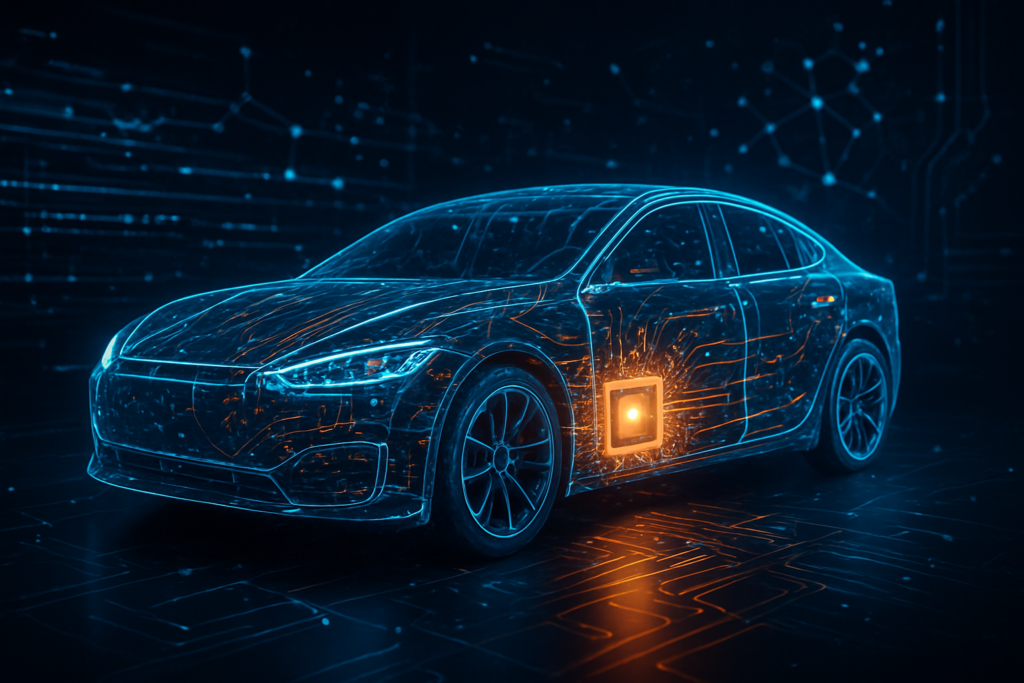
The automotive semiconductor industry has officially moved past the era of scarcity, entering a transformative phase where the vehicle is no longer a machine with computers, but a computer with wheels. As of December 2025, the market has not only recovered from the historic supply chain disruptions of the early 2020s but has surged to a record valuation exceeding $100 billion. This recovery is being fueled by a fundamental architectural shift: the rise of Software-Defined Vehicles (SDVs), which are radically altering the demand profile for silicon and centralizing the "brains" of modern transportation.
The transition to SDVs marks the end of the "one chip, one function" era. Historically, a car might have contained over 100 discrete Electronic Control Units (ECUs), each managing a single task like power windows or engine timing. Today, leading automakers are consolidating these functions into powerful, centralized "zonal" architectures. This evolution has triggered an explosive demand for high-performance System-on-Chips (SoCs) capable of handling massive data throughput from cameras, radar, and LiDAR, while simultaneously running complex AI algorithms for autonomous driving and in-cabin experiences.
The Technical Shift: From Distributed Logic to Centralized Intelligence
The technical backbone of the 2025 automotive market is the "Zonal Architecture." Unlike traditional distributed systems, zonal architecture organizes the vehicle’s electronics by physical location rather than function. A single zonal controller now manages all electronic tasks within a specific quadrant of the vehicle, communicating back to a central high-performance computer. This shift has drastically reduced wiring complexity—shaving dozens of kilograms off vehicle weight—while requiring a new class of semiconductors. The demand has shifted from low-cost, 8-bit and 16-bit Microcontroller Units (MCUs) to sophisticated 32-bit real-time MCUs and multi-core SoCs built on 5nm and 3nm process nodes.
Technical specifications for these new chips are staggering. For instance, the latest central compute platforms entering production in late 2025 boast performance metrics exceeding 2,000 TOPS (Tera Operations Per Second). This level of compute power is necessary to support "over-provisioning"—a strategy where manufacturers install more hardware than is initially needed. This allows for the "decoupling" of hardware and software lifecycles, enabling OEMs to push over-the-air (OTA) updates that can unlock new autonomous driving features or enhance powertrain efficiency years after the car has left the showroom.
Industry experts note that this represents a departure from the "just-in-time" manufacturing philosophy toward a "future-proof" approach. Initial reactions from the research community highlight that while the number of individual chips per vehicle may actually decrease in some high-end models due to integration, the total semiconductor value per vehicle has skyrocketed. In premium electric vehicles (EVs), the silicon content now ranges between $1,500 and $2,000, nearly triple the value seen in internal combustion engine vehicles just five years ago.
The Competitive Landscape: Silicon Giants and Strategic Realignment
The shift toward centralized compute has created a new hierarchy among chipmakers. NVIDIA (NASDAQ: NVDA) has emerged as a dominant force in the high-end autonomous segment. Their DRIVE Thor SoC, which reached mass production in late 2025, has become the gold standard for Level 3 and Level 4 autonomous systems. By integrating functional safety, AI, and infotainment into a single platform, NVIDIA has reported a 72% year-over-year surge in automotive revenue, positioning itself as the primary partner for premium brands seeking "mind-off" driving capabilities.
Meanwhile, Qualcomm (NASDAQ: QCOM) has successfully leveraged its mobile expertise to dominate the "digital cockpit." Through its Snapdragon Digital Chassis, Qualcomm offers a modular platform that integrates connectivity, infotainment, and advanced driver-assistance systems (ADAS). This strategy has proven highly effective in the mid-market and high-volume segments, where automakers prioritize cost-efficiency and seamless smartphone integration over raw autonomous horsepower. Qualcomm’s ability to offer a "one-stop-shop" for the SDV stack has made it a formidable challenger to both traditional automotive suppliers and pure-play AI labs.
Traditional powerhouses like NXP Semiconductors (NASDAQ: NXPI) and Infineon Technologies (OTC: IFNNY) have not been sidelined; instead, they have evolved. NXP recently launched its S32K5 family, featuring embedded MRAM to accelerate OTA updates, while Infineon maintains a 30% share of the power semiconductor market. The growth of 800V EV architectures has led to a 60% surge in demand for Infineon’s Silicon Carbide (SiC) chips, which are essential for high-efficiency power inverters. Mobileye (NASDAQ: MBLY) also remains a critical player, holding a roughly 70% share of the global ADAS market with its EyeQ6 High chips, offering a balanced performance-to-price ratio that appeals to mass-market manufacturers.
Broader Significance: The AI Landscape and the "Computer on Wheels"
The evolution of automotive semiconductors is a microcosm of the broader AI landscape. The vehicle is becoming the ultimate "edge" device, requiring massive local compute power to process real-time sensor data without relying on the cloud. This fits into the larger trend of "Generative AI at the Edge," where 2025 model-year vehicles are beginning to feature localized Large Language Models (LLMs). These models allow for intuitive, natural-language voice assistants that can control vehicle functions and provide contextual information even in areas with poor cellular connectivity.
However, this transition is not without its concerns. The concentration of compute power into a few high-end SoCs creates a new kind of supply chain vulnerability. While the general chip shortage has eased, a new bottleneck has emerged in High-Bandwidth Memory (HBM) and advanced foundry capacity, as automotive giants now compete directly with AI data center operators for the same 3nm wafers. Furthermore, the shift to SDVs raises significant cybersecurity questions; as vehicles become more reliant on software and OTA updates, the potential "attack surface" for hackers grows exponentially, necessitating hardware-level security features that were once reserved for military or banking applications.
This milestone mirrors the transition of the mobile phone to the smartphone. Just as the iPhone turned a communication device into a platform for services, the SDV is turning the car into a recurring revenue stream for automakers. By selling software upgrades and features-on-demand, OEMs are shifting their business models from one-time hardware sales to long-term service relationships, a move that is only possible through the advanced silicon currently hitting the market.
Future Horizons: GenAI and the Path to Level 4
Looking ahead to 2026 and beyond, the industry is bracing for the next wave of innovation: the integration of multi-modal AI. Future SoCs will likely be designed to process not just visual and radar data, but also to understand complex human behaviors and environmental contexts through integrated AI agents. We expect to see the "democratization" of Level 3 autonomy, where the technology moves from $100,000 luxury sedans into $35,000 family crossovers, driven by the declining cost of high-performance silicon and improved manufacturing yields.
The next major challenge will be power efficiency. As compute requirements climb, the energy "tax" that these chips levy on an EV’s battery becomes significant. Experts predict that the next generation of automotive chips will focus heavily on "performance-per-watt," utilizing exotic materials and novel packaging techniques to ensure that the car's "brain" doesn't significantly reduce its driving range. Additionally, the industry will need to address the "legacy tail"—ensuring that the millions of non-SDV vehicles still on the road can coexist safely with increasingly autonomous, software-driven fleets.
A New Era for Autotech
The recovery of the automotive semiconductor market in 2025 is more than a return to form; it is a complete reinvention. The industry has moved from a state of crisis to a state of rapid innovation, driven by the realization that silicon is the most critical component in the modern vehicle. The shift to Software-Defined Vehicles has permanently altered the competitive landscape, bringing tech giants and traditional Tier-1 suppliers into a complex, symbiotic ecosystem.
As we look toward 2026, the key takeaways are clear: centralization is the new standard, AI is the new interface, and silicon is the new horsepower. The significance of this development in AI history cannot be overstated; the car has become the most sophisticated AI robot in the consumer world. For investors and consumers alike, the coming months will be defined by the first wave of truly "AI-native" vehicles hitting the roads, marking the beginning of a new era in mobility.
This content is intended for informational purposes only and represents analysis of current AI developments.
TokenRing AI delivers enterprise-grade solutions for multi-agent AI workflow orchestration, AI-powered development tools, and seamless remote collaboration platforms.
For more information, visit https://www.tokenring.ai/.